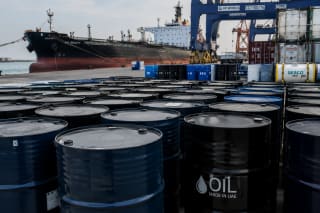
For the oil market, the loss of Iranian barrels is being offset by non-Iranian Gulf supply, which is flowing through the Strait of Hormuz above prewar levels under US protection. That helps explain why the depletion is not by itself a fresh supply shock. The more immediate effect is a reshuffling of trade flows: Chinese refiners, particularly independents that relied on discounted Iranian crude, are buying more from Brazil and West Africa, which could tighten Atlantic Basin grades and lift their premiums. The bigger risk is escalation. With its main revenue source shut off, Tehran has fewer economic options and more incentive to use energy disruption as leverage, which keeps a geopolitical risk premium in crude. Any move to strike Gulf energy infrastructure or shipping would hit physical supply directly, rather than just sentiment.
—
Earlier:
US and Israel plan specific renewed Iran strikes after US midterms, New York Times reports
—
Iran’s floating oil piggy bank off Southeast Asia is empty, leaving Tehran’s war economy with its biggest cash source cut off and few good options left.
Summary:
Iran’s offshore crude reserves held in Asian waters were fully depleted by mid-October under the US naval blockade, according to ship-tracking analysts cited by the Wall Street Journal
US Central Command says the blockade has denied Iran at least $25 billion in oil revenue, limiting its ability to replace weapons and factories
Oil sales account for about 30% to 40% of Iranian government revenue and are its largest source of foreign exchange
The floating reserves, which peaked at nearly 90 million barrels, fell below 1 million barrels by October 5
Chinese refiners are increasingly turning to alternative suppliers, including Brazil and West Africa
Non-Iranian oil exports from the Gulf have recently exceeded prewar levels under US protection through the Strait of Hormuz
Iran’s stockpile of crude oil held on tankers in Asian waters has run dry under the US naval blockade, cutting off a key source of cash for Tehran during the war, the Wall Street Journal (gated) reported.
Ship-tracking analysts said the floating reserves, mostly held off the coasts of Malaysia and Singapore, were fully depleted by mid-October, because the blockade stopped Iran from replenishing the crude it normally sells to Chinese refineries. US Central Command said the blockade has denied Iran at least $25 billion in oil revenue, which it said would constrain Tehran’s ability to replace destroyed weapons and factories.
The floating storage was part of a long-running system Iran used to get oil to China despite US sanctions. Iranian-linked tankers carried crude to waters off Malaysia and Singapore and transferred it to other vessels bound for Chinese refineries, making the flows harder to track.
When the war began in February, Iran had around 135 million barrels stored overseas, likely worth $10 billion or more after oil prices surged. After the US first imposed a blockade in April, Iran kept selling from that reserve. When the blockade was lifted in mid-June as part of peace talks, Tehran rushed out more oil, rebuilding stocks to a peak of nearly 90 million barrels before the blockade was reimposed in mid-July. By October 5, reserves had fallen below 1 million barrels, and they have since been exhausted, according to analysts. Other trackers reported similarly sharp declines, with one estimating about 6 million barrels off Singapore as of October 9.
Oil sales account for roughly 30% to 40% of Iranian government revenue and are the country’s largest source of foreign exchange. Iran’s currency has lost about a third of its value against the dollar since early July, fuelling rapid inflation. Because Chinese payments can take around two months to arrive, Tehran may still receive some funds from past sales in the coming weeks. Analysts say overland routes such as trucking cannot replace seaborne exports.
Chinese refiners are increasingly turning to alternative suppliers, including Brazil and West Africa. Meanwhile, oil from elsewhere in the Middle East has recently exceeded prewar levels, as US protection helps secure non-Iranian shipments through the Strait of Hormuz.
Iran’s central bank governor, Abdolnaser Hemmati, said last week that the economy had shown resilience and rejected claims that it is collapsing. Analysts note Iran has so far defied predictions that the blockade would force it to make nuclear concessions.
This article was written by Eamonn Sheridan at investinglive.com.