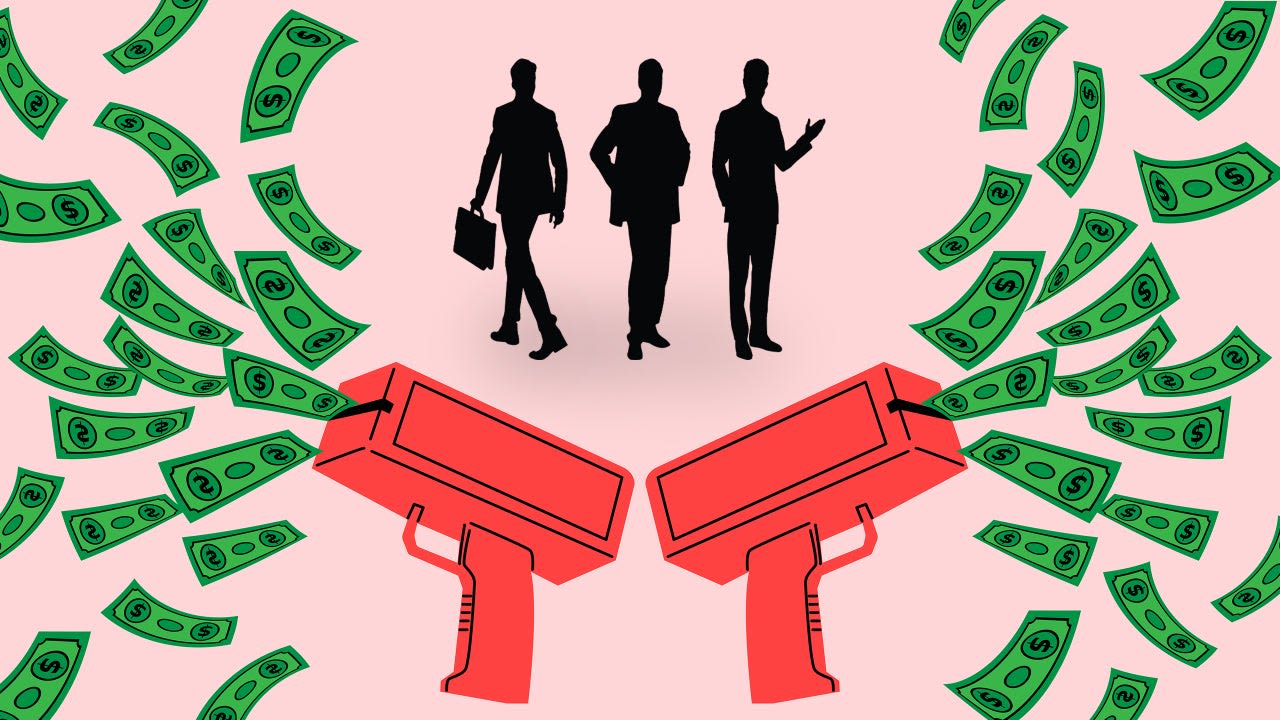

Generosity is in the air, or so it would seem. The Trump administration recently mailed a round of $500 checks to almost a million users of Healthcare.gov. The AI rivals OpenAI and Anthropic have promised to share their (eventual) wealth with the public beyond investors, and Anthropic this week got a bit more specific, proposing a Public Benefit Fund pegged at 5% of the company’s overall value. And never to be outdone, Elon Musk promptly pledged to give “every kid in America” a share in SpaceX.
What explains the abrupt rise of these largesse Olympics among some of our most powerful institutions? Presumably there’s actual generosity involved. But let’s face it: Each of these schemes doubles as reputational marketing .
Naturally, the details vary. The government checks are the most straightforward. They are accompanied by a letter ostensibly from President Trump, attacking Democrats and promising to lower healthcare costs. If that’s not a blatant enough pitch to vote Republican in the midterm election, the White House has also promised a $5,000 “ Trump dividend ” cash payment to every adult U.S. citizen—but only if the GOP keeps control of both the House of Representatives and the Senate. So far this blunt generosity-as-persuasion approach doesn’t seem wildly effective; voters appear highly skeptical that the Trump dividend will materialize under any circumstances.
For the artificial intelligence giants, the scenario is more nuanced. For some time now, the enormous promises attached to the technology have been accompanied by warnings of enormous risks. These range from taking our jobs to energy hog data centers to the more sci-fi-ish possibilities of wiping out humanity. The leaders of some of these companies haven’t exactly been shy about darker potentials—to the point that some have accused them of practicing a kind of doomsday marketing .
Finding some way to share a portion of whatever wealth AI creates might take the edge off at least some of the doomer worries. It also gives the companies a happier talking point that spotlights their potential impact on life, and the stock market in particular. Anthropic now says it will commit 5% of its shares to the creation of the Anthropic Public Benefit Fund, a limited liability corporation. Anthropic is reportedly eyeing an IPO, and was valued recently at nearly $1 trillion, so this new entity would not be trivial. The company doesn’t yet have concrete plans for the fund, but has floated labor market impacts as a potential focus.
This approach has some precedents. Salesforce, Google, and others have set aside corporate equity for social purposes, and Mark Zuckerberg and Priscilla Chan have pledged most of their Meta shares toward a philanthropic LLC. But at this stage, at least, Anthropic’s version strikes some as more performative than transparent or generous. “Trying,” as one critic put it , “to curry public favor.”
Of course they are trying to curry public favor! That’s the point: Just as political actors depend on public sentiment leaning their way, so do high-profile businesses whose mission entails a plan to reshape the society. Which brings us to Musk, who has become both a political figure as well as an aspiring society-shaping tech entrepreneur.
Musk’s announcement was in part responding directly to Anthropic, criticizing its plan for funneling equity through a vehicle it ultimately controls, and arguing for giving shares directly to the public. Granting one share apiece to “every kid” in America would involve about 73 million people under 18, adding up to about $11 billion in stock. (Musk is worth upwards of $900 billion, depending on market conditions.) He would apparently use the government’s new so-called “Trump accounts ” to manage the giveaway. Gwynne Shotwell, president of SpaceX, and her husband earlier promised a share apiece to 2 million American children in the program, and Michael and Susan Dell have pledged $6.25 billion from their own foundation to help seed the program.
Many details of Musk’s gift aren’t clear—but the message is hard to miss. His generosity is personal, record-setting, unambiguous, and, not incidentally, smarter than Anthropic’s (in Musk’s view). Musk has long been image conscious, and has more reason than ever to try to burnish his public persona. Aside from being the world’s richest man, he’s attracted increasing attention to his politics and geopolitical influence, from spending millions in campaign contributions on midterm races to accusations that his SpaceX throttled Ukraine’s access to the vital Starshield service associated with the company’s Starlink satellite network.
It makes sense that a nonelected individual with global influence would want to project benevolence from time to time. And there’s something almost flex-like in handing out shares to every child in the country; even Musk’s philanthropy is a little intimidating.
To be clear, generosity is a positive force, and there’s no call to be cynical. A gift does not become economically meaningless because it generates good publicity, including warm fuzzies toward the giver. But then again, the image payoff that comes with the announcement of generosity is immediate. What ultimately matters is when—or even whether—the actual generosity manifests.