
As the iPhone grew into an unprecedented success, Apple was marching its users toward millions of downloads to the drumbeat of “There’s an app for that.” Meanwhile, Amazon and Google were flooding homes with waves of TV platforms , smart speakers , and cameras . These products and their underlying connectivity standards formed a deep foundation to support a new generation of AI -driven services far surpassing those of Google Assistant and the original Alexa.
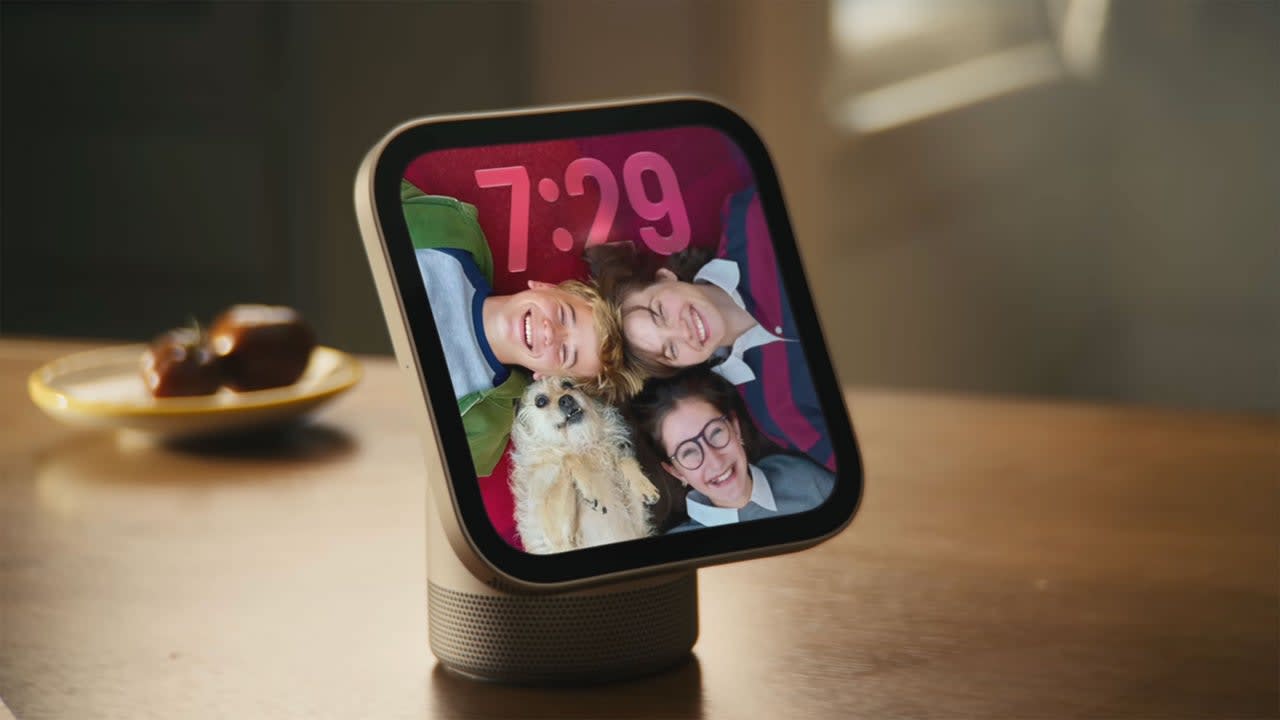
At its home product launch on October 13, Apple updated its Apple TV and HomePod mini speakers. But all eyes were on HomeView . The touchscreen family hub is spinning and tilting the company toward a new direction led by a reinvented Siri and away from a dedicated app-first ecosystem.
If the iPad was originally dismissed as a large iPod Touch, the HomeView—with its 1:1 aspect ratio and widget-driven display—may at first evoke a large Apple Watch. But not for long. The device can be mounted on a wall or tilted on a domed aluminum speaker base that has the metallic texture of a Mac mini as opposed to the cozier cloth stylings of a HomePod mini. And if the frenetic 3-minute family morning tableau Apple produced to showcase the device proves accurate, we can expect it to serve up a whirlwind of multimodal interactions as opposed to the tap-and-takeaway interactions of Apple’s wrist computer.
On the other hand, HomeView’s platform philosophy borrows from another Apple experience: CarPlay, which presents apps installed on the connected iPhone on automakers’ dashboard displays. While HomeView is an independent device, it still has strong ties to the iPhone, which provides its personalization and app engine.
Amazon and Google smart screens have long featured cameras and personalized their experiences for recognized individuals. But Apple has enabled much richer personalization on the fly by using iPhone proximity to determine who’s using HomeView. It’s a best-of-both-worlds approach that Google should absolutely adopt with Android should it revive its Nest Home displays. The approach would also benefit both the Apple TV box and service, the latter of which trails Netflix, Disney+, Peacock, and others in supporting viewer profiles.
No App Store, but all Apple
Though HomeView offers far more of a standalone experience than CarPlay, it doesn’t have its own app store. Nor does it introduce a “homeOS” (Apple says it’s powered by “HomeView software”) to complement Apple’s family of operating systems for its computers, phones, watches, and TV devices. It‘s Apple’s first “post-app” device, similar to the way the iPhone was its first major “post-PC” platform.
Of course, that doesn’t mean that apps have vanished, any more than PCs (including Macs) did in the post-PC era. But as it created a device that serves as a primary interface for smart homes, Apple—like Google and Amazon before it— has recognized that an app store is not the ideal approach.
Developers can indirectly introduce apps onto HomeView by including support for the device in their iPhone apps, the same way CarPlay works. In fact, third-party iPhone audio and video apps that support CarPlay, such as Spotify and Audible, should work out of the gate on HomeView.
However, this approach can lead to relevant apps not getting noticed by consumers, if they’re not as compelling on the iPhone. Conversely, less relevant HomeView apps could also show up on the device simply because they’re companion components of an iPhone app.
In any case, while the HomeView may not have as rich an app ecosystem as the iPad, it’s still relatively app-centric compared to its Amazon and Google counterparts. Moreover, customers will appreciate that there isn’t an ad in sight, in contrast to Amazon’s Echo Show.
Home hubs such as HomeView pose a unique privacy challenge because they are far more likely to capture information that some family members might want to keep private from other family members than, say, a streaming device like Apple TV. As major ecosystem vendors feed far more intimate knowledge about us into AI than was ever captured for advertising personalization, the stakes for privacy will rise even further.
HomeView provides an exceptionally good platform for Apple to promote its commitment to privacy protection. In addition to the iPhone-driven personalization, communications are protected by Apple’s Private Cloud Compute . The device’s rollout also marked the debut of cameras and thermostats from LG and Schneider that feature high-end design and adhere to Apple’s privacy standards.
Despite the appeal of the privacy pitch, it’s unlikely that HomeView will be much of a beachhead into homes that aren’t already deep into Apple’s ecosystem. It’s enmeshed in a web of Apple services and technologies beyond Siri, including Apple’s cloud, video and music services, FaceTime, Home, Safari, Handoff, and even Find My. (Despite the focus on touchscreen interactions, there’s no support for Apple Arcade or iOS games in general.)
Striving with Siri
Like other smart screens, HomeView has a rich touch interface. However, as Apple’s first post-app device, it is also the company’s first Siri-first device. The past few iPhone launches have leaned heavily into spotlighting Apple Intelligence and showing how its revitalized agent is creating and improving new experiences, but smart screens are a new twist, and are often accessed from across the room. The new Siri’s more natural conversation and far greater knowledge and skills make HomeView a much more compelling proposition, one that stands to improve more rapidly because it learns consistently from iPhone usage.
This year has seen Apple jump into categories where competitors had a longstanding presence. Samsung introduced the first Galaxy Z Fold in 2019 and Amazon’s Echo Show debuted two years before that . Functionally, Siri closes the gap with devices that only recently got access to Gemini Home and Alexa+. And true to form, Apple has leveraged late market entry to shake up some category assumptions.
HomeView’s mix of closeup and distant functionality has raised the bar for the incumbent devices from Amazon and Google. And its departure from Apple’s standard practice of dedicating an operating system and app store to each major device category could presage a new era for the company’s devices.