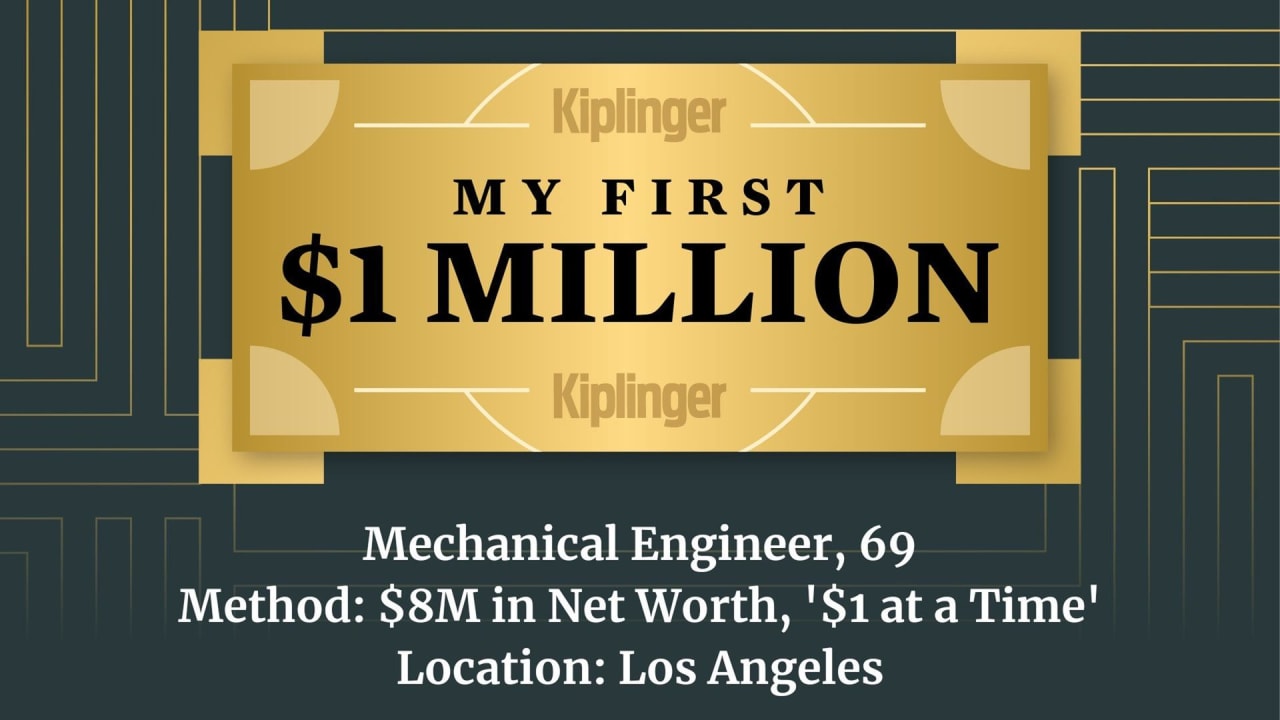

Welcome to Kiplinger’s My First $1 Million series, in which we hear from people who have made $1 million. They’re sharing how they did it and what they’re doing with it.
This time, we hear from a 69-year-old mechanical engineer in the aerospace industry. He has been with his partner for 35 years and lives in Los Angeles, having moved there from Cleveland after college. He reports he started in the defense industry in 1979 with a salary of $15,000. He now brings in $220,000.
See our earlier profiles, including a writer in New England , a literacy interventionist in Colorado , a semiretired entrepreneur in Nashville and an events industry CEO in Northern New Jersey . ( See all of the profiles here. )
Each profile features one person or couple, who will always be completely anonymous to readers , answering questions to help our readers learn from their experience.
These features are intended to provide a window into how different people build their savings — they’re not intended to provide financial advice.
To learn what these millionaires have taught us, check out the articles 5 Key Insights We Learned From 50 Millionaires and 5 Things 50 Millionaires Wish They’d Known Before They Retired .
And to hear more about My First $1 Million, you can check out this podcast with bestselling author and tax attorney Toby Mathis :
The Basics
How did you make your first $1 million?
All of my money was made $1 at a time. I am the classic ” millionaire next door .” I started saving in the company saving plan with my first paycheck at age 22 and never stopped.
When the savings plan stopped, and a 401(k) plan was introduced, I put the savings account value into an IRA with some lower-cost equity mutual funds ( ETFs did not exist at the time).
I have always maxed out the company savings / retirement accounts.
(Image credit: Getty Images)
The company also had a defined-benefit pension plan. For the first eight years, I contributed only to the company savings plan, trying hard to save up for a condo down payment.
I purchased a condo in 1986 and continue to live in the same condo today. After the condo purchase, I contributed to the company pension plan until it was terminated.
A company ownership change along the way required a divestiture of my work group to a second, smaller company. To retain the engineers, that company instituted a deferred-salary plan modeled after the earlier company’s defined-benefit plan, so I was able to retire from that second company at age 56, start that “pension” payout and continue to work at a third company in the area.
I have invested most every dollar of that “pension” over the years in the stock market in low-cost funds.
Along the way, at age 45, the second company offered a long-term care insurance plan through MetLife. I signed up for that LTC plan for a five-year benefit with two riders: A 5% inflation rider and a 50% annual premium reduction starting at age 65. MetLife does not offer this plan anymore, and I have been told that it is an excellent plan.
(Image credit: Getty Images)
When I was growing up in Cleveland, my parents needed to purchase too many cars — I remember at least eight — because of the corrosion from salty winter roads. I was determined to use the nice weather in Southern California to pare back that number of cars. I am currently on my fourth car — hopefully my last.
I have had each car for at least 10 years and 100,000 miles. None of my car loans exceeded 36 months.
I cook most all of my meals from scratch over the weekend, then live on leftovers during the next week. Sometimes, I dine out with friends on weekends as a treat.
When Roth IRAs became available, my salary for years was under the maximum contribution threshold, so I used extra cash to fund that account, along with a brokerage account.
Eventually, my salary consistently went over the Roth contribution limit, so I did some Roth IRA conversions along the way.
I achieved my first $1 million around age 50 in 2007, as the economy began to slide into the Great Recession.
(Image credit: Getty Images)
I have continued to work as a mechanical engineer (my dream occupation since I was a child) to this day.
I have delayed starting Social Security until its value maximizes at age 70.
My current balance in the retirement plans is just under $6 million(!), and my net worth is about $8 million. The retirement plan balances are about equally split between traditional IRA, Roth IRA, brokerage account and 401(k) plans.
What are you doing with the money?
Having made extra payments on the condo loan over the years, the balance was low, but I wanted to end the mental stress of making the payment each month, so I paid off the condo loan. I have invested the freed-up cash over the years into the stock market.
I had a small balance on my car loan at the time, as well as a small credit card balance, so paid those off, too.
To this day, I continue to have credit card balances under 5% of my credit limit.
I pay for daily purchases with cash, a debit card or backfill the credit card after making a purchase to get the cash points.
The Fun Stuff
Did you do anything to celebrate?
I shared a steak dinner with my partner. I also purchased a Rolex sports watch. I wanted one since I was a child.
(Image credit: Getty Images)
What is the best part of making $1 million?
I come from a low-income blue-collar family that had just enough money to live on. Making the decision to begin the investment process in my 20s and watching that balance grow over time was rewarding.
Did your life change?
Retirement savings gave me peace of mind; it provides options to “live and give like no one else” later in life.
My estate will split the balance of the traditional IRA and 401(k) plans and give that money to my alma mater and a local community college.
Does anyone know you’re a millionaire?
My partner of 35 years knows. He is financially comfortable, too.
Any plans to retire early?
I have decided to work for a few more years, though I do not know how many. I realize that I have excess retirement assets and do not need to work.
Mechanical engineering is physically easy and provides intellectual stimulation, socialization and daily structure.
Healthcare through the company is better and less expensive than Medicare .
(Image credit: Getty Images)
Looking Back
Anything you would do differently?
I would have focused more on Roth IRA conversions to whittle down the IRA balance subject to income taxation at age 73.
Also, the stock market swoon during the Great Recession tested my mental fortitude. In hindsight, I could have taken out a HELOC loan on my condo for $100,000, put that into equity ETFs and doubled or tripled the return on that money, but I did not feel confident in work prospects at the time to do so.
What advice would you give to your younger self?
Remember not to panic when the stock market swoons. Market swoons come along naturally, and the published rate-of-return numbers include the effects of these down markets.
If you take out the money in a panic, you upset that compounding math .
(Image credit: Getty Images)
Trust the math! Take advantage of these down market periods and continue to invest.
Did you read any articles or books that helped you on your journey?
Back around 1980, the Wall Street Journal began a weekly column on personal finance. I put into practice the tips I read about in that column.
Today, I would advise people to search for personal finance videos on YouTube. There is a wealth of information there. I find videos from Alex Finance to be particularly helpful to show how $100 a month automatically transferred to an investment account can compound to an enormous amount at retirement.
Did you work with a financial adviser?
My current employer uses TIAA to administer the retirement plan. I heard that Elizabeth Warren (D-MA), of Harvard Law School, has her retirement money with TIAA. Hearing that was good enough for me!
(Image credit: Getty Images)
When my investments reached about $2 million, I wanted some help on managing the investments and wanted the investments behind a “firewall,” so I moved all of my retirement money into a TIAA professionally managed trust account.
This structure has worked out well for me for a decade.
Did anyone help you early on?
The program manager at my first employer was self-made and was approachable for investment guidance. He said, “Put a small amount of your money into the stock market. Emphasize large companies.” I followed his advice.
Looking Ahead
Plans for your next $1 million?
I will eventually retire and take some higher-end cruises with my partner.
Any advice for others trying to make their first $1 million?
Start the investing process with your first paycheck and make it automatic. After two paychecks, you will not miss the money.
The amount can be very small, since you have 40-plus years for those contributions to compound.
I have been told that contributing to a health savings account ( HSA ) is now the best when starting a career, due to flexibility and tax savings, and I probably would invest in that if starting out now.
Do you have an estate plan?
I have a will , power of attorney , healthcare power of attorney and a revocable trust as my estate plan.
(Image credit: Getty Images)
How have you balanced immediate vs delayed gratification over time?
The investment process rewards delayed gratification — a concept that younger generations have difficulty learning these days.
What do you wish you’d known …
When you first started investing? I would have biased my contributions even more toward equities in the beginning.
When you first started working with a financial professional? Financial advisers take fees . TIAA takes 0.9% of the first $1 million managed, then lesser percentages as assets increase out to $5 million.
When you first started saving? That I had made the correct decision to begin saving in the first place. I learned over the years that you need to make every decision as good as you possibly can, given the information available at the time.
You will not know which decisions in life were pivotal until years or decades after the decisions were made.
If you have made $1 million or more and would like to be anonymously featured in a future My First $1 Million profile, please fill out and submit this Google Form or send an email to MyFirstMillion@futurenet.com to receive the questions. We welcome all stories that add up to $1 million or more in your accounts, although we will use discretion in which stories we choose to publish, to ensure we share a diversity of experiences. We also might want to verify that you really do have $1 million. Your answers may be edited for clarity.
Related Content
Are You Rich? U.S. Net Worth Percentiles Can Provide Answers
Compare Your Net Worth by Age
Being Rich vs Being Wealthy: What’s the Difference?
These 5 Rules Separate the Rich From Everyone Else
Can Money Buy You Happiness? Yes, It Can. However…