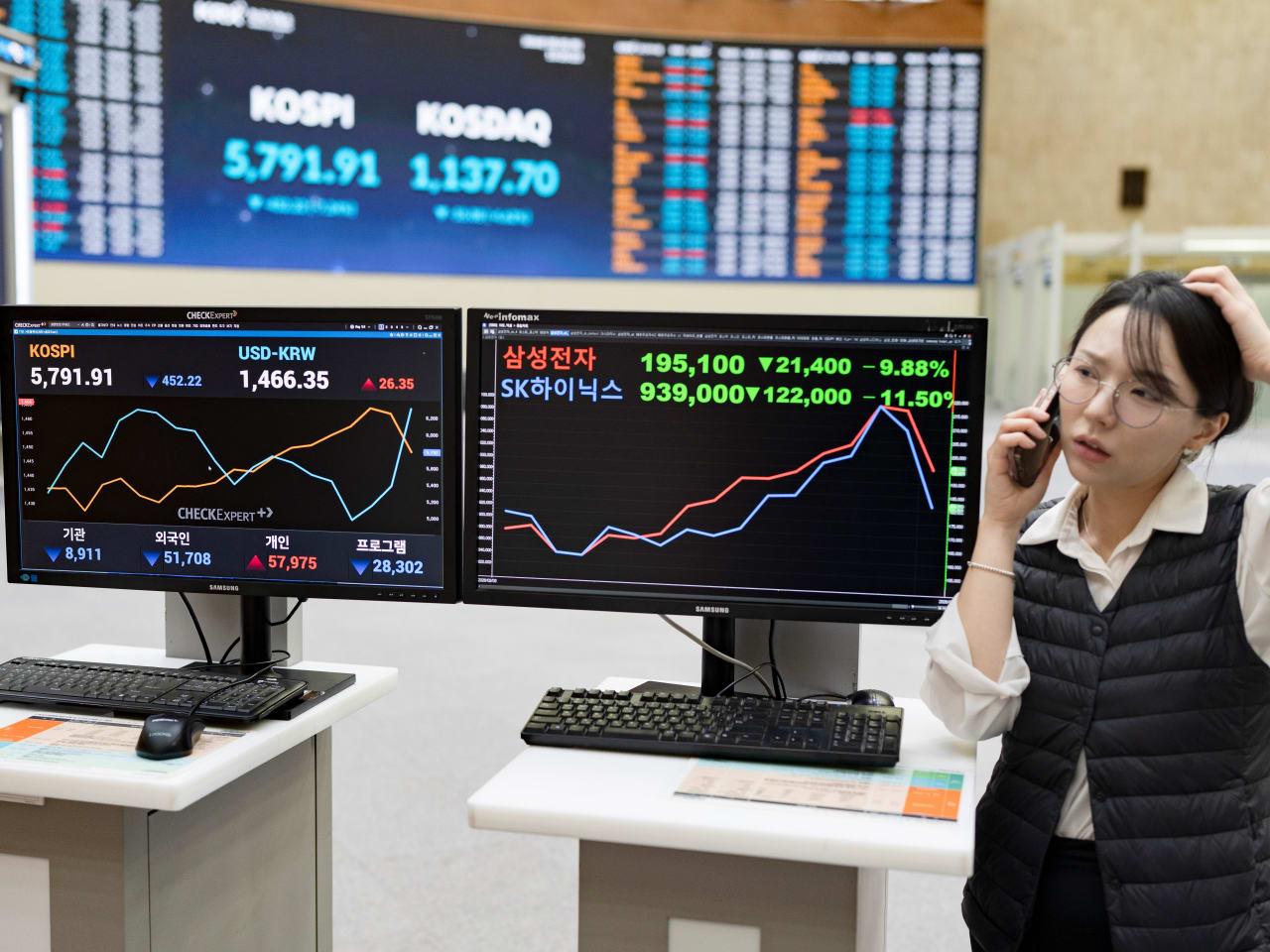

Market chaos in South Korea is bleeding into the chips sector in the US.
Chris Jung/NurPhoto via Getty Images
Heavy selling in South Korea spilled over to the US chips sector on Tuesday.
Investors dumped Samsung and SK Hynix on concerns about valuations and Chinese competition.
Jitters are building around the AI trade as investors head toward a pivotal tech earnings season.
South Korea’s stock market has once again descended into chaos.
Chip stocks are feeling the pain as investors took in a round of heavy selling in Korea’s KOSPI , a stock index that has become heavily exposed to the fortunes of the AI trade.
The Asian benchmark index dropped more than 5% on Tuesday to its lowest level in about three months as traders worried about valuations in the country’s stocks and mulled competitive threats from China.
Samsung Electronics , which makes up around 30% of the KOSPI’s market cap, was down 7%, while SK Hynix , which makes up around a fifth of the index, plunged 10% in South Korea. Its US-listed ADRs dropped 6% ahead of the opening bell.
The selling added to risk-off sentiment that’s been building in the US lately, with investors growing more cautious last week after the global sell-off in bonds picked up steam.
Chip stocks took on the brunt of the selling. All three benchmark indexes were relatively flat in the early morning, though the iShares Semiconductor ETF dropped more than 1%.
Here’s where major indexes stood at 10:15 a.m. ET:
S&P 500 : 7,799.19, down 0.1%
Dow Jones Industrial Average : 51,818.13, down 0.06% (-32.42 points)
Nasdaq 100 : 30,558.00, down 0.35%
Here were some of the biggest moves in the chips sector:
Company Ticker Today’s move
SK Hynix SKHY -10%
Samsung Electronics SSNLF -7%
Sandisk SNDK -2%
Micron MU -4%
AMD AMD -0.5%
Western Digital WDC -4%
Intel INTC -1%
Samsung, SK Hynix, and Micron, the “Big Three” in the memory space, have largely been hit by concerns about CXTM , a Chinese chipmaker that said it made progress in creating a chip with improved cell design, David Morrison, a senior market analyst at Trade Nation, wrote in a client note on Tuesday.
“This development suggests that supplies of DRAM chips may not be as tight as expected going forward. The news also provided investors with an excuse to cut their exposure to AI-adjacent companies,” he said.
Chip stocks have been hit with selling for five trading days in a row, the longest stretch since Liberation Day of last year, according to an analysis from Jefferies.
The tech selling this week is a symptom of “fragility” in the AI trade, top economist David Rosenberg said in a client note.
“For semiconductor investors, attention now turns to Thursday’s TSMC earnings, widely viewed as the next major test of the AI investment thesis,” the Rosenberg Research president said.
Mixed earnings reports added to some of the pessimism felt by investors. Bank stocks wavered as the market took in results from US bulge-bracket banks, with JPMorgan missing on revenue and earnings, and Wells Fargo missing on earnings expectations for the third quarter.
Bond yields, a key focus for investors recently, eased as investors turned their attention to lower oil prices and upcoming inflation data, with the September consumer price index due Wednesday. The 10-year US Treasury yield declined 5 basis points to 5.19%.
Read the original article on Business Insider