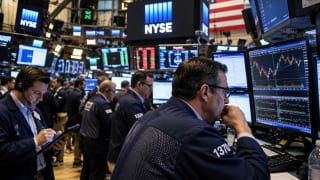

AI debt jitters are spreading on Wall Street as more bonds funding data center projects enter distressed territory.
Spencer Platt/Getty Images
Investors are growing nervous about stress in the market’s mountain of AI-linked debt.
More data center bonds dropping to distressed levels in the last month.
The decline reflects factors like reduced investor demand, increased supply, and higher rates.
The AI debt mountain is drawing nervous scrutiny from markets this week.
The jitters rippled through Wall Street in recent days as investors eyed the huge sums of borrowed money being used to fund the AI buildout, the health of which is being questioned as yields surge and more of the debt inches toward distressed territory.
The fear is that more stress could be on the way, potentially resulting in negative consequences for the AI trade and the broader financial system if losses on the bonds trigger a cascading effect the trickles into the stock market.
That fear was in the spotlight midweek when Chamath Palihapitiya, the billionaire venture capitalist, drew attention to some of CoreWeave’s bonds, which have seen yields spike and prices tumble into distressed territory.
Here’s a quick rundown of the events:
Tuesday: The value of CoreWeave bonds fall below 80 cents on the dollar, the threshold that marks debt as distressed. CoreWeave stock plunges 15%. As of Friday, shares were on track to end the week 20% lower.
Tuesday, 6:01 PM: Chamath Palihapitiya posts on X about CoreWeave’s bond yield rising to 15.1%, up from 9.6% in June. Palihapitiya also included an analysis that theorized that AI is blowing up a private credit bubble .
Tuesday, 7:43 PM: Tesla CEO Elon Musk replies “Yikes” to Palihapitiya’s post, drawing more attention.
Wednesday morning : DA Davidson’s Gil Luria, a tech analyst, says on a podcast that CoreWeave stock could fall to $0 if the AI spending boom falters.
Wednesday evening: The Financial Times reports Anthropic brought in $16.8 billion in revenue in the third quarter. The figure causes unease among investors, as it reflects a slowdown from the prior quarter’s revenue growth and adds to concerns that the boom may be waning.
Thursday morning: The sell-off in chip stocks picks up, with the sector heading for $1 trillion in losses . More tech selling on Friday pushes stocks toward their worst week since July.
Price declines in AI debt have been most acute in smaller neocloud companies , but even among hyperscalers, the value of some loans is inching toward distress. The debt issued by Blue Owl and Beignet Investor, the special purpose vehicle backed by Meta, to fund the Hyperion data center , for instance, has fallen below 92 cents on the dollar, according to the FT. The bonds were valued at a premium, or above par, in early July.
“We are confident in our backlog which more than supports all of our debt obligations,” a spokesperson for CoreWeave told Business Insider. “We structure the majority of our financing so that cash flows from customer contracts repay the associated debt and generate additional free cash flow.”
Distressed debt prices don’t necessarily mean the companies themselves are in imminent danger of defaulting. Hyperscalers like Meta and Amazon continue to hold investment grade credit ratings and boast healthy balance sheets. Instead, the declining value on some of the debt reflects a few different things:
Investors may be concerned about the risks associated with big projects, which reduces demand for those bonds.
Firms have issued more debt lately, which increases the supply of bonds. Both dynamics can weigh on prices.
It may also reflect higher interest rates , which drags bond prices lower.
The average price of high-yield data center bonds began to fall in September, Goldman Sachs said, pointing to the spike in rates as well as an uptick in the supply of bonds.
The average dollar price of high-yield data center bonds dropped sharply in September.
Bloomberg/Goldman Sachs Global Investment Research
Bond yields have surged in the last month, with the 10-year Treasury yield, which influences borrowing costs for consumers and companies, ticked up to 5.12% on Friday and remains near two-decade highs.
Credit spreads on AI-related debt, or the yield on the bonds over a benchmark like Treasurys, have widened sharply, a sign that investors are pricing in more risk and want to be paid more to hold AI-related debt.
Spreads on Al-related high-yield debt recently widened to over 350 basis points, while spreads on debt used specifically for data centers widened to over 400 basis points, according to Goldman Sachs. That compares to the spread for non-AI BB/B debt, which has held steady at around 250 basis points.
High-yield spreads on AI-related debt have widened sharply over the past month.
iBoxx/Goldman Sachs Global Investment Research
In a note, Goldman flagged the risk of a “correction across some risk assets,” pointing to how higher rates have drawn out concern about the funding costs of the AI buildout.
AI capex is also expected to remain “elevated” in the near-term, Goldman said, which is expected to raise supply relative to demand for AI-related bonds, potentially putting pressure on prices.
“We think the widening reflects a reassessment of the economics of the AI buildout, particularly for lower-rated borrowers that are more exposed to higher-for-longer rates and potential energy-cost pressures,” the bank wrote of investor concerns, adding that they expected “dispersion across AI-related issuers” to remain high.
Ross Mayfield, an investment strategist and vice president at Baird Private Wealth Management, said he would be monitoring hyperscaler credit spreads going forward. He flagged the growing risk of a credit event as yields rise, noting that AI debt used to fund the infrastructure buildout has become a pillar of the bull market in stocks.
“Wider spreads become a real problem and it demands a higher level of ROI on these projects,” he said.
Global fund managers surveyed by Bank of America this month said AI debt issued by hyperscalers was the most likely source of a systemic credit event. Respondents also flagged a hyperscaler credit event in the top five biggest perceived tail risks to markets.
Read the original article on Business Insider