
When you buy through our links, Business Insider may earn an affiliate commission. Learn more
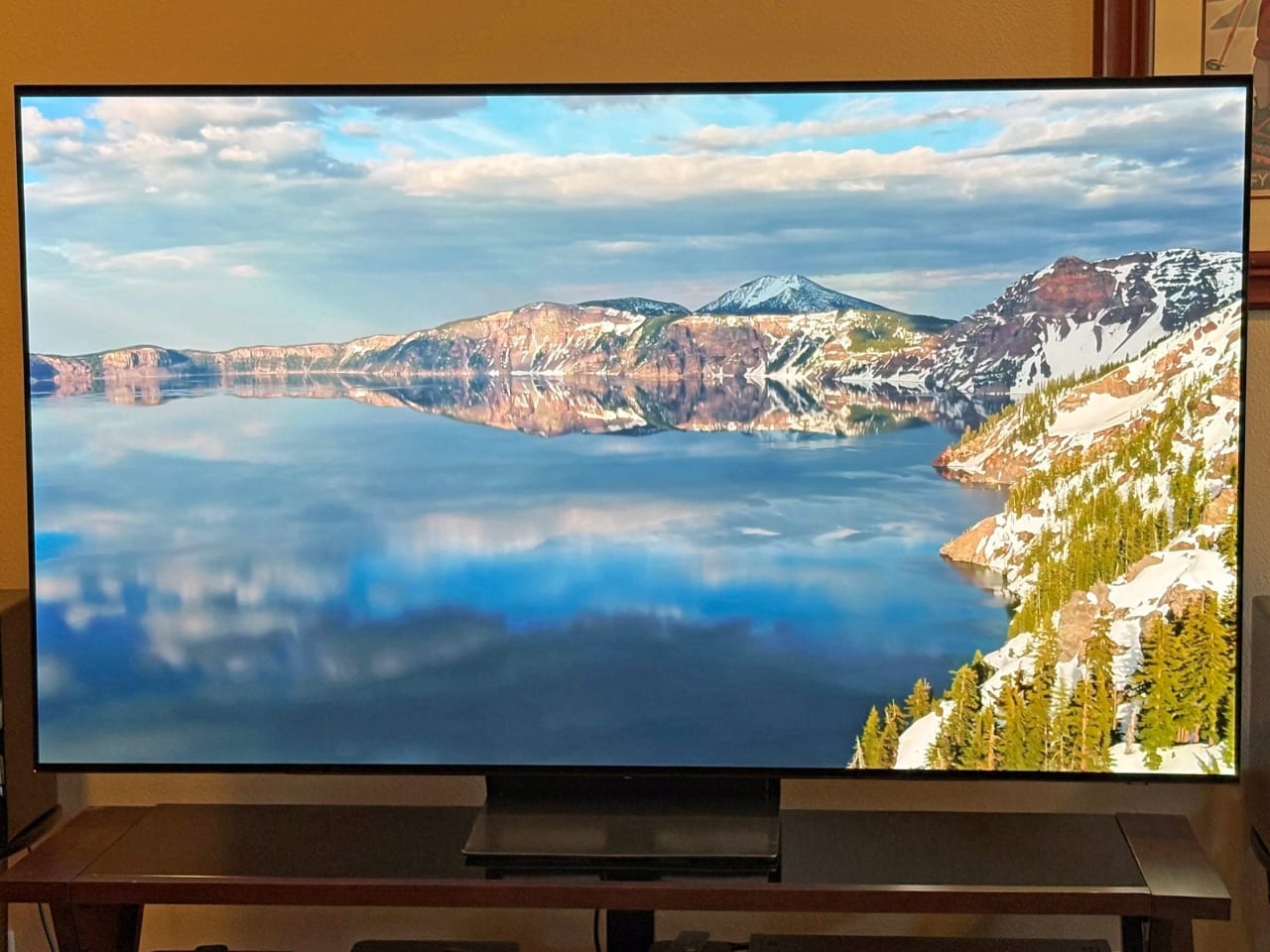
Our reviewer put the Samsung S90H through its paces with test patterns and real-world content.
Ryan Waniata/Business Insider
Last year’s Samsung S90F OLED TV impressed me by nailing all the essentials: vibrant yet natural colors, fantastic processing for clear, detailed images, and striking contrast that brings out the best in your favorite videos. While other TVs fought for ever-brighter, showier images, the S90F succeeded by focusing on accuracy over bombast.
This year’s S90H doesn’t do much to change that winning formula. Its OLED panel delivers the same pixel-level contrast and wide viewing angles, and it offers similar brightness. However, a couple of tweaks could make this new model even more appealing, depending on your priorities.
The biggest upgrade for 2026 is the S90H’s new matte-like screen, which uses the same glare-free technology previously reserved for Samsung’s pricier S95 Series. This screen virtually eliminates all but the brightest reflections, which is a huge perk for sunny rooms. However, the S90H’s color performance is actually slightly worse than the S90F’s. But since recent discounts have brought both models down to similar prices, the S90H wins out as the more versatile of the two.
Though not without its faults, the S90H’s unique combination of features and excellent overall value helps cement its status as the best TV for a wide range of uses. If you want a midrange OLED that looks good in both dark home theaters and sunlit rooms, the S90H is hard to beat.
The design is slick, and it’s quick to assemble
The TV’s stand isn’t as sturdy as the metal bases used on some rival models, but it’s easy to assemble without screws.
Ryan Waniata/Business Insider
Compared to many TV assemblies, Samsung’s S90 series feels like a cheat code. Though you’ve got to be extremely careful with its precariously slim panel, putting the stand together requires no screws and takes just seconds to secure its slide-and-click feet. There’s also a snap-on cover that makes the feet look like a single pedestal.
As someone who assembles several TVs a year (sometimes a month), I find it hard to complain about the S90H’s plug-and-play design. However, the stand does feel a bit jankier than other options in this class. For instance, the more affordable Hisense U7SG employs a robust metallic base plate for a sturdier, true pedestal stand. I actually had to jam the S90H’s right leg in so hard I felt like I was going to break something.
It’s great that the TV has four HDMI 2.1 ports, but we don’t love that two of them are positioned downward.
Ryan Waniata/Business Insider
I’m also not a fan of the S90H’s input layout: two HDMI ports are easily accessible on the side, but the other two face downward, so you’ve got to contort yourself to reach them. That said, I do appreciate that the HDMI ARC port is on the side for a simple connection to a soundbar or receiver, and that all four ports support HDMI 2.1 for high-bandwidth gaming features like 165Hz and VRR (Variable Refresh Rate). That puts the S90H ahead of some pricier models, such as the Sony Bravia 8 II .
I also like the new beveled back of the micro-sized SolarCell remote, which provides even better handling and complements its battery-free design that runs on solar and/or USB-C. Moreover, it’s hard to argue with the S90H’s visual aesthetic once assembled, matching its spacey matte screen with slimline graphite-black bezels for a stealth bomber vibe.
The S90H is available in sizes ranging from 42 to 83 inches. I reviewed the 65-inch size, but most specifications are the same across all sizes. However, the 48- and 77-inch editions reportedly use a four-stack OLED panel, which should make them brighter than other sizes.
The new glare-free screen kills reflections with minimal trade-offs
Samsung’s glare-free screen is a game changer for sunny rooms.
Ryan Waniata/Business Insider
As the last of Samsung’s premium models to make the leap to a matte screen, the S90H’s new design was bound to stir up some controversy. I generally prefer the richer gloss of previous models and the obsidian screens of rivals like the LG C-Series , as they tend to offer deeper black levels, while still providing solid reflection handling for anything but a sun-drenched room.
Even so, I can’t deny that this third generation of Samsung’s glare-free screen tech is shockingly good. Indirect reflections, like the sun bouncing off my kitchen wet bar, are wholly lost into the screen’s black void, while even direct reflections, like my recessed overhead lighting, are mostly diffused into a soft reddish hue.
Just as importantly, the latest version barely affects performance, with only slightly raised black levels in daylight and a nominal difference at night. The TV seems to almost actively defy sunlit rooms, displaying even challenging night scenes with impressive shadow detail, so you get the full picture.
Image quality is engaging and accurate, but last year’s model had better color performance
The 65-inch S90H uses a WOLED panel, which isn’t quite as colorful as the QD-OLED panel used on the older S90F.
Ryan Waniata/Business Insider
Like the S90F, the S90H’s picture performance is incredibly accurate in its Filmmaker Mode, matching the creators’ intent for both SDR (Standard Dynamic Range) content (think sitcoms and older films) and HDR (High Dynamic Range) without the need to tweak settings. The dusty-orange desert and fuzzy, filmic blues of “Mad Max: Fury Road” are instantly cinematic, virtually dragging you from the couch to the theater. Amazon’s “Spider-Noir” looks similarly fabulous in black and white, providing a litany of greys and blacks in a film-noir haze.
If you find the screen too dim in challenging scenes, you can swap HDR Tone Mapping from Static to Active for a bit more pop in HDR, or, in SDR, change the default Peak Brightness from Medium to High. I found the latter helpful for daytime viewing with the curtains open.
Thanks to OLED’s pixel-level control, the S90H provides flashy contrast between the darkest and lightest elements in most scenes. The TV’s max brightness of around 1,440 nits (measured with Calman’s Portrait Displays software, a G1 pattern generator, and a Calibrite Display Plus HL colorimeter) is great for a midrange OLED like this, but it isn’t exactly eye-blasting compared to step-up OLED models or similarly priced Mini or RGB LED TVs .
In fact, it falls ever so slightly below our measurement of last year’s S90F (though results may vary from panel to panel). There’s more than enough punch for anything you can stream, but the hottest highlights in searing 4K HDR Blu-ray scenes, like the psychedelic sandstorm in “Fury Road,” will look a bit dimmer than intended.
The S90H’s HDR contrast is good, but the TV isn’t quite bright enough to display the full intensity of highlights in some movies, like “Mad Max: Fury Road.”
Ryan Waniata/Business Insider
The TV’s color performance also lags slightly behind last year’s S90F. Samsung previously used QD-OLED (Quantum Dot OLED) panels in the 55-, 65-, and 77-inch S90F, but the S90H doesn’t use quantum dots in any size. This results in lower color volume in the next-gen BT.2020 color space, measuring around 70% compared to around 80% in the S90F. This isn’t a huge deal, since the TV still covers nearly 100% of the DCI-P3 color space, which is what the vast majority of content uses — but it’s still a bit disappointing that Samsung decided to downgrade the panel this year.
While I wasn’t able to compare the S90F and S90H side-by-side, there seemed to be a little less pop in vivid colors like the ultra-bright pink of Scott’s Baskin-Robbins shirt in “Ant-Man,” while SDR content tended to look slightly warmer and creamier than expected, including in test patterns.
But thankfully, colors like skin tones, fabrics, and subtle hair highlights are still revealed with impressive nuance, especially compared to cheaper sets like Hisense’s U7SG, and the S90H’s fantastic image processing provides some very tasty icing on the cake. You’ll see almost everything, from little divots and imperfections on Michael Scott’s face in “The Office” to the minute mechanical bezels in the weaponry of “The Guardians of the Galaxy Volume 2” or each tiny hair in Grogu’s miniature fleece in “The Mandalorian.”
The S90H does a fine job with other signature OLED traits, including a screen that’s mostly free of aberrations or smudges even in challenging scenes, and excellent off-angle performance, with virtually no detectable loss of color or brightness even from my corner easy chair.
The TV’s gaming and smart features impress, but Tizen is still frustrating
Samsung’s Tizen interface isn’t our favorite, but we do like the platform’s Gaming Hub, which features apps like Xbox Game Pass.
Ryan Waniata/Business Insider
While Samsung’s latest One UI Tizen smart TV interface is quick and responsive, it remains among my least favorite platforms. This year, “AI” is front and center, but I found its automated suggestions like “Find a film for my mood” in the main navigation area less useful than, say, a cross-app Continue Watching function, which I couldn’t find.
Decisions like the lack of a search function in the Apps section sent me on a frustrating goose chase for prominent apps like HBO Max. And like last year, the ad-based Samsung TV Plus service insidiously pops up every time you turn the TV on, to the point where I ended up deleting it. To be clear, the interface is still serviceable, but it all feels like it was designed with daily users as an afterthought.
The S90H is otherwise pretty well appointed on the feature front, with the two most notable omissions being ATSC 3.0 for NextGen antenna channels (something a lot of premium TVs skip these days) and Dolby Vision HDR, which no Samsung TVs support. I was pleased to see the addition of Google Cast streaming alongside Apple AirPlay, forward-looking connection options like Auracast Bluetooth for next-gen headphones, and plenty of smart features, including SmartThings device control and voice control from both Amazon Alexa and Bixby. There’s even an auto-wake feature that turns on the TV when you enter the room.
The TV’s fully loaded HDMI ports offer top gaming features, including support for VRR options such as Nvidia G-Sync and AMD FreeSync Premium Pro. The response is snappy, and games look appropriately vivid, while the TV’s handy gaming bar menu makes it easy to adjust settings. Samsung’s dedicated Gaming Hub is still my favorite Tizen feature, offering options such as simplified wireless connectivity with multiple controller models and built-in streaming services like Xbox and Amazon Luna.
Should you buy the Samsung S90H OLED TV?
The S90H is easily one of the top midrange OLEDs released in 2026, especially if reflections are a big issue in your room.
Ryan Waniata/Business Insider
The Samsung S90H is one of the most versatile TVs on the market, with performance that suits a wide range of rooms and needs. It offers impressive accuracy, the pixel-level contrast control OLEDs are known for, plenty of punch for most content you’ll watch, and utilizes Samsung’s latest glare-free tech to impressive effect, with little negative impact on overall picture quality.
However, for those who don’t like the look of a matte screen, there are a few worthy alternatives at this price, and even below it. LG’s C6 OLED is a very similar TV, with the primary differences being that it uses a glossy screen rather than a matte one and supports Dolby Vision. If you’re OK sacrificing pixel-level contrast and wide viewing angles to get an even brighter image, the TCL QM8L Mini LED TV is another good option. It uses new SQD (Super Quantum Dot) technology for fantastic color vibrancy, though it doesn’t offer the S90H’s deep black levels or anti-glare tech.
Otherwise, those after a midrange OLED ready for any lighting adventure will find plenty to like in the S90H , especially now that it’s regularly discounted.
Interested in other TV models? Check out our guide to all the best Samsung TVs for more recommendations.
Read the original article on Business Insider