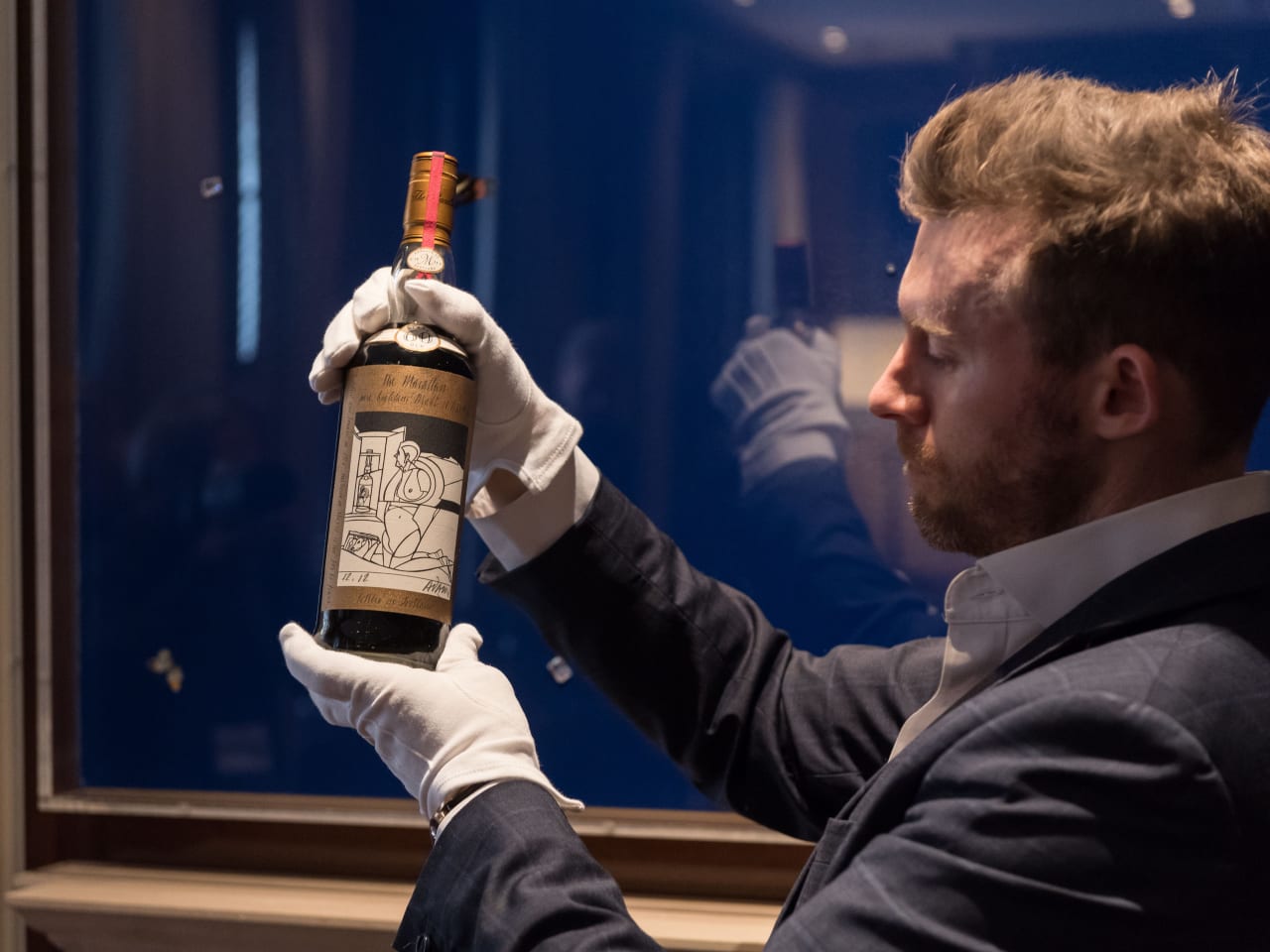

Sotheby’s global head of spirits, Jonny Fowle, poses with a bottle of Macallan 1926 Adami, in 2023.
credit should read Wiktor Szymanowicz/Future Publishing via Getty Images
A Sotheby’s auction drew $2.8 million for a bottle of Macallan whiskey this month.
It’s a staggering sum, bolstered by its origins from a prized 1928 cask.
Luxury market experts unpacked the economics of the market for high-priced alcohol.
The market for high-end booze is giving new meaning to the term “liquid assets.”
Niche investments like fine art, whiskey, and wine have always enjoyed a modicum of popularity among investors as alternative assets. But a Sotheby’s auction this month that saw a bottle of Macallan whiskey go for $2.8 million begs the question: what can possibly drive such a high price for a bottle of booze?
Whiskey is a different animal than wine, largely because the liquor ages in a barrel , while wine ages in the bottle. This is an important distinction in this case, as the enormous sum paid for the bottle at auction comes from a coveted cask filled in 1926 and not bottled until 1986.
But apart from rare casks and astoundingly old liquor, there are other economic drivers that influence prices collectors are willing to pay.
“The factor that determines the value of an investment Scotch bottle is of course supply and demand,” Jeremy Kasler, the CEO of whiskey cask investment firm CaskX, told Business Insider. “But it’s different from a normal supply and demand situation, where you can produce something and then you produce more if you need to, and less if there’s too much around.”
The bottle Sotheby’s sold is a Scotch whiskey, but Marlon Tulaszewski, a former Sotheby’s whiskey specialist turned private client manager at Campari Group, says buyers are demonstrating a surging interest in American whiskey investments as well.
“The category offers accessible entry points across a wide range of prices, opening collecting to a broad and incredibly passionate audience,” he stated. “Its appeal encompasses the liquid, the history of the distilleries and the people behind them.”
Kasler, who has worked in both wine and luxury art, described whiskey as an “alternative alternative” market. It’s a niche but increasingly popular investment theme in recent years, as more people seek out alternatives to traditional markets like stocks and bonds. That’s been evidenced by the growing number of app-based platforms that offer everyday investors exposure to portfolios of everything from art to wine to watches and handbags.
Some investors are not just buying bottles, but the casks themselves.
Though most who purchase valuable casks are primarily whiskey lovers , Kasler noted that they recognize barrels as a highly tangible asset. He compared whiskey casks to gold bars in terms of how investors often think of them as a store of value.
“It’s one of the few assets that, if market conditions stay exactly the same, will increase in value, because there’s a there’s a world of difference between one year old bourbon and eight year old bourbon,” he said of whiskey. “Every day, every night, it is increasing a little bit in value.”
Geoff Kirk, global prestige lead at The Macallan distillery cited the story behind a whiskey as key investment factor to consider, along with quality and provenance.
Jonny Fowle, global head of whisky and spirits at Sotheby’s, took it a step further, highlighting the importance of focusing on truly appreciating the product, whether it’s an entire whiskey cask or simply a bottle, maintaining that it has helped yield results for investors.
“The greatest investment one can make in whisky is investing one’s time into understanding and appreciating the product first and the market second,” he said. “Those who have done best from whisky’s value increases have largely done so by accident, buying initially for the love of the product and exiting once the offers become too good to turn down.”
Read the original article on Business Insider