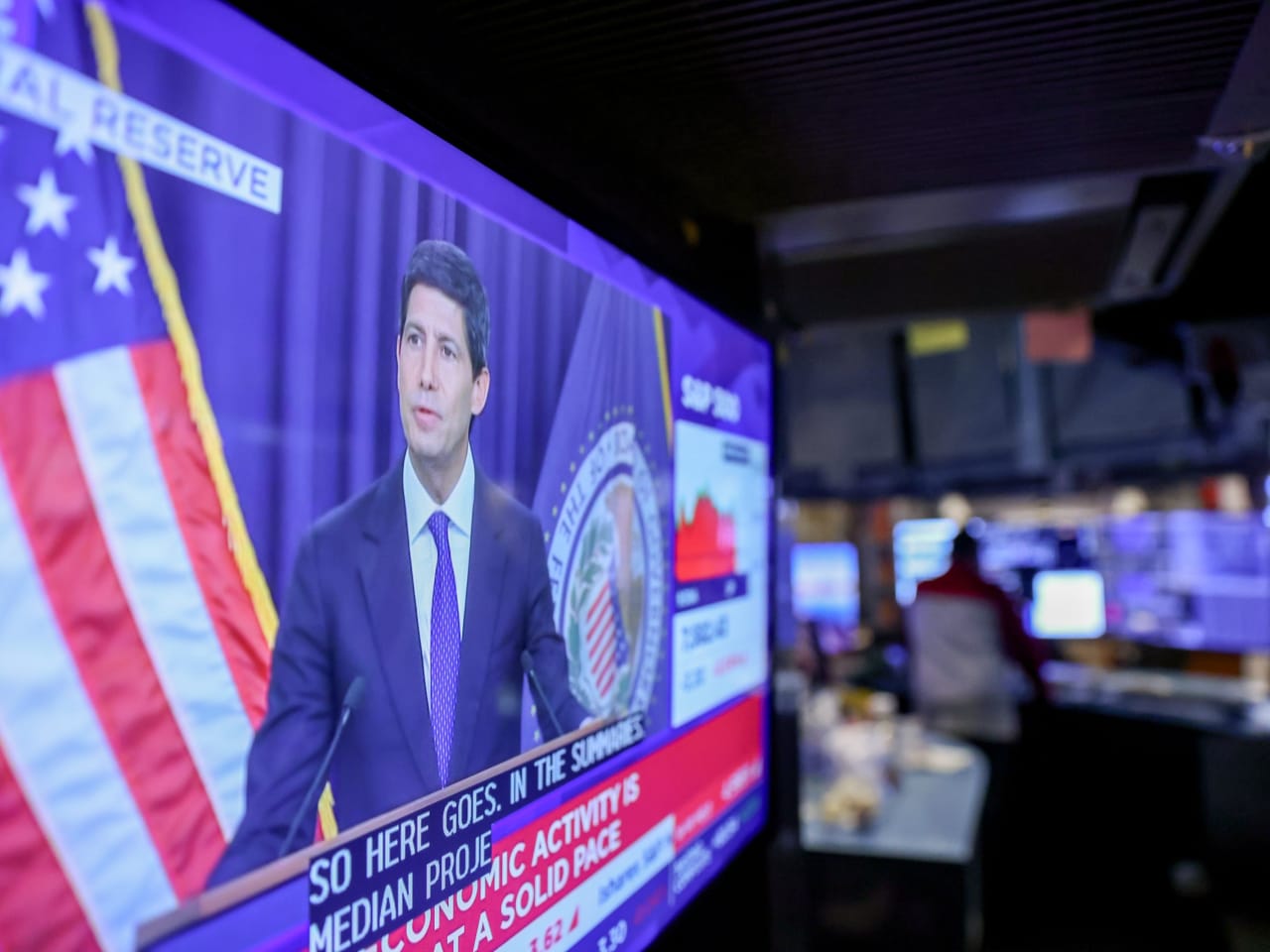

Michael Nagle/Bloomberg via Getty Images
NYSE
The next two weeks will be huge for markets.
Alphabet, Microsoft, and Amazon report earnings this week, with the Fed delivering a policy decision on Wednesday.
Midterm elections next week will also have potential implications for investors to digest.
Stocks are kicking off a monumental couple of weeks.
On top of Anhtropic’s S-1 filing released on Monday morning, the week’s pipeline of market-moving events includes financial results from top players in the AI trade, an interest rate decision from the Federal Reserve and how its chairman, Kevin Warsh, sees the economy, and the outcome of the US midterm elections.
The broader market has been fairly flat over the last few months, with the S&P 500 down less than 1.5% since August 4.
But certain pockets of the AI trade have endured a serious de-risking episode in October, sparking concerns of potential turmoil rattling the broader market is it remains heavily dependent on the fortunes of a handful of companies. Rising borrowing costs have fueled fears of a pullback in AI infrastructure spending sending neoclouds and chip stocks tumbling.
Let’s take a closer look at what investors will be watching.
AI earnings
Investors will have their eye on big tech earnings over the next couple of weeks as they look for clues about where the AI trade is headed — whether hyperscalers are monetizing their investments, and whether they can expect the big spending to continue.
Here’s a calendar of some of the top earnings reports the watch:
Wednesday, October 28:
Alphabet
Microsoft
Thursday, October 29
Amazon
Monday, November 2
Apple
Tuesday, November 3
Advanced Micro Devices
“We generally expect tech earnings to come in line with or modestly above expectations, as the bar is rising for tech companies to deliver against a backdrop of increasing questions about the return on investment from their AI spending,” said Richard Saperstein, the chief investment officer at Treasury Partners, said.
After consecutive quarters of smashing estimates, many companies pursuing AI have had trouble wowing investors. Meta stock dropped last week after delivering upbeat results and guidance, with Wall Street dismayed by the pace of capex spending and the uncertain results so far to show for it.
Bank of America said in its earnings preview on Monday that the bad vibes in AI are overshadowing strong fundamentals in the space. The wider AI trade and the AI infrastructure trade in particular have sent many of the top tech names tumbling.
“The breadth of positive EPS revisions in Info Tech remains the strongest of any sector (nearly 5x more upward than downward revisions to 2027 EPS MTD), but fears that today’s AI boom is paving the way for tomorrow’s bust have put the sector on pace for its worst month vs. the S&P 500 since DeepSeek in January 2025.”
Fed decision
The US central bank’s next meeting kicks off on Tuesday, with the interest rate decision and press conference coming on Wednesday.
As of Monday morning, markets are pricing in a 90% chance that the Fed keeps rates unchanged, but investors still see one more hike by the end of 2026, coming at the December FOMC meeting.
Fed chair Kevin Warsh has so far been loath to give forward guidance about future policy decisions, but investors will be looking for any updates on how he is thinking about the economy.
Since the last meeting, inflation has ticked up to 3.7% year-over-year.
Interest-rate moves can have serious implications for stocks. According to Jeff deGraaf, the founder of Renaissance Macro Research, the Fed’s hike in September is part of the reason AI stocks have sold off.
“They raise rates, and that might not matter or seem to matter for non-debt-heavy or even debt issued companies, but it does tend to have an impact at some point in time. And I think that’s exactly what you’re seeing now,” deGraaf said. “The credit markets have kind of found a weak link here with the CoreWeaves of the world and the buildout, and those high rates are having an impact.”
Midterm elections
Historically, outcomes of midterm elections have been a mixed bag in terms of the market reaction, and the clearing of uncertainty that builds ahead of the result tends to boost the market either way.
Franklin Templeton recently looked at stock performance in the year after midterm elections under Republican presidents (10 of them since 1954) and found that the S&P 500 has returned an average of 14.9%.
Markets have largely already priced in a Democrat majority in the House of Representatives, according to Steve Sosnick, the chief strategist at Interactive Brokers.
“The question then becomes, to what extent has the market priced in a potential change in Senate leadership,” Sosnick told Business Insider on Monda: “But realistically, the president still holds the veto pen.”
Read the original article on Business Insider