
When you buy through our links, Business Insider may earn an affiliate commission. Learn more
Uplift and Flexispot both make some of the best standing desks we’ve tested, but there are a couple of key differences. While both offer extensive customization in colors and desktop materials, Uplift builds its lineup around a unified frame design, whereas FlexiSpot offers multiple frame styles to target different weight classes and price tiers.
To offer a fair comparison, I tested two of our top buying guide picks: our best overall Uplift V3 with the heavy-duty FlexiSpot E7 Pro . Alongside customization options, both deliver sturdy, dependable builds, pro-level stability, sleek aesthetics, and smooth height-preset and adjustments, but key differences emerge in price, accessory ecosystems, and warranty terms.
Flexispot vs. Uplift: Overview
Flexispot E7 Pro Uplift V3
Starting Price (Sale) $490+; (Regular) $590+ $599+
Surface Size (inches) 48×24, 48×30, 55 ×28, 60×24, 72×30 42×30, 48×30, 60×30, 72×30, 80×30, 42×24, 48×24, 60×24, 72×24, 80×24
Materials Chipboard, bamboo, solid wood texture, rubberwood, ergo series, gaming series, chipboard with drawer, and solid wood Walnut, laminate, bamboo, eco curve, rubberwood, acacia, birch, reclaimed birch, saman, walnut, mahogany, reclaimed fir, pheasantwood, ash with epoxy
Frame Dual motor, three-stage C-Frame Dual motor, three-stage C-Frame
Accessory Add-ons Underdesk drawer, power strip, casters, monitor arms and stands, cabinets, etc. Different types of grommets and keypads, wireless foot switch, smart Bluetooth adapter, casters, movement accessory/mat, cup holder, hammocks, organizer sets, headphone stand, power strips, monitor arms/stands, CPU holder, desk storage, enhanced cord management solutions, keyboard tray, privacy panels
Min-Max Height 25-50.6 inches 22.6-48.7 inches
Weight Limit 440 pounds 355 pounds
Speed 2 inches per second 2 inches per second
Noise 61 dB 46-56 dB
Returns Free within 30 days; shipping and/or restocking fee applied after Free within 30 days
Warranty 15 years for frame and electronics, the desktop is 2-5 years 15 years
Customization & Design Options
The verdict: Both brands offer many custom design elements, such as desktop materials and frame colors, but Uplift edges out in the customization experience.
Flexispot (left) and Uplift desks (right) look virtually identical at first glance, but the real differences live in their frames, keypads, and cable management.”
Alex Temblador/Business Insider
There are a lot of similarities between the Uplift V3 and the Flexispot E7 Pro. So much so, at the surface level, you might not be able to tell them apart. Both desks are sleek and professional, with quiet dual motors, stability, and numerous configurations to fit your workspace needs.
Surfaces and Size
Where they differ most is in the number of customizable elements, such as materials, sizes, and colors. They each offer a lot of the same basic frame colors and desktop materials, but Uplift definitely has the edge when it comes to more luxe desktop designs (plus it offers an extra frame color). You’ll find some really beautiful desktop options from Uplift, like live-edge finishes, chevron-patterned acacia, and quality hardwoods. Both brands also sell just the frame if you prefer to use your own desktop. Uplift tends to offer more desktop sizes, ranging from 42 to 80 inches long in 24-inch or 30-inch depths. Flexispot desks range from 48 to 80 inches long and from 24 to 30 inches deep, depending on the desk size. Both Flexispot and Uplift also offer designs in an L-shaped configuration and as four-legged desks.
Keypad controls
The keypad is also an important consideration, as it unlocks features like memory presets, anti-collision technology, and child locks. Uplift offers six keypad options. The base offering provides basic up-and-down functionality; you’ll need to upgrade to the $29 advanced keypad to create presets and child locks. Flexispot includes just one, with four memory presets included at the base price, and it has a built-in USB port, a feature we really liked.
Cable management
Cable management comes standard on both models, but Uplift’s setup is far easier to assemble and reconfigure over time. FlexiSpot relies on a rigid under-desk metal tray paired with a magnetic fabric cover that snaps over the crossbeam. It has a sleek look once set up, but is somewhat fiddly to align during assembly. Uplift includes its patent-pending FlexMount system: a high-capacity fabric pouch that mounts directly to pre-drilled frame holes in seconds, offering easy access for heavy power bricks and cords.
Extras and add-ons
Beyond cable management and keypads, both brands offer desk accessories such as drawers, monitor arms, caster wheels, and power strips. Uplift offers more robust customization and tech upgrades, including a Bluetooth adapter that lets you control the desk via an app or a foot switch. Uplift also offers up to four freebies with each desk, including a desk mat and a clip-on cupholder.
Assembly
The verdict: Assembling the Uplift V3 was easier and less confusing than the Flexispot E7 Pro.
I had an easier time setting up the Uplift desk (right) than the Flexispot (left).
Alex Temblador/Business Insider
Both desks arrived in about the same number of boxes, with the same number of items to assemble; however, there were stark differences during assembly.
Uplift streamlined the V3 assembly process by providing a QR code linking to a 3D animation assembly video for buyers to follow. I opted for the printed instructions, which were very clear. The company also reduced the number of screws required to assemble the V3 compared with the previous V2.
I had a lot of issues understanding the printed instructions provided by Flexispot. The pre-drilled holes in the E7 Pro desktop didn’t quite align with the beam or the frame, and adjusting the frame to the right distance took me a long time to figure out.
Both Flexispot and Uplift offer assembly tools, but while I had no issue using the Uplift tool, I came close to stripping the screws with the screwdriver Flexispot provided.
I didn’t have any problems installing the control panel, legs, or feet for either standing desk, but I had some difficulty figuring out the cable organizer on the Flexispot E7 Pro. Installing the FlexMount Cable Manager on the Uplift V3 took seconds to do and really improved the organization of my desk.
The only difficult part of the Uplift V3 assembly process was installing the drawer, because there are no pre-drilled holes for it (I suggest using a drill if you have one). I did not test the Flexispot E7 Pro with a drawer, so I can’t speak to how their drawer installation works .
Performance and daily use
The verdict: The day-to-day user experience wasn’t much different between them, despite some small design differences.
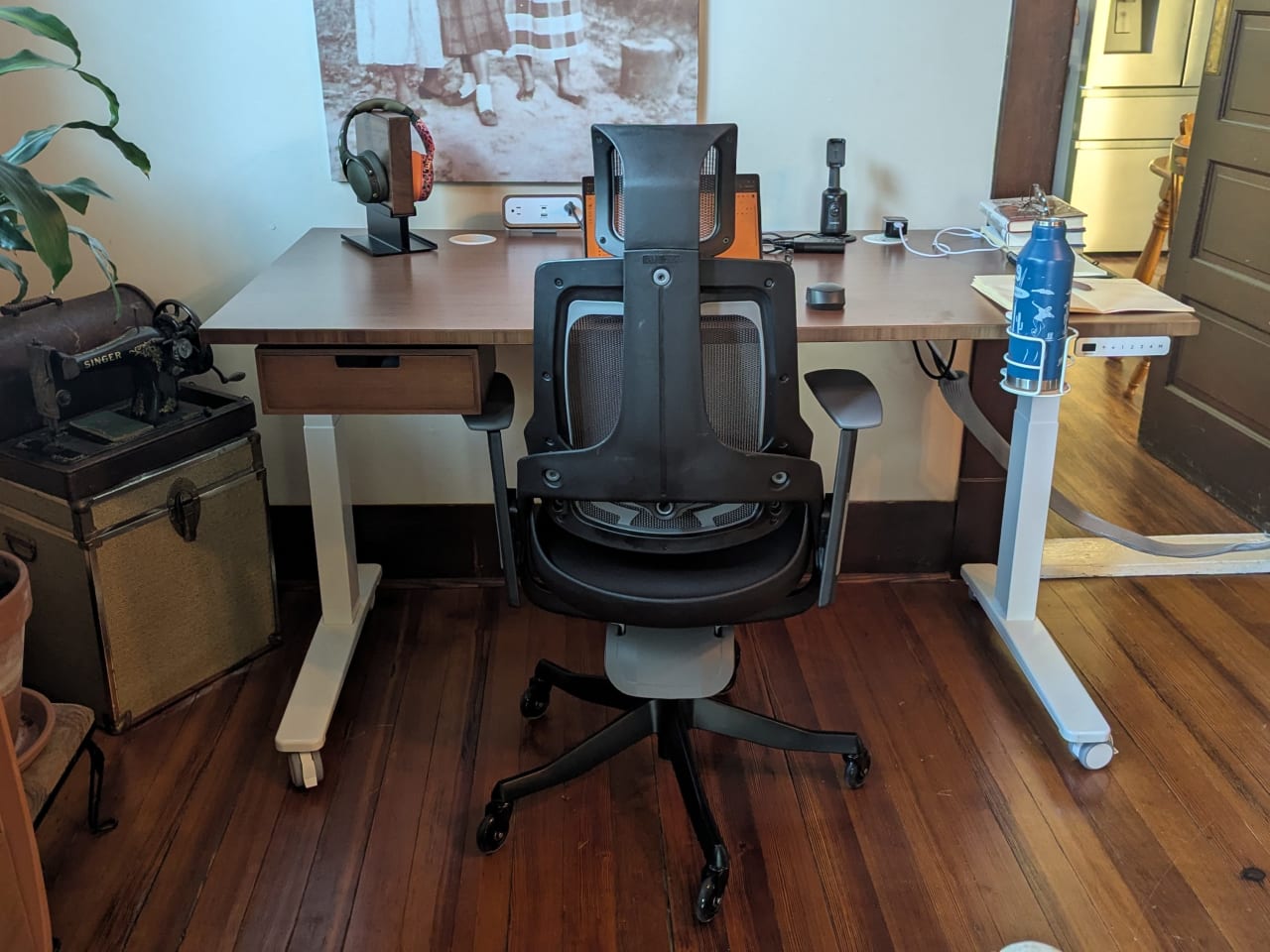
Both desks are stable, adjust smoothly and quietly, and naturally fit into my daily life and work routine.
Alex Temblador/Business Insider
Both desks were stable when I leaned against them. They were also quiet and very easy to shift from sitting to standing height with the keypads. Noise-wise, the Uplift V3 has a dB rating of 46-56 dB. I measured the Flexispot E7 Pro at 61 dB, but in person, I wouldn’t say the noise is bothersome or noticeably louder than the Uplift V3.
If you’re tall, you might prefer the Flexispot E7 Pro because it has a minimum height of 25 inches and a maximum height of 50.6 inches. On the other hand, shorter people might find the Uplift V3 more ideal because it has a minimum height of 22.6 inches and a maximum of 48.7 inches. Uplift’s height range complies with ANSI/BIFMA standards to fit 95% of the population (people between 5′ and 6’3″) and offers a slightly wider adjustment range.
In terms of speed/efficiency, the Uplift V3 rose from the lowest to the highest setting in 13 seconds, while the Flexispot E7 Pro took 17.5 seconds to do the same. Even so, both desks rise at 2 inches per second.
I can’t say that the Flexispot E7 Pro or the Uplift V3 performed better than the other. With both, I could preset my sitting and standing positions, and I didn’t have to wait long for the desk to adjust. Neither desk wobbled nor felt shaky at any height, whether I was leaning on it or not.
Weight capacity & frame stability
The verdict: The Flexispot E7 Pro wins for lifting weight capacity, with one of the beefiest on the market at 440 pounds.
This is in stark contrast to the Uplift V3’s maximum weight capacity of 355 pounds, which is also impressive and should suit most people’s needs and equipment. I sat on both desks (I’m 175 pounds) and had them lift and lower me, and I did not notice either desk struggling to do so. By comparison, other standing desks we’ve tested have lifting capacities between 176 and 310 pounds, putting both the Uplift V3 and the Flexispot E7 Pro well beyond those limits.
Pricing
The verdict: The Uplift V3 is generally a bit more expensive, especially because Flexispot is constantly hosting sales. Uplift, however, will give free gifts.
Base Laminate Bamboo (48”x24”) Walnut (60” x 30”)
Flexispot
$590 $490
(48” x 24”)
$630 $530 $1,159 $1,109
Uplift $599 (42” x 24”) $699 $1,389
As of this writing, the Flexispot E7 Pro is a slightly more affordable option because it’s on sale — and it’s frequently discounted. Normally, the E7 Pro ranges from $590 to $3,000, while the Uplift V3 runs $599 to $2,168. With current sales, the E7 Pro drops to $490 to $2,800, making it the better deal.
The lowest-priced E7 Pro is a 48×24-inch laminate chipboard model that costs $490 on sale (or $590 regular). The comparable Uplift V3 starts at $599 for a slightly smaller 42×30-inch laminate desktop.
Among bamboo options, Uplift’s starts at $699, while Flexispot’s starts at $630 and that drops to $530 during sales (though only with a white frame; black and gray cost more).
Overall, the two desks are close in price, but Flexispot’s frequent discounts can make it significantly cheaper. Uplift, however, doesn’t charge extra for frame colors and generally offers more surface area for the price.
Both Flexispot and Uplift work with TrueMed to let you use your pre-tax HSA or FSA funds toward your purchase, if deemed medically necessary by a licensed provider.
Flexispot vs Uplift: Trial and warranty
Both brands offer free returns for 30 days if the item is in like-new condition. Both brands also offer a 15-year warranty on their desks, but Uplift’s covers every aspect of the desk, whereas Flexispot’s only covers the metal and mechanical parts. There’s a separate warranty for the desktops, which is shorter (two or five years) and depends on the material. For instance, bamboo desktops are covered by a 5-year warranty, while chipboard, fiberboard, and solid wood or solid wood texture are covered by a 2-year warranty.
Neither company will charge you shipping costs or fees for product replacements or repairs due to defective parts. But for Flexispot, if you discover a quality issue after the first 30 days, shipping costs and a 10% restocking fee will be deducted from the refund.
The bottom line
If price isn’t a concern, the Uplift has some customizations that give it the edge, but the Flexispot is a solid budget option with one of the highest lifting capacities we’ve seen.
It’s a very close call as to which desk is better; it could come down to price or the customizations you seek to tailor the desk to your work needs.
Alex Temblador/Business Insider
Both desks excel in stability and daily performance, but they target two distinct buyers. If budget isn’t your primary constraint, buy the Uplift V3. Its effortless assembly, ergonomic height range (suitable for users 5’0″ to 6’3″), extensive accessory ecosystem, and all-inclusive 15-year warranty make it the superior long-term investment.
If you want maximum performance per dollar, buy the FlexiSpot E7 Pro. It delivers an industry-leading 440-pound weight capacity, includes a USB-equipped memory keypad in the base price, and routinely drops under $500 on sale — making it the smarter pick for heavy tech setups on a budget.
For more details on each model, I’ve written dedicated reviews of the Flexispot E7 Pro and the Uplift V3 .
Who should buy the Uplift V3?
Design & accessory enthusiasts: Offers an unmatched selection of desktop materials (including live-edge, butcher block, and solid hardwoods) alongside a massive frame-mounted accessory ecosystem and attractive cable management that conceals cords
Shorter or ergonomically focused users: The low 22.6-inch minimum height meets ANSI/BIFMA standards for users 5’0″ and up, ensuring correct seated posture without needing a footrest.
DIYers wanting painless assembly: Features a streamlined frame setup with 3D guided instructions and reliable pre-drilled alignment.
Long-term peace-of-mind buyers: Backed by a full 15-year warranty that covers the desktop surface in addition to the motors, frame, and electronics.
Who should buy the FlexiSpot E7 Pro?
Budget-conscious buyers: Frequently discounted below $500, offering premium performance at a lower baseline price.
Taller individuals: Reaches up to 50.6 inches, making it ideal for comfortable standing use by individuals over 6’2″.
Heavy-rig power users: Features an industry-leading 440-pound weight limit, which is ideal for massive multi-monitor setups, heavy desktop PC towers, and mounted gear.
Value seekers wanting out-of-the-box tech: Includes a 4-preset memory controller with an integrated USB-A charging port at no extra charge.
Read the original article on Business Insider