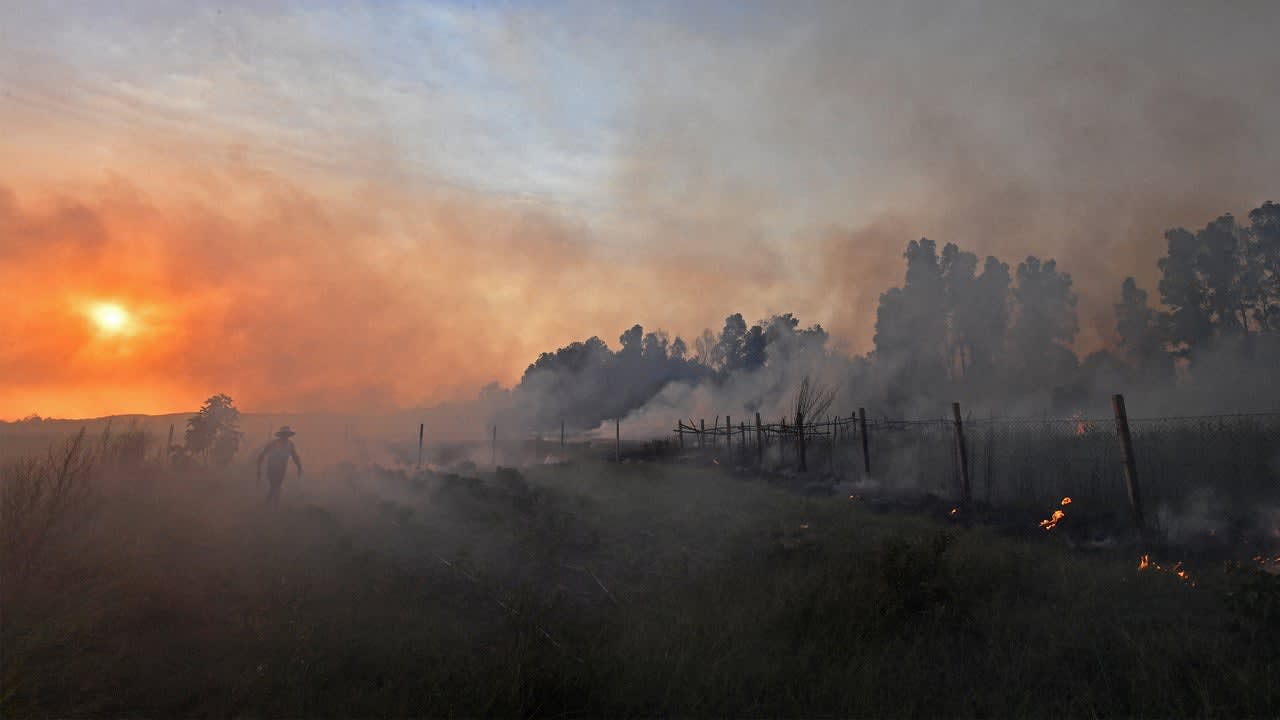

Climate change is a global phenomenon, meaning that everyone, in some way, will feel its devastating impacts.
And increasingly, those impacts are happening simultaneously: Over the past two decades, more than half of the world’s population has experienced simultaneous heat waves and wildfires, occurring on the same day, a study found.
Researchers at Monash University in Melbourne, Australia, published their findings this week in the journal Science Advances.
The study looked at 20 years of data, from 2000 to 2019. To see who experienced a wildfire, researchers looked at who was exposed to “fire-sourced air pollution”; their data took into account hourly temperature, fire emissions, air quality, and population information.
Over those 20 years, researchers found, the number of people around the world exposed to both wildfires and heat waves, on the same days, increased by 287 million—from 761 million people per year in the first half of that time period to more than one billion people per year in the second.
That means 55.9% of the global population has experienced at least one day where a heat wave and wildfire pollution occurred in tandem.
And the number of such days is increasing, too. From 2000 to 2009, the average was one such day per person. Between 2009 and 2019, that rose to 1.7 days of co-exposure per person.
Damaging on multiple levels
The research doesn’t only illustrate how climate change is making extreme weather more frequent. It also shows how the health impacts of these events can compound as extreme weather overlaps.
Both heat waves and wildfires can cause serious harm to our health. Along with the risk of heat stroke—which can damage your brain, heart, kidneys, and even be fatal—extreme heat and humidity can make it harder for some people to breathe , especially those with asthma or other lung conditions.
Wildfires come with intense air pollution, full of tiny particles called PM2.5 that can get into our lungs and bloodstream, raising the risk of heart attack, stroke, and reduced lung function.
When heat waves combine with air pollution, the health impacts exacerbate. On days when an area sees a “double whammy” of high heat and high air pollution, the risk of death is three times greater “than the effect of either high heat or high air pollution alone,” health researchers have previously written.
The Monash University researchers emphasize this in their study, too.
“Compared with exposure to heat wave or landscape fire-sourced air pollution alone, coexposure to both hazards may exert greater health impacts than the sum of their individual effects,” they write.
In other words, the health risks—including respiratory and cardiovascular impacts—become amplified when wildfire air pollution and extreme heat happen together.
Extreme heat and wildfires also impact each event occurring. Conditions like high temperatures and dry soil promote wildfires, and wildfires then exacerbate heat waves, because they release heat and pollution into the air.
“These processes create a positive feedback loop in which heat waves and fires amplify one another,” the researchers wrote.
Which regions are being hit hardest?
Some regions of the world are experiencing these simultaneous effects more than others.
Zambia, for example, sees more than 28 such days per person every year. The Democratic Republic of the Congo was second, with just over 24 days per person per year
Countries with lower life expectancy, education, and income tended to see the highest amount of wildfire and heat co-exposure, an example of the way that climate change is hitting the world’s poorest countries the hardest.
Still, almost every area of the world saw an increase in this trend.
Central America, South America, Central and Eastern Africa, Southeast Asia, and parts of North America, Australia, and Russia all experienced “notable increases” in the annual average number of days where wildfire pollution and extreme heat occurred together.