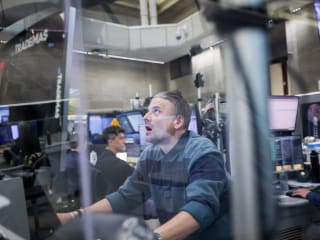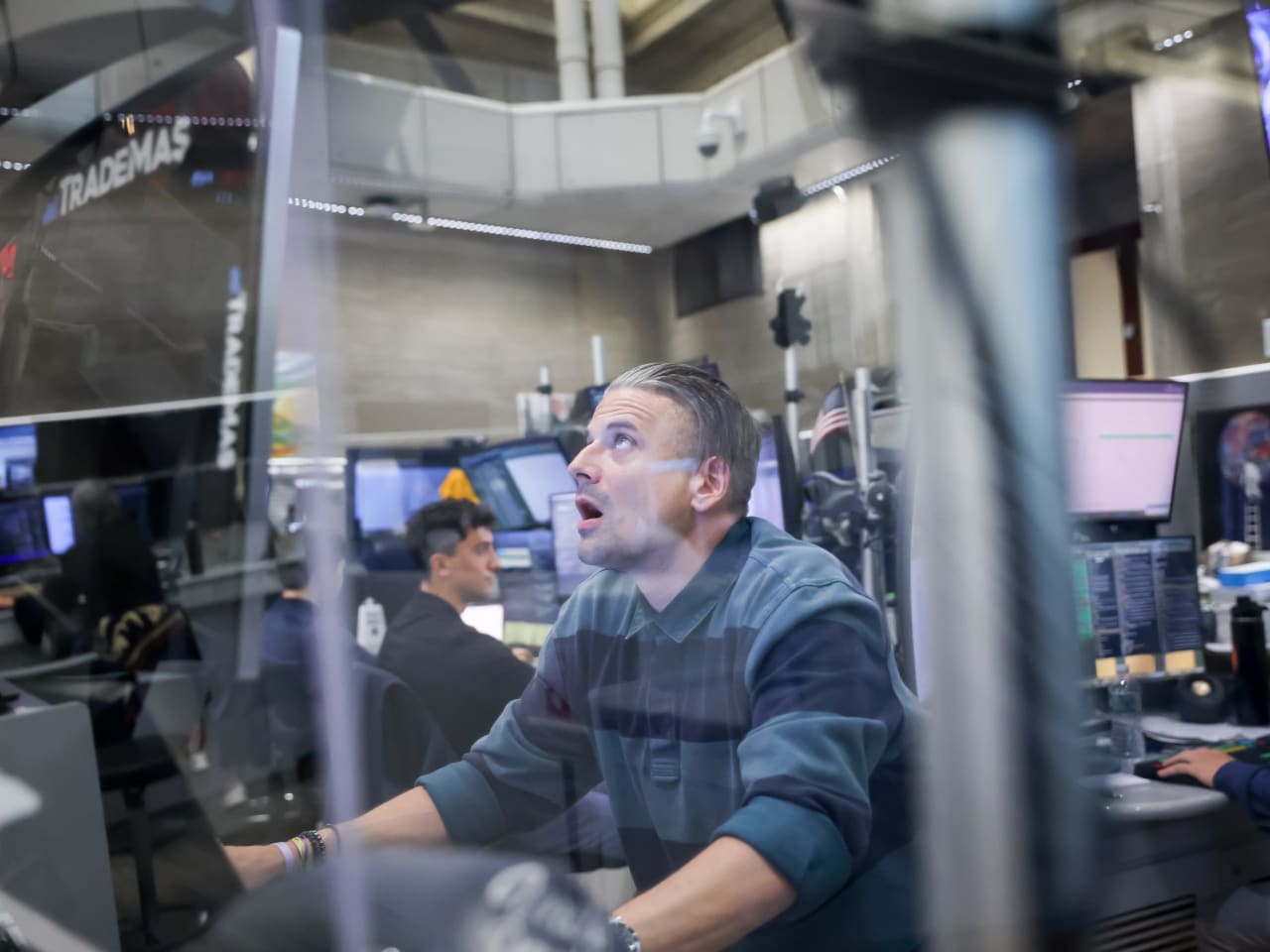

US stocks dropped as investors took in higher oil prices and continued jitters over the tech trade.
Michael Nagle/Bloomberg via Getty Images
A tech-led sell-off ripped through the stock market on Thursday amid renewed fears about AI.
Meta and Tesla delivered solid earnings, but more concerns about AI spending clobbered markets.
Chip stocks were hammered, oil price surged, and bond yields plunged back below 5%.
The stock market was clobbered on Thursday.
AI spending fears once again rocked the bull market , shaving nearly 3% off the Nasdaq 100 and sending investors retreating back to Treasury bonds, which have seen yields touch multi-decade highs this month. It was the worst day for the tech-heavy index since June.
The the tech-led rout was brought on by renewed fears that AI giants may be spending too much on artificial intelligence with too little to show for it. Recent earnings from Meta and Tesla failed to wow investors despite beating estimates.
Here’s where US indexes stood at the 4 p.m. ET closing bell:
S&P 500 : 7,663.39, down 1.21%
Dow Jones Industrial Average : 52,866.85, up 0.02% (+10.76 points)
Nasdaq 100 : 28,958.69, down 2.90%
The drop attests to how sensitive markets has become to even slight changes in sentiment around capex and the broader AI buildout.
The jitters, combined with a spike in oil prices that sent Brent crude to the highest level since May, were enough to send investors rushing back to bond for safety.
The 10-year Treasury yield plunged 18 basis points, falling below 5% for the first time in almost a month. The yield ended the day at about 4.97%.
Tesla beat estimates for the third quarter, but its stock dropped 2% as investors balked at the company’s lowered profitability. Meta also fell as much as 7% as traders shrugged off the Facebook parent’s upbeat earnings and strong guidance.
Tesla whittled its capex estimate for the year to $20 billion, down from $25 billion. Meta’s capex estimate was largely unchanged for the year, but investors sense that more “spending discipline” from tech titans means the AI investment boom could slow, sparking negative consequences for “supplies across the entire chain,” economist David Rosenberg said.
In August, Goldman Sachs projected that global AI investment was on track to surpass $1 trillion this year.
“Following an extraordinary run in technology stocks, markets are becoming more demanding around evidence of the payoff from high investment in AI and concerned about the sustainability of this spending amid higher interest rates,” said James McCann, senior economist at Edward Jones.
The chips sector saw the sharpest declines, with the iShares Semiconductor ETF losing nearly 7%.
Geopolitical tensions added to the selling pressure. Brent crude , the international benchmark, spiked 4% to top $113 a barrel as markets digested a New York Times report that said the US and Israel are planning strikes on Iran after the midterm elections.
David Morrison, a senior market analyst at Trade Nation, said the market was exhibiting a worrying reaction to Meta’s and Tesla’s earnings , given that both firms reported solid results.
“The market reaction to these key updates and the overall effect this has had on the chip sector and other AI-adjacent stocks this morning is concerning. Not only does it show that upside momentum has waned significantly, but that intermediate support levels are creaking dangerously,” he wrote in a client note.
“Investors may be mostly passive investors nowadays, but their mood seems to follow the trend of individual stocks, plenty of which have been struggling even as the indices trade much closer to all-time highs,” Paul Hickey, the co-founder at Bespoke Investment, said of weaker investor sentiment.
CoreWeave , a neocloud company that’s come under investor scrutiny recently for its debt, plunged 10%. The stock is down 39% from levels in early October, even as Nvidia CEO Jensen Huang has come out to defend CoreWeave and other neoclouds, claiming that demand is “off the charts .”
Here were some of the most notable moves in the tech sector:
Company Ticker Today’s move (intraday low)
SK Hynix SKHY -7%
Samsung Electronics SSNLF -4%
SanDisk SNDK -9%
AMD AMD -7%
Intel INTC -7%
Meta META -7%
Tesla TSLA -2%
Micron MU -5%
Nebius Group NBIS -8%
Nvidia NVDA -4%
Broadcom AVGO -3%
Alphabet GOOGL -3%
Amazon AMZN -4%
It’s been a volatile few weeks for traders as the midterm elections — a key event that stocks are often thought to struggle leading into — inch closer.
The bullish tone in markets has seemingly “reversed overnight,” and investors appear to be on “flight-to-quality trade,” strategists on JPMorgan’s markets intelligence desk wrote in a note.
The bank pointed to lower yields, a sign that investors are scooping up safe-haven Treasurys. The 10-year US Treasury yield dropped 11 basis points on Thursday despite the move up in oil, falling back to its lowest level in about a month.
“Underlying price actions and feedback from our trading desk also suggested the still fragile narrative around AI financing concerns and the lack of conviction / re-grossing from the recent tech reversal,” the bank said of factors contributing to the sell-off.
Treasurys are acting like more traditional safe-havens again after a long stretch of selling driven by fears of high inflation and fiscal instability. Investors have flocked back to US government debt as tech weakness causes the four-year-old bull market to falter and as more geopolitical instability looms.
Meanwhile, hyperscalers’ corporate bond spreads , a measure of how much investors want to be paid to hold the debt, have widened back to levels last seen in July, the bank added, attesting to credit jitters weighing on the AI trade.
Pressure also continued on the bond market across the Atlantic. The 10-year French OAT surged 7 basis points as political unrest continued across the nation, a sign that investors are dumping government debt securities and heading toward other areas of safety. France’s bond market has been catapulted into a historic sell-off amid the cost-of-living riots, with its 10-year bond yield breaking past 5% for the first time in 24 years this week.
Read the original article on Business Insider