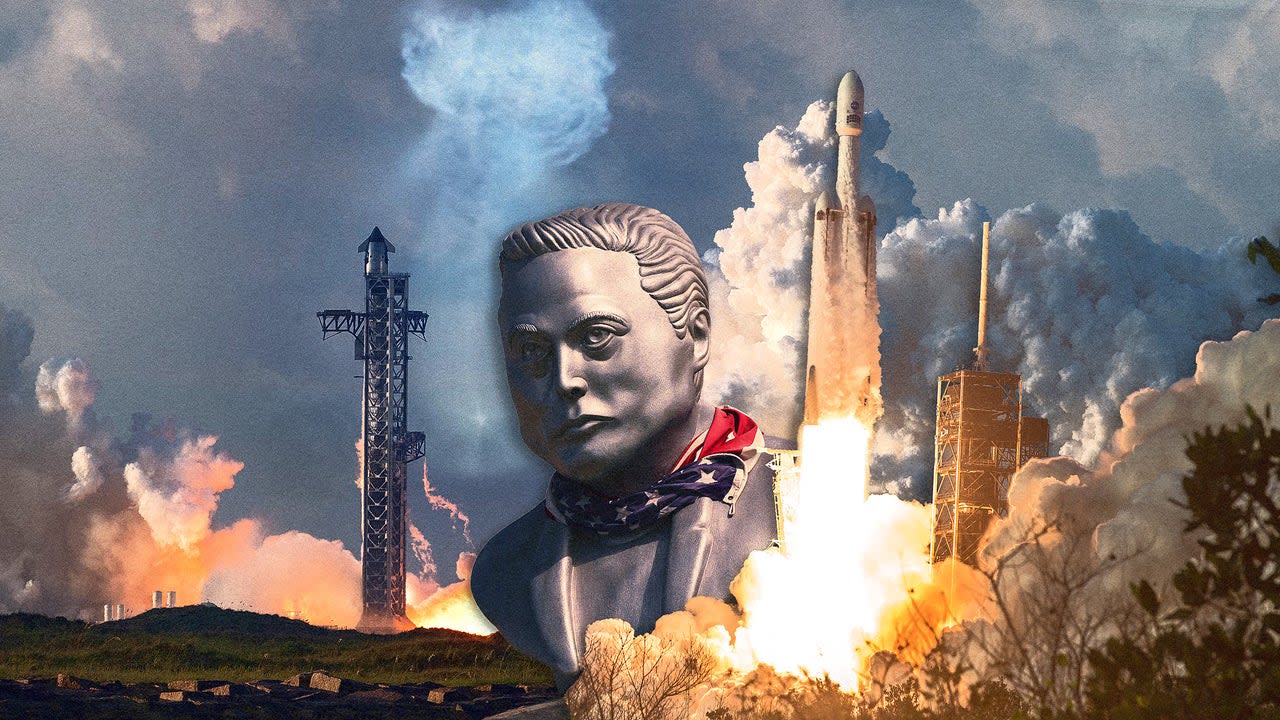

Elon Musk has spent years promising a rocket that flies as often as an airliner , a radical idea by current aerospace standards. Now, his bombastic tale has a very real, very scary number attached to it: 456.
That’s the number of Starship launches per year SpaceX has asked the Federal Aviation Administration to allow. It’s almost 40% more than all the orbital launch attempts worldwide in 2025 —a record year with 329. The scientists who study what rockets and satellites leave behind in the sky think the whole world should be paying attention.
Leonard Schulz, a researcher at the Technical University of Braunschweig in Germany, who studies the metals that burned-up spacecraft leave behind, believes the entire planet needs to weigh in on this sudden increase in launches and the massive deployment of satellites that will come with it. “I think this problem should be addressed internationally: limits to the use of space need to be quickly established and adhered to by everyone; we only have one atmosphere,” he said in an email.
SpaceX’s request works out to nearly two launches every weekday. Every single year, Starship alone would fly more than three times the 135 missions NASA’s space shuttles flew in three decades. That’s a lot of rocket engines roaring over a coastline full of people and wildlife. And those satellites Starship will carry by the thousands? They will seed the upper atmosphere with metals whose effects nobody fully understands. And before that, they will crowd low Earth orbit, the band of space a few hundred miles up where most satellites circle the planet, and raise the odds of collisions.
License to kill
The FAA licenses every commercial launch in the U.S. Before it lets SpaceX fly this often, it has to produce an environmental impact statement, a detailed study of what the plan would do to its surroundings (the FAA published a notice on Wednesday, announcing an environmental review of the plan). This one will cover an entire program of operations rather than a single project, and SpaceX’s request comes in two phases.
In the first, Starbase, the company’s launch site next to the city of Brownsville, Texas, on the Gulf of Mexico, would go from 25 to 100 launches a year, plus 200 landings, which could take place at any hour from Monday to Friday. The second phase would arrive “within several years,” according to the FAA, and raise the ceiling to 456 launches and 912 landings. (Starship goes up with its two stages in one piece; the stages come back down separately.) Launches would stop on weekends, but not at night. For its analysis, the agency assumes that half of all launches and landings would happen between 10 p.m. and 7 a.m.
Not every flight would come home. Starship’s booster could also make a gentle splashdown in the Gulf or be deliberately blown up in flight, and the spacecraft could splash down at sea or be discarded there.
The review will look at how all that noise and traffic affects the air, wetlands, groundwater, the coastline, and wildlife around Boca Chica, Texas, among other things. What happens to the global atmosphere and to orbit falls outside it. The U.S. will make this call alone, even though the Outer Space Treaty , which it signed in 1967, says that the exploration and use of space belong to all of humanity and that no nation can claim it as its own.
Final countdown
If Musk pulls this off, putting anything in space would get a lot cheaper, from internet satellites to the crewed moon missions NASA has hired the company to fly. That’s great! It will enable Musk, and other companies that want to do the same thing in Europe or China, to deploy tens of thousands of Starlink-like satellites, for better or for worse.
For now, though, this plan is another insane Musk pipe dream . Today, SpaceX is allowed to launch Starship 25 times a year from Texas, but the rocket has flown only three times in 2026 and has never managed more than five flights in a single year. The company has also yet to prove that the vehicle can be fully reused, let alone turned around in a matter of days. So far, Starship has cost more than $15 billion and has taken four years longer than Musk predicted (he said it would reach orbit in 2022).
But we will get there. This 456-launch license request, combined with the partially successful orbital Starship launch on September 28, shows that Musk’s endgame may be getting closer to reality faster than we thought.
Musk isn’t slowing down. He claims that within a decade, Starship will fly more than once an hour. His plans go beyond Texas, too. The FAA is reviewing a proposal for up to 76 Starship launches a year from Cape Canaveral, Florida, and in August, SpaceX announced it would spend as much as $100 billion on a giant launch complex in Louisiana.
From airplanes to orbit
Going from three flights a year to hundreds would bring problems that no multibillion-dollar investment can solve, starting with commercial aviation. Starship’s seventh and eighth test flights blew apart in 2025, scattering debris over the Caribbean while airliners flew nearby.
After the first explosion, 21 planes seemed to swerve abruptly to leave or steer clear of an emergency no-fly zone, ProPublica found . This year, the FAA warned that launches can “significantly reduce safety” for planes, and before Starship’s ninth flight it nearly doubled the stretch of sky it closes to traffic during each launch. With hundreds of missions a year, those closures would become a constant headache for airlines.
The second major issue is orbit. One of the main reasons Starship exists is to put more Starlink satellites into space, faster. The constellation already has more than 10,000 working satellites, two-thirds of everything operating around Earth, and SpaceX has asked to expand its second-generation broadband fleet alone to nearly 30,000.
Only Starship can economically carry the next-generation Starlinks. Each of these V3 satellites weighs about 4,400 pounds, roughly three and a half times as much as the current model, and SpaceX expects Starship to deploy up to 60 per flight (a Falcon 9 rocket carries up to 29 of today’s smaller satellites). On top of that, in January it asked the Federal Communications Commission for permission to launch up to a million satellites for a separate system that would work as data centers in orbit.
Jonathan McDowell, an astrophysicist at the Harvard-Smithsonian Center for Astrophysics, who logs every launch in his newsletter Jonathan’s Space Report , told me in an interview last year that “if you have 10 times as many satellites, you have 100 times as many close misses.”
The numbers bear it out. In the 12 months ended May 31, Starlink satellites performed more than 355,000 maneuvers to dodge space junk and other satellites, according to SpaceX’s latest semiannual report to federal regulators. That’s more than triple the 2024 total, while the fleet itself grew by about two-thirds, from about 6,000 satellites in 2024 to more than 10,000 now. The dodging grows faster than the constellation because every new satellite can cross paths with every satellite already up there, its own siblings included, inside the same altitude bands, or shells. “Double the satellites in a shell and you roughly quadruple the number of pairs that need to be watched,” Tommaso Sgobba, director of the International Association for the Advancement of Space Safety, told Space.com.
And not every dead satellite comes down on command. “Even with a 99% success rate for de-orbiting, a 1% failure rate on a 30,000-satellite constellation means you’re adding 300 dead, multihundred-kilogram satellites to orbit every five years,” McDowell added. Each one could be the first domino, because “once you have the first collision, the debris from that is now threatening all the other satellites.” Meanwhile, China has filed paperwork for constellations of its own totaling more than 200,000 satellites.
Scientists call that chain reaction Kessler syndrome. In the worst-case scenario, it would turn low Earth orbit into an unnavigable cloud of shrapnel.
Not everything that comes down burns up completely, either. In a 2023 report to Congress , the FAA warned that if Starlink debris survives reentry, the growth of these constellations could mean one person injured or killed every two years by 2035. SpaceX disputes that conclusion.
Poison in the sky
Perhaps the least understood problem is what happens to the satellites that do burn up. According to the study by Schulz and his team at the Technical University of Braunschweig, rockets and satellites burning up overhead already add the equivalent of 16% of the metal that arrives naturally with meteoroids, the bits of space rock that turn into shooting stars when they hit the air. In 2015, human activity was the main source of 18 elements in the upper atmosphere. By 2024, it was the main source of 24.
In theory, a fully reusable Starship wouldn’t add much metal to the atmosphere—although its exhaust will have an effect we have yet to measure. Its cargo is another matter, Schulz points out. Remember, thousands of satellites will keep coming down and vaporizing, only to be replaced by new ones that will burn up in turn. That’s why Musk needs a crazy number of Starship launches.
“If these launch rates would become reality, a much increased amount of metal injection well surpassing our extreme Scenario 2, can be expected,” Schulz wrote, referring to the most pessimistic future his team modeled. The number of elements where human activity outweighs meteoroids would then “rise above 30 (that is a lot!),” he added.
Copper from wiring and titanium from structures are among the metals already reaching the upper atmosphere, and both can speed up chemical reactions. Researchers fear three effects: These metals could eat away at the ozone layer the way CFCs, the chemicals once used in spray cans and refrigerators, did. They could change how clouds form. And they could heat or cool the atmosphere in unpredictable ways.
Nobody has yet studied, for example, how titanium affects ozone. Schulz tells me that research from recent years shows “a considerable risk of strong changes in our atmosphere,” such as ozone loss or more clouds at high altitude. The size of those effects hasn’t been measured yet, but he doesn’t think we should wait for the numbers, “because in the meantime, the atmosphere is used as a giant testing ground.”
Boca Chica can be very ‘grande’
Which brings us back to the FAA and its license. The agency will count decibels in Boca Chica and check on its wetlands. That’s great. The stratosphere and orbit stay off the books. “It shouldn’t be just the U.S. that decides that. It should be decided by all of the countries in the world, because they’re all affected whether they’re space powers or not,” McDowell told me. Schulz agrees. He credits reusable rockets, an area where SpaceX leads the industry, as one way to reduce the harm to the atmosphere, “but there are limits to the use of space,” he wrote.
The FAA license is a decision that will affect the sky over every country. It shouldn’t be settled by a review that stops at the Texas coastline.