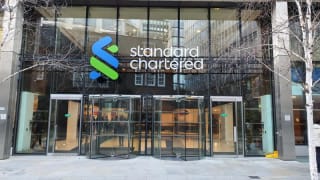
Standard Chartered will now hold Ripple’s dollar-pegged stablecoin, RLUSD, for institutional clients through its branch in the Dubai International Financial Centre. The bank also plans to let those clients use RLUSD as trading collateral at LMAX Group without the tokens ever leaving the bank. That second part is not live yet. Together, though, the two pieces show how traditional finance is trying to fix one of crypto’s oldest problems: what happens to your money when the venue holding it fails.
To see why this matters, it helps to unpack three ideas: stablecoins, custody and collateral.
What happened
The bank announced on Monday that it now supports institutional custody of RLUSD issued on the XRP Ledger. The service runs through its DIFC branch, which is regulated by the Dubai Financial Services Authority. Separately, Standard Chartered has joined a planned integration with LMAX Group, a London-based marketplace for currencies and crypto, that would make RLUSD eligible collateral on agreed LMAX products.
What is RLUSD?
A stablecoin is a crypto token designed to hold a steady value, in this case $1. RLUSD is backed by US dollars, US government bonds and cash equivalents. Ripple launched it in December 2024 on both Ethereum and the XRP Ledger, a public blockchain closely associated with Ripple. The bank’s new service covers only the XRP Ledger version.
RLUSD has grown to a market value of roughly $2.45 billion. That sounds large, but it is still less than 1% of a stablecoin market worth about $306 billion. It is a small player in a field dominated by much bigger tokens.
What custody actually means
Custody is the unglamorous plumbing of finance. A custodian is a regulated institution that keeps your assets safe and is legally responsible for them. In crypto, that usually means the custodian controls the private keys needed to move the tokens.
There is a trade-off. Handing assets to a custodian adds protection, but it also means the custodian sits between you and your funds. Because it operates under regulation, it can be required to monitor, freeze or restrict assets in its care. For institutions, that oversight is usually a feature rather than a drawback, because their own rules often require assets to be held by a regulated party.
Collateral and the exchange problem
When traders use leverage, they must post collateral, also called margin. This is a safety deposit the trading venue holds against possible losses.
Traditionally in crypto, that collateral sits with the exchange itself. If the exchange collapses, traders can become unsecured creditors waiting to recover their money. The 2022 collapse of FTX made that risk painfully clear to the market.
How collateral mirroring works
Standard Chartered’s answer is what it calls collateral mirroring. Under the planned set-up, the RLUSD stays at the bank. LMAX receives a mirrored record of its value, and that value counts toward the client’s trading positions. The tokens themselves never move to the exchange.
The practical effect is a separation between where you trade and where your assets live. If the exchange ran into trouble, the trader’s collateral would still be sitting at Standard Chartered, one of 29 banks the Financial Stability Board classes as globally systemically important and subjects to stricter capital rules.
The bank’s head of digital assets in securities services, Waqar Chaudry, said institutions want access to digital asset markets without weakening how their assets are protected. That is the core pitch: trade on the venue, keep the money at the bank.
What this does and does not mean
It is worth being precise about what has changed. Custody of RLUSD is live for eligible clients. The LMAX collateral arrangement is only planned. The bank said it still depends on final documentation, testing and regulatory approvals, and it gave no date for when clients could post RLUSD as margin.
This is also not Standard Chartered buying RLUSD or XRP. Offering custody is a service, not an investment. Readers should be careful not to treat it as a direct source of demand for XRP, the separate token linked to the XRP Ledger.
The move does fit a pattern. Standard Chartered has offered crypto custody in Dubai since 2024, and in July it said it became the first global systemically important bank to let institutions mint and redeem Circle’s USDC directly. RLUSD received approval from the Dubai regulator in June 2025.
What to watch next
The key milestone is the LMAX integration going live. Watch for confirmation that testing and regulatory approvals are complete, and which LMAX products will accept RLUSD as collateral.
Also watch whether RLUSD’s market value keeps growing relative to the wider stablecoin market. Bank-grade custody could make it more attractive to institutions, but a move from under 1% to a meaningful share would be the real evidence of demand.
What could change the picture: delays or conditions attached to the LMAX approval, or other large banks offering similar mirroring arrangements for bigger stablecoins, which could leave RLUSD’s advantage short-lived.
The lesson for traders is straightforward. Where your collateral sits matters as much as where you trade. Collateral mirroring is one attempt to separate the two, and it is worth understanding before it becomes standard practice.
This article was written by Eamonn Sheridan at investinglive.com.