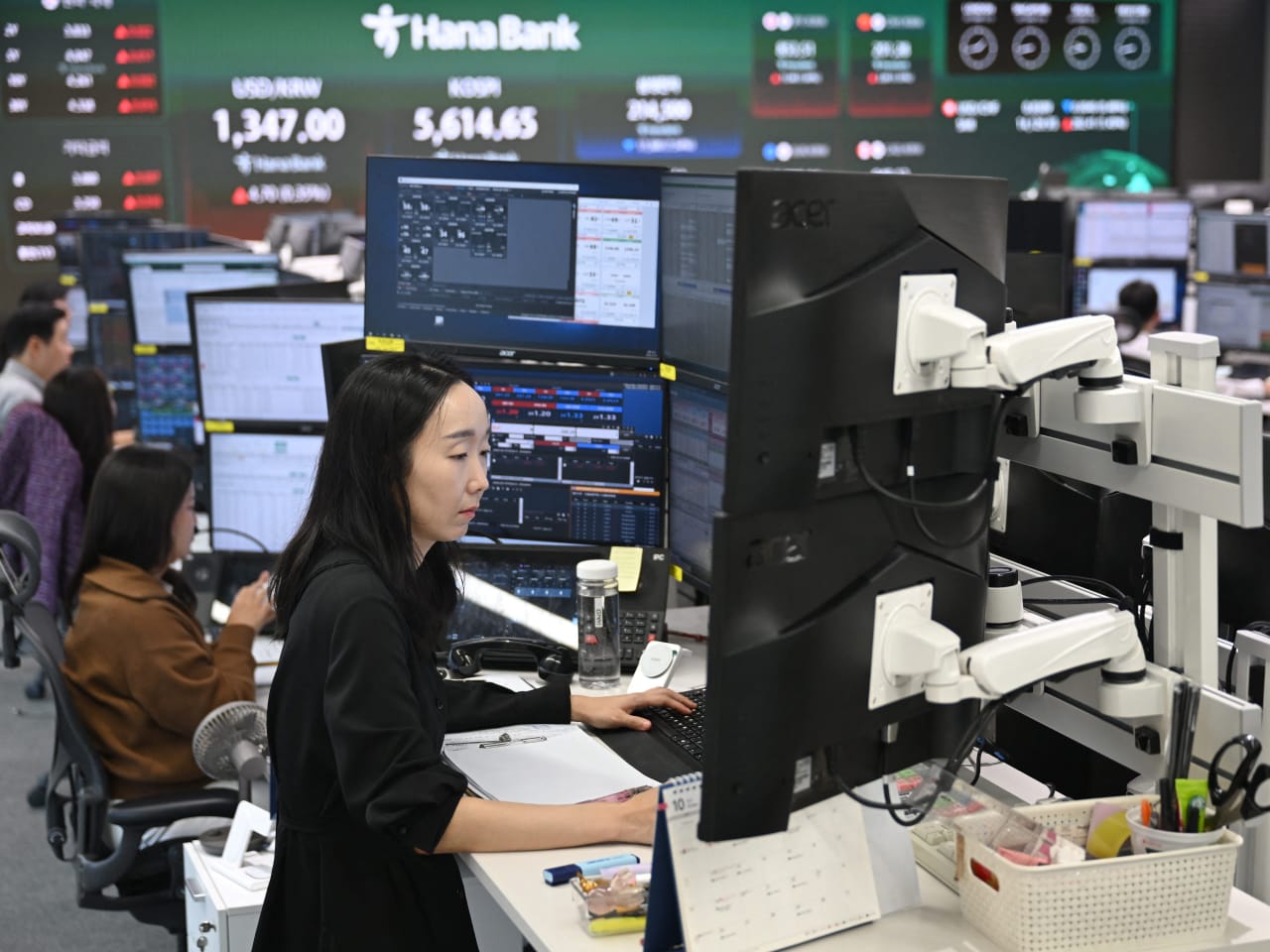

South Korea’s stock market has seen wild swings as the global AI trade drives investor sentiment.
Jung Yeon-je/AFP/Getty Images
Semiconductor stocks are now moving global markets more than oil, Goldman Sachs says.
The AI trade is increasingly driving investor sentiment across stocks, bonds, and currencies.
South Korea shows the extremes: an AI-fueled stock rally followed by a brutal 40% selloff.
Artificial intelligence has become such a powerful force in financial markets that semiconductor stocks are now doing more to explain movements across asset classes than oil prices, according to Goldman Sachs.
“Tech has become an increasingly important driver of risk appetite,” Goldman analysts wrote in a note published on Monday.
The bank found that exposure to semiconductor stocks explained about 54% of the differences in performance across a range of assets over the previous three weeks. Exposure to oil prices explained just 2%.
Goldman’s findings also show how closely investor sentiment has become tied to technology stocks . The relationship has strengthened in recent years, with the bank’s measure of risk appetite moving almost in lockstep lately with the relative performance of major tech stocks.
Its measure of investor willingness to take risks fell last week to its lowest level since April 2025, as selling spread through technology stocks and corporate bonds.
However, investor sentiment had not yet fallen to levels that historically presented buying opportunities, the strategists wrote.
The latest swing came on Monday, when Wall Street rebounded after Anthropic filed for an initial public offering, boosting enthusiasm for AI-related stocks.
The Nasdaq Composite and the S&P 500 both rose about 1%. Nvidia jumped 2%, and the Philadelphia Semiconductor Index climbed 3%.
The rally spread to Asia on Tuesday. South Korea’s Kospi gained as much as 5%, with Samsung Electronics rising as much as 6% and SK Hynix climbing 8%.
South Korea feels the AI whiplash
South Korea has been particularly exposed to the AI trade, with memory-chip stocks accounting for about half the Kospi.
The benchmark index has fallen roughly 40% from its June peak, erasing part of a rally that had more than doubled its value this year.
The selloff has also hit companies outside the chip industry.
“Memory sector concerns have spilled over to the rest of the market in a broad-based derisking,” Goldman analysts wrote in a separate note on Sunday.
Goldman estimates that South Korean stocks outside the memory-chip sector are more than 30% undervalued relative to their profitability.
The bank thinks Korean stocks have been oversold.
It cut its 12-month Kospi target from 12,000 to 9,000 but said that still implied more than 60% upside from levels prevailing at the time of its report.
“The market is pricing an overly negative fundamental outlook,” the strategists wrote.
Goldman remains modestly bullish on equities, saying strong earnings, lighter investor positioning, and lower valuations should support stocks through year-end.
Read the original article on Business Insider