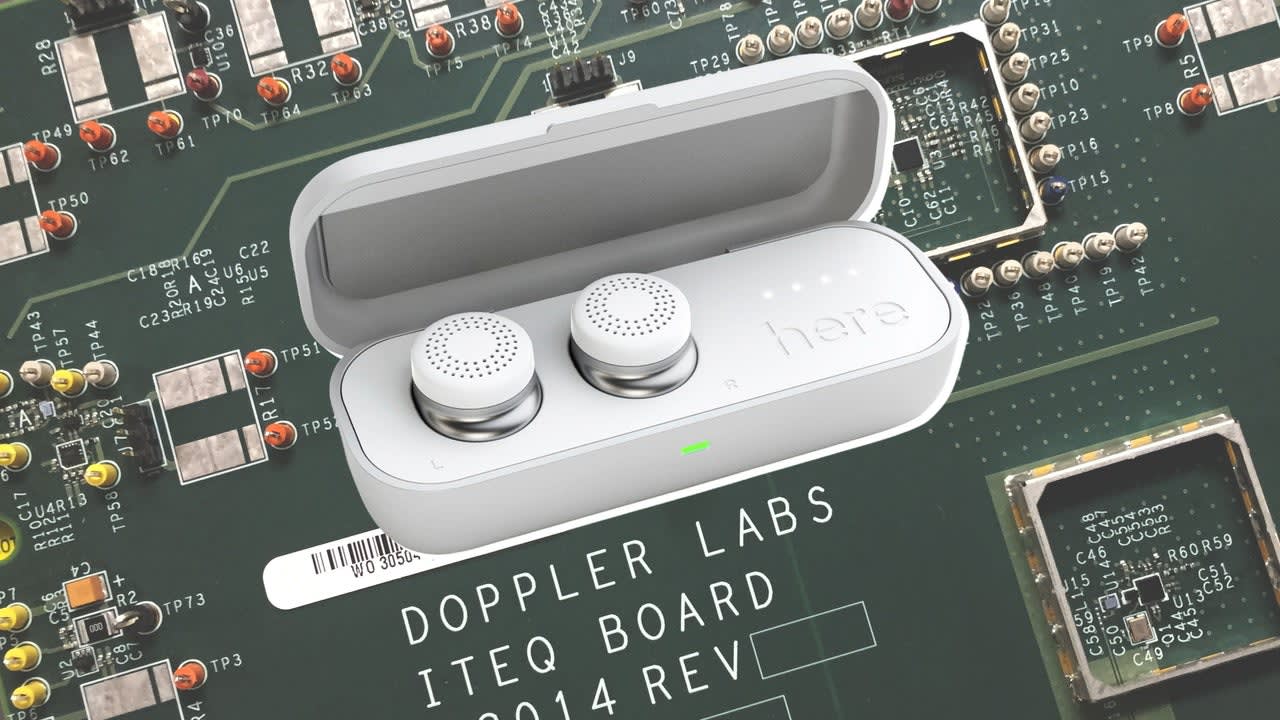

Few elements of Silicon Valley’s culture are more cherished than its embrace of failure . Nobody looks askance at you for starting a company that doesn’t make it. Indeed, it’s widely regarded as a badge of honor, proving your willingness to make bold, risky bets and leaving you a smarter, more battle-tested veteran.
And yet failed startups tend to be forgotten the moment their doom is sealed. Aside from a few flops so epic they become legends—hello, Webvan and Humane —defunct businesses quickly stop ringing a bell. Everyone involved moves on to chasing the next big thing.
That has been true of many intriguing upstarts I’ve profiled over the years. The one that set out to be the Uber of shipping . The one that partnered with Steph Curry to build a tiny, minimally distracting smartphone . The one that aspired to build an AI-powered computer for the ears well before AI became the industry’s obsession.
Unlike AirPods, Here One came in your choice of white or black. [Photo: Doppler Labs]
But wait. Though that last startup, Doppler Labs, ceased to be back in 2017 , its vision didn’t die along with it. Doppler’s flagship product was Here One, a pair of wireless earbuds designed to do far more than stream music and make phone calls. The company developed technology to perform feats such as intelligently mixing streamed audio with live ambient sound. It hoped to help people with hearing loss get a better listening experience than that offered by traditional hearing aids, at a much lower price. It was working on live translation that would let people speaking different languages chat in real time.
When Doppler was founded in 2013, these goals were exceptionally forward-looking. At the time, nobody had even figured out how to incorporate Bluetooth into earbuds that worked reliably and offered acceptable battery life. Those were table stakes that Doppler had to achieve along with its loftier vision.
As you already know, a key moment in the history of wireless earbuds—no, the key moment—happened when Apple released the first AirPods. That happened in December 2016, months before Here One hit stores. Apple didn’t position AirPods as tiny computers. Instead, it was happy to have people think of them as wireless headphones—just remarkably convenient ones with high-quality audio and long battery life.
When the AirPods Pro followed in 2019, however, Apple watchers did describe them as a computer for your ears . As AirPods became one of Apple’s most important product lines—the company shipped 16.8 million units in the second quarter that year alone, according to research firm Omdia—they grew increasingly capable. Eventually, they checked off many of the boxes in Doppler’s original vision, from mixing streaming and ambient sound to real-time translation.
Sketches for Here One. [Image: Doppler Labs]
Today, any product that aspires to compete seriously with AirPods, such as Google’s Pixel Buds and Samsung’s Galaxy Buds , ends up implementing features that Doppler was working on a decade ago. The emergence of talking assistants based on generative AI technology has only intensified the intrigue around the ear as an emerging playground for consumer electronics giants and startups alike.
Doppler’s alumni certainly regard elements of their big ideas as playing out today, even if other companies are making them real and reaping the rewards. “We developed, I think, a pretty exceptional vision that unfortunately still hasn’t really been realized,” says cofounder Fritz Lanman. Still, none of them accuse Apple or anybody else of commandeering their concept. Nor do they make any excuses for their company’s early demise.
“At the end of the day, we took a really good shot,” sighs Doppler’s other cofounder, Noah Kraft. “The final product was just not enough for it to justify its existence.“
Old startups may fade away, but the tale of why Doppler didn’t make it—and how its vision proved powerful enough to fuel an entire industry ever since—is worth putting on the record. Here it is.
“What if we could curate how we hear the world?”
Back in mid-2016, when Doppler was still furiously getting Here One ready to ship, I witnessed its progress in person. Fast Company had assigned me to write a feature on the startup, which occupied two adjacent buildings on an alley in San Francisco’s SOMA district. They were a few minutes’ walk from my desk, making frequent drop-ins easy.
The Doppler story was intriguing for reasons that went beyond the raw ambition of its vision. Pre-Doppler, Kraft’s most notable career credit was in movie production . He was also a musician and music lover. Helping out with a friend’s electronic-music tour, he’d noticed that performances sounded different in each venue—and often not as good as they might have. That led him to ask a question: “What if we could curate how we hear the world?” As he mulled over what the answer might look like, he envisioned the product that became Here One.
Doppler’s team in a celebratory mood. [Photo: Courtesy of Noah Kraft]
At the time, there was a fair amount of excitement over wearable technology, but the best-known example, Google’s Google Glass AR goggles, did not have the greatest of reputations . To Kraft, headphones felt like a better starting point than eyeglasses. “We’ve worn tech on our ears since the Walkman, 50 years ago,” he told me in 2016. “It’s just less intrusive than the eyes.”
The catch was that he wasn’t even a little bit technical. “I wasn’t sure if this was even possible,” he admitted. An acquaintance in the music business knew a tech executive and brokered an introduction. That executive was Lanman, and when he and Kraft met over brunch, what they thought would be a brief chat turned into a multiday conversation, and then a partnership. They founded Doppler Labs in the fall of 2013, with Kraft as CEO and Lanman as chairman. The company went on to raise $50 million in funding from VC firms as well as music-industry luminaries such as David Geffen and Quincy Jones.
The two made for a bit of an entrepreneurial odd couple. Kraft exuded a sense of wonder about the whole adventure of starting a company. Lanman, by contrast, gave off the air of someone who’d already seen it all—because he had. A former Microsoft business development executive who’d led the company’s prescient investment in Facebook , he’d become a prolific angel investor, putting money into more than 70 startups, including Pinterest and Square.
Rather than remain entirely stealthy while they worked to bring Kraft’s idea to fruition, the cofounders bit off specific parts of the project in public. Doppler’s first product, Dubs Acoustic Filters, was just a nice pair of $25 earplugs, aimed at people who didn’t want to look goofy when they wore them. (For more info, check out the Dubs website, which mysteriously lives on .)
Next, Doppler launched a successful Kickstarter campaign for Here Active Listening, a set of earbuds that let you fine-tune real-world audio around you, such as at a concert. Then it promoted that product at Coachella, priming the world for the then-new concept of earbuds that performed tasks other than streaming music and phone calls—which Here Active Listening couldn’t do.
Doppler CEO Kraft brandishes two trophies after the company’s Here Active Listening won Best of Show at SXSW 2016. [Photo: Courtesy of Noah Kraft]
The fact that Here Active Listening didn’t try to replace wired Apple EarPods or whatever else you were plugging into your smartphone simplified Doppler’s story. “By not having wireless streaming capability and audio playback, people couldn’t say, ‘It’s a headphone,’” Lanman explained in 2016. “They really focused in on these bionic hearing capabilities and noise filtering capabilities.”
But the product’s lack of streaming also reflected a basic truth that’s easy to forget a decade later: Making Bluetooth buds work at all was a formidable challenge for anyone, let alone a tiny startup. Both buds would need to stay in sync, with imperceptible latency. They’d have to run for hours on a charge. And the electronics involved would have to be tiny enough to stick in your ears.
Not engineers themselves, Kraft and Lanman were keenly aware of the technical expertise their startup required. The team they assembled had impeccable credentials from companies such as Dolby, Nike, Sony, Qualcomm, and Sennheiser. I happened to be visiting the day they got prototype earbuds reliably streaming for the first time, using near-field magnetic induction technology rather than Bluetooth for bud-to-bud communication. Kraft beamed as he showed it operating on a workbench.
Mastering wireless streaming was only one of the challenges Doppler had given itself. Well before machine learning provided the foundation for generative AI, the company was using the technology to understand the audio it wanted to control. “I did a lot of walking around with microphones in my ears and then labeling audio samples from those recordings, so that we could differentiate between a baby crying versus somebody speaking versus a car honking a siren,” recalls audio quality engineer Caleb Rau. “We were trying to basically separate wanted sounds from unwanted noise.”
Already, Doppler’s thinking was also racing ahead to future versions that pushed the boundaries of what was possible at the time. In April 2015, its executives plotted out a road map at a research lab the company had established in Southern California. “I think the space had previously been the test kitchen for a restaurant chain,” remembers VP of R&D Jeff Baker. “It was Fritz and Noah and myself and a few other people, and we were brainstorming and capturing notes about things you could do with earbuds. Translation was on the list.”
Eventually, they decided that Baker’s lab would focus on translating between languages in real time, a bet that future smartphones would provide sufficient computational muscle to do the job. That led to a partnership with Systran, a major player in multilingual software. When Baker demoed a proof-of-concept version to me, I was intrigued—even though it required me to don a backpack containing a small desktop PC and a big battery, and didn’t translate between English and Spanish all that well.
Here One was born in two adjacent San Francisco offices full of busy people and a vast amount of electronics and testing equipment. [Photo: Courtesy of Noah Kraft]
“We were living in Noah’s reality distortion field”
On June 28, 2016, Doppler gave itself a hard deadline by announcing Here One . The company said it would ship the following November, just in time for the holidays. Within a month, almost 100,000 people had joined a waitlist for the product. “We’re trying to move tens of thousands of units in Q4 and then hopefully hundreds of thousands in 2017,” Kraft told me.
If Doppler was going to sell hundreds of thousands of earbuds, it would have to get very good at mass-producing them. In service of that goal, the company had already dumped its original Asian contract manufacturer in favor of a new one. That was a sign of faith in the judgment of its VP of product, Kennard Nielsen, whose résumé included the development of successful high-volume consumer electronics such as Nike’s FuelBand wearable and Amazon’s Kindle Fire tablets. (“We call him ‘Obi-Wan,’” Kraft told me.)
Months after that switch, Doppler was still struggling with component supply chain issues. In late November, around the time it had planned to ship Here One, the company announced that it was delaying its release until the following February, with retail availability the next month. That pushed any possibility of the earbuds selling in high volume until well into 2017.
Meanwhile, Apple shipped its first AirPods in December, after a two-month delay that showed even it found making wireless earbuds to be unexpectedly challenging. “I remember seeing pictures of them, and I thought they looked kind of funny,” says Doppler firmware engineer Mary-Ann Rau (who met her husband, Caleb Rau, at the company). “We kind of dismissed them. We were living in Noah’s reality distortion field: ‘Here One looks way better. We have way more features. What’s there to worry about?’”
Among the music lovers who received demos of Doppler’s technology was a former Beatle. [Photo: Courtesy of Noah Kraft]
As it turned out, plenty. When Here One reviews hit in February, they were uniformly impressed by the buds’ “layered listening,” which let users pull off feats such as choosing how much ambient sound to let in as they listened to streaming music. But Doppler’s buds got beat up for their rough edges, especially poor battery life and intermittent connectivity glitches. More than one reviewer said the overall experience felt more like a tech demo than a product worth $299.
“I was hoping Here One would be my first real taste of that future we see in sci-fi books and movies, where a computer in your ear can change your perception of the world around you,” wrote The Verge ’s Sean O’Kane. ”Here One shows that future is closer than ever, but it falls short of being the product that gets us there.”
Doppler head of music Michael Thurber (left) gives another musical luminary, Jon Batiste, a listen. [Photo: Courtesy of Noah Kraft]
All along, Doppler had taken pains to communicate that it was building something truly new, not just a pair of wireless headphones. “Apple’s mission is not to make hearing amazing for everyone, and that was our goal,” Lanman says. “We thought of streaming and phone calls as kind of a commodity.”
The lackluster reviews showed that Here One would be cut little or no slack merely for being amazing. “The fundamental issue wasn’t the things that made it special; it was the fundamentals,” Kraft says. “The battery [life] was not enough.”
“The excitement across the board was palpable”
By the time Here One shipped, the fate of Doppler Labs was in flux for reasons that went far beyond the product’s disappointing launch. The company was already months into discussions that might have led to it being acquired, a possibility that would have transformed its finances and product strategy overnight had it happened.
Those discussions were ignited by Apple’s announcement of the AirPods on September 7, 2016. Its entry into the wireless earbud market led many other companies to develop a sudden interest in technologies such as those Doppler had already developed.
Consumer electronics startups often ended up being rolled up into industry giants’ broader aspirations. Even before VR pioneer Oculus had shipped its first headset, it was acquired by Facebook for a mind-melting $2 billion. Dropcam, a maker of security cameras, had been bought by Google’s Nest division for $555 million. With those 2014 transactions still a recent memory, the potential seemed to be there for Doppler to collect a windfall of its own. It gave itself an aspirational goal: at least $1 billion.
Doppler’s electronics didn’t just have to work. They had to fit in your ear. [Photo: Courtesy of Doppler Labs]
Thanks to the company’s billionaire investors and the well-connected Lanman, it didn’t have any trouble attracting the attention of top executives at the tech industry’s biggest names, including Apple, Amazon, Facebook, Google, and Microsoft. Over an intense couple of weeks, Doppler had introductory meetings with all of them. “The excitement across the board was palpable,” Kraft says.
One prospective suitor seemed especially eager to do more than simply get to know Doppler. Amazon had been embarrassed by its Fire Phone flopping in spectacular fashion , but had rebounded with the well-received Alexa voice assistant and Echo speaker . Now it was moving quickly to build an entire audio-centric platform.
Even during the first meeting, Kraft says, Amazon executives were talking expansively about making a major investment in Doppler or buying it outright. Their exuberance led Doppler to explore all its options. It hired Morgan Stanley as an adviser and “probably took 100 acquisition meetings,” Kraft says.
“We were actively showing ourselves to investors in a beautiful space overlooking the Bay Bridge owned by [Doppler investor] UMG Music,” Baker recalls. “I spent three months showing a who’s who of the VC and corporate world our earbuds, because Fritz was very connected.”
When Doppler delayed Here One, Amazon put negotiations on hold for a time. But by early 2017, they picked up again and focused on Doppler providing the foundation of a would-be AirPods killer called Echo Ears. Though no deal had been struck, the two companies held a celebratory dinner at the Four Seasons in San Francisco and began collaborating on the technical details. Then Amazon became unresponsive again.
Already harried by the pressures of startup life, Kraft found the acquisition exploration and its attendant uncertainty even more taxing. “Emotionally, I thought we were going to sell the business,” he says. “Now I’m basically doing two things. I’m running a business and running a process.”
Before Here One’s technology fit in a pair of earbuds, it got prototyped with circuit boards on a hard hat. [Photo: Courtesy of Noah Kraft]
As 2017 continued on and Doppler remained independent, it considered other alternative futures for itself. One was licensing its technology to other manufacturers for use in their own products. “We were, like, ‘Maybe we could become the “ Intel Inside ” of audio,’” Kraft remembers. “I wouldn’t even call it a pivot. Just that we could make some revenue by selling not our hardware, but our brains. That wasn’t the vision for the company. It was just, ‘Maybe this is a way to stay afloat.’”
Not that being the Intel Inside of smart audio would have necessarily been any easier than continuing as a hardware maker. “I kept it quiet, but [licensing] didn’t smell great to me,” Baker says. “Earbuds are incredibly bespoke things.”
The company had already been pursuing another opportunity that, though also fraught, could have been transformative: taking on the handful of deeply entrenched companies that dominated the hearing aid business.
Even when Doppler’s tech demos involved a bunch of loose electronics strung together, Kraft had shown me how it could facilitate clearer audio by removing the background cacophony from a simulated restaurant. All along, the company had a director of accessibility and advocacy, K.R. Liu, who used hearing aids herself and told me that “the technology in hearing aids is pretty crappy. It doesn’t sound very good. It’s not very clear. It’s just not where Doppler’s technology is.”
At the time, hearing aids were pricey and available only by prescription, and Doppler was legally required not to position its product as one: “Here One, to be really clear, is not a medical device,” Kraft emphasized to me. But along with other consumer audio companies such as Bose, it was lobbying for the Over-the-Counter Hearing Aid Act . The proposed law aimed to spur innovation and lower prices—a change that would give Doppler the chance to make good hearing a lot more affordable.
By the time the bill was passed in August 2017, it was too late to bolster Doppler’s fortunes. But both Kraft and Lanman point to the company’s role in galvanizing public support for the law as one of its lasting achievements, even if it didn’t redound to their favor. “We could have destroyed the hearing aid industry,” Lanman says wistfully. “Or if not destroyed, at least democratized it.”
Despite Here One’s weak start and the failure of acquisition talks to turn into a deal, Doppler wasn’t too worried. The company was forging ahead with work on its second-generation earbuds, Here Two, and continuing to staff up with industry veterans. Brian Hall, who’d been a Microsoft corporate vice president overseeing products such as Surface and HoloLens, came aboard as COO. Jim Pitkow, a web pioneer and veteran of Xerox’s fabled PARC laboratory, became chief science officer. “It was incredibly validating when he agreed to join us full time,” Kraft says (Sadly, Pitkow, who was inspired by the Sandy Hook school shooting to spearhead the development of gun safety technologies and later became CTO of a nonprofit devoted to protecting children from sexual exploitation, died in July of this year.)
In the summer of 2017, Doppler had $10 million in the bank. It would need another round of venture funding to ship Here Two. To help assure prospective investors that its top management had sufficient hardware experience, the company promoted Hall to CEO, with Kraft becoming executive chairman.
When Doppler went seeking money, however, it found that VCs were spooked. “Honestly, one of the hardest things for us to explain away during the Series C talks in 2017 was, ‘Wait, haven’t you been in deep talks with Amazon for over a year? Why aren’t they doing something? What are we missing?’” Kraft recalls.
Why wasn’t Amazon doing something? Doppler’s leaders concluded that the acquisition talks and excitement over Echo Ears had been pointless. Talks with other potential acquirers had been less of a time sink, but no more fruitful.
By October 2017, Doppler was running short on money. It was compelled to listen when Amazon, at long last, made a formal bid. The tech giant offered $10 million, a price that conveyed its confidence that the startup was out of other options.
Already irate over the odyssey that had led to this point, Kraft didn’t blink. “They’re like, ‘But you’ll be able to say you sold your business to Amazon,’” he recounts. “And I was, like, ‘Oh, you misread this. I have no interest in the optics of selling a business to Amazon. Not to mention, I hate you guys now.’” The encounter did leave him proud—not because he sold a company to Amazon, but because he refused to do so.
As November began, Doppler announced that it was shutting down. It ended up selling a portfolio of patents to Dolby. And with that, its story officially ended. (A hearing aid startup that has operated under the Doppler Labs name more recently was founded by a former Doppler employee but is unrelated to the original company.)
Sans Doppler technology, Amazon did introduce its own wireless earbuds, which it called Echo Buds. They were latecomers to the market, arriving in October 2019, almost three years after the original AirPods. After several iterations, they wound up emphasizing a budget price over technological innovation . And then Amazon quietly discontinued them.
“We laid the groundwork and set the direction”
Doppler was hardly the only notable startup that didn’t make it through 2017. (Others included Jawbone , Yik Yak , Sprig , and the infamous Juicero .) Its end was more fittingly marked than most, with Wired’ s David Pierce writing a fine eulogy . He chronicled the company’s achievements and disappointments, including its ill-fated negotiations with an unnamed “big five” tech company. (Kraft was not yet ready to call out Amazon by name.)
Both of the company’s founders bounced back from the Doppler disappointment. Lanman became CEO of one of the companies he’d invested in, ClassPass , which offers a subscription service for fitness classes. It was acquired by another startup, Mindbody, in 2021. That led to the creation of a new company, Playlist, which merged with another earlier this year to form a powerhouse “fitness and wellness operating system.” Lanman is the CEO.
Kraft pondered his post-Doppler career for some time until the entrepreneurship itch got the better of him. In 2021, he teamed with his brother Lucas to form an over-the-counter digestive health startup, Wonderbelly. Last January, they sold it to Procter & Gamble for an undisclosed amount.
Though Lanman and Kraft’s direct influence on the world of smart audio ended when Doppler disbanded, the sudden availability of the team they’d assembled was a boon to the rest of the industry. Mary-Ann Rau remembers being shocked by the company’s closure: “I was an engineer, so I was not paying too close attention to the financials or sales.” But the following month, she joined Apple to work on AirPods firmware. She went on to introduce new AirPods features during two product launch keynotes, a living embodiment of the Doppler-Apple link. (Later, her husband and fellow Doppler alum, Caleb, also joined the AirPods team, and remains on it.)
When Doppler employees Mary-Ann Ionascu and Caleb Rau got engaged, they wore their Here One earbuds in the official photos. (Their former boss, Doppler cofounder Noah Kraft, officiated at their wedding.) [Photo: Courtesy of Mary-Ann Rau and Caleb Rau]
According to LinkedIn, seven former Doppler employees are at Apple today. Others scattered to Google, Amazon, Dolby, and Bose, ensuring that the company’s diaspora would continue to have an impact on the product category it had helped kick-start.
In an August 2018 Fast Company story , Peter Burrows wrote about Silicon Valley’s embrace of “hearable” computing and took note of the former Doppler staffers who’d landed elsewhere. Fourteen months later, Apple introduced AirPods Pro . Unlike their non-Pro predecessors, the pricier new buds blocked out background distractions with active noise cancellation and introduced a mode called Transparency that mixed streamed and local environmental sound so both could be heard—two features reminiscent of the “layered listening” that Here One had offered.
The AirPods Pro’s Doppler-esque evolution continued with a 2024 software update that let the AirPods Pro 2 be used as hearing aids. The following year, the AirPods 2 and 3 and the AirPods 4 got real-time translation, the same feature Doppler had shown me back when its test bed required a PC in a backpack. Now Apple is reportedly gearing up to introduce AirPods Pro with built-in cameras that let them see real-world objects and identify them with AI—a concept that would have sounded like fantasy in Doppler’s day, yet is very much in tune with its vision of a computer for your ears.
In tech, victory belongs to the companies that turn ideas into successful businesses, not those that have them first. In this case, that’s Apple. The Doppler alumni I spoke with enumerated some of the Apple advantages that the startup could never have matched, such as the fact it designs its own chips and controls both the AirPods and iPhone, lessening its dependence on Bluetooth for connectivity.
Then there’s Apple’s ability to invest in a product for years on its own terms, not those of venture capitalists seeking a quick return on investment. At one point in my conversations with Kraft, he theorizes that fulfilling Doppler’s promise would have required another $50 million; at another point, $200 million. Either way, “The sheer capital required to invent a new form of computing is beyond the capacity of the VC ecosystem, at least as it existed 10 years ago,” Lanman says. I can’t think of any examples, then or now, that disprove his point.
Still, the vibe I got from the Doppler veterans who talked with me about AirPods wasn’t resentful or jealous. Instead, it sounded like pride—albeit of a bittersweet variety.
“We laid the groundwork and set the direction,” says former product chief Nielsen. “Having a company with the technical prowess and the resources like Apple come in and pick it up and carry it to the finish line was super gratifying.”
We’ll never know what wireless earbuds would look like in 2026—and beyond—if Doppler had never existed. But Mary-Ann Rau sees parallels in the story of General Magic . That legendary 1990s startup tried to build a wireless personal communicator years before the technology was ready, and ceased operations in 2002. The conversation it kicked off about the future of mobile computing was still in progress when Apple came up with the iPhone. Did I mention that General Magic also created a voice-powered assistant that eerily foreshadowed current AI agents such as Meta’s Muse and OpenAI’s Dots ?
“The same pattern happens over and over in Silicon Valley,” Rau says. “There’s the startup with the big dream and the small team, and they don’t quite make it, in the sense that they don’t make the product that ends up being ubiquitous.” (Undaunted, she left Apple in 2023 and later became cofounder and CEO of her own company with a big dream and a small team, heat pump startup Merino Energy .)
Ubiquitous is what AirPods swiftly became. Apple doesn’t disclose unit sales or revenue, but a 2024 Bloomberg Intelligence report estimated that the company had sold between 94 million and 119 million units a year since 2020, good for $18 billion to $22 billion in annual revenue. As others noted when those figures came out, they made AirPods a bigger business than Nintendo or Spotify.
Doppler would not have had to beat Nintendo and Spotify to have had a far happier ending. “When we started, we wanted a billion-plus,” Kraft says. “But towards the end of it, if someone had swooped in and said, ‘Here’s 300 mil,’ we would have taken it in a heartbeat. Because we’d only raised $50 million.”
Had an acquirer then gone on to capture just 5% of AirPods’ market share, Kraft adds, it would have created that rarest of phenomena in Silicon Valley: a major new hardware business. He stresses that he wouldn’t change a thing about the Doppler experience. But all these years later, he hasn’t stopped turning it over in his mind. The epiphany he had when he was assisting with his friend’s music tour still sounds like a great idea for a company to him.