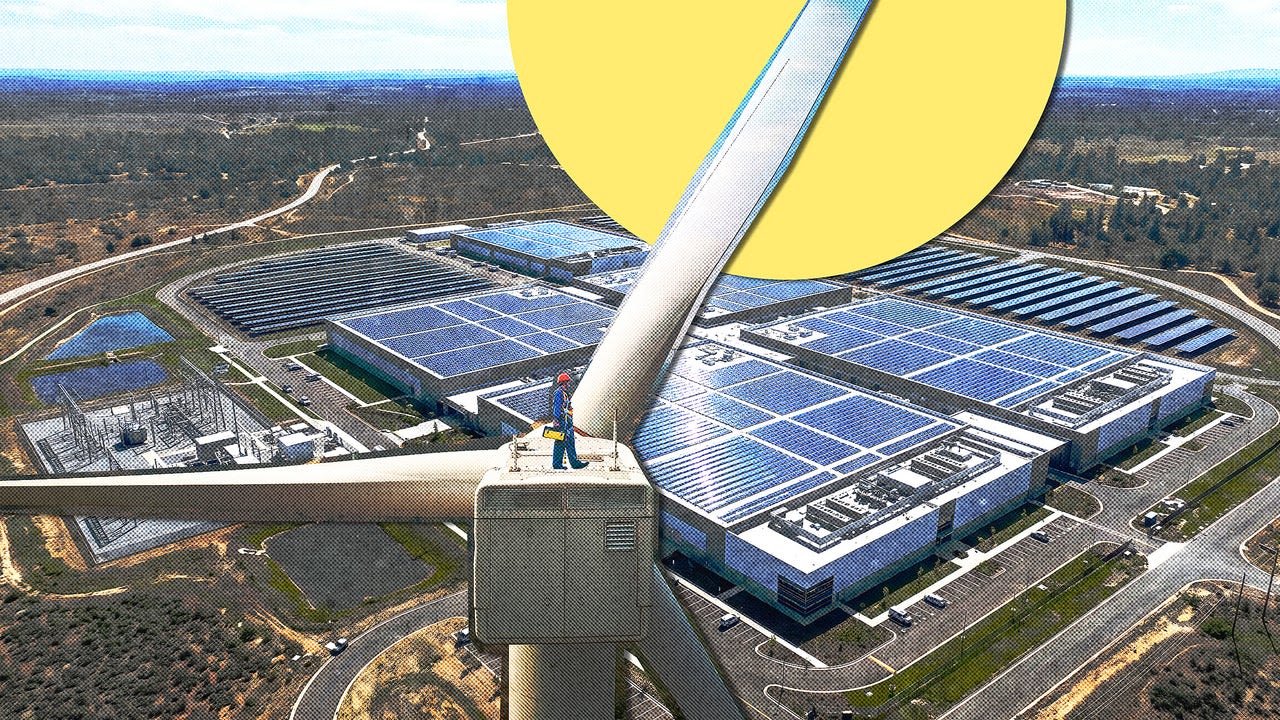

The U.S. is on track to add a record 86 gigawatts of new wind, solar, and battery storage capacity this year—roughly the size of the U.K.’s entire grid. And there’s far more clean energy in the pipeline, with low-cost proposed projects that could help meet the surging demand from data centers. So why are data centers increasingly turning to polluting gas plants instead of clean energy?
A startup called Firma Power says that the issue isn’t cost, speed, or reliability, but the difficulty of assembling enough clean energy from a patchwork of projects—a problem that it is trying to solve.
Securing enough reliable, clean electricity for a massive new data center is complex. But Firma’s software calculates what a proposed data center needs, and then automatically searches through proposed clean energy projects to suggest a portfolio that could support it. An analysis that might otherwise take a team months can now take minutes. Firma then does the hard work of pulling all of the clean energy projects together, and data center developers can sign a single contract.
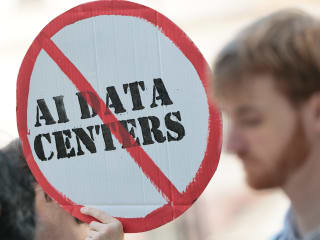
The company says that the process can get data centers power faster than building new gas-fired power plants—and it can compete on cost. And at a time when Americans really don’t like data centers , using clean power could make it more feasible for some projects to be greenlit by communities.
Why data centers aren’t tapping into clean energy
“We started the company with the hypothesis that despite the fact that 98% of what’s in the queue is wind, solar and storage, that’s not getting tapped as the default path to power for large loads—so there’s got to be some market frictions and barriers there,” says Jesse Jenkins, an energy systems engineer and associate professor at Princeton University who cofounded Firma Power and serves as CTO. “What are they, and can we build the platform that overcomes those?”
Firma cofounder and president Scott Burger, who previously worked at the pioneering battery company Form Energy , reached out to Jenkins, a former MIT classmate, to talk about the challenge as the data center boom grew in 2024. Burger’s modeling showed that clean energy should be economic and scalable for data centers; Jenkins said that he saw the same thing.
At the same time, they knew that tech companies with clean energy goals were struggling to stay on track. Burger and Jenkins partnered with a third cofounder and CEO, wind and solar developer Brent Alderfer, to launch a startup to tackle the problem. Drawing on more than a decade of their own research modeling the power system, they built custom software called FirmaOS. The startup, based in San Francisco and Princeton, New Jersey, raised around $1.4 million in a seed round in February 2026.
They realized that data center developers and tech companies were struggling with the complexity of the current system. Tech giants have been buying renewable energy for data centers for years, but the situation is different now. In the past, tech companies typically signed contracts for renewable energy credits. The power from a wind or solar farm helped offset the emissions from energy used at a data center, but usually wasn’t expected to be available 24/7 to keep the data center running. (In some cases, companies paid for clean energy projects on a completely different grid.) Securing reliable clean energy to actually power a data center around the clock is a very different challenge. While some companies are working on the latter approach—notably Google —it requires a large team and a lot of effort, and can’t easily be replicated across the industry. Firma wanted to change that.
The scale is also different now. The power demand for a “large” data center in the past might have been 50 megawatts. Now a single AI data center might require 500 megawatts, or even a gigawatt—roughly as much as the entire city of San Francisco. Getting enough clean power requires working with multiple projects and developers, not something like a single solar farm.
How Firma turns a patchwork of projects into a power supply
When customers come to Firma, they typically come with a site for a data center in mind, and share the size. For example, a project might need 300 megawatts in 2028, scaling up to 1 gigawatt by 2030. Firma looks at the local utility’s requirements for bringing a large customer online, and runs its software to calculate the generating capacity needed to serve the data center and which clean energy projects could supply it, while optimizing for cost. Then the team reaches out to each renewable developer to confirm if the project is on schedule and can be built, and starts signing contracts. (In some cases, Firma may buy and complete some of the projects itself.) Over the length of the contract, it manages the portfolio, adding more capacity if needed.
“Because of our unique model, we can deliver executable load-enabling strategies in days,” says Burger. “The data centers come online between 2028 and 2029. The usual alternatives, waiting for a utility’s planning and procurement cycle or buying project by project, can take years—indeed, we often hear from customers that say ‘our utility told us to wait until 2032 for a new gas power plant.’”
The startup is now working on around a dozen projects with customers including hyperscalers, AI cloud companies, and data center developers. While the company declined to publicly share the details of specific projects, it’s already assembling portfolios of solar, wind, and batteries on grids where customers would have had to wait much longer to access gas power. In cases where data centers were considering behind-the-meter gas plants—in other words, managing their own power plants—Firma’s approach also has the advantage that it lets customers rely on the infrastructure of the larger electric grid.
Bringing new clean energy to the grid
The approach helps bring new clean energy to the grid that likely wouldn’t have been built otherwise. More clean energy is in planning now than the grid actually needs, Burger says. (In three grids alone, PJM , SPP , and MISO , Firma calculated that around 200 gigawatts of clean energy could theoretically be added to the grid by 2030 and meet requirements for reliability, far more energy than the entire country needs.) Most of the projects in the queue don’t get built.
“Projects drop out for many reasons, such as grid upgrade costs, permits and local opposition,” Burger says. “One of the most common is the simplest: no buyer. Without a long-term contract, a developer can’t finance the project. In some cases, that’s because a developer couldn’t find a customer to sign a contract for the power.”
Firma can help rescue some of those projects. Utilities buy power for their existing customers; “bring-your-own-power” customers like data centers can support different projects, adding new clean energy to the grid.
Since the process is faster and cheaper than developing new gas power plants right now, it’s likely that more developers will move in this direction. “We don’t actually even need to market it as clean,” says Jenkins. “It is clean, and it’s important to many of these customers that it is. It’s increasingly important to the communities that live next to these data centers. But it’s also just economically competitive and basically the only way besides gas power plants to get to tens of gigawatts of deployable scale before 2030.” In the longer term, he says, solutions such as advanced geothermal can also help, but they haven’t scaled up yet.
“This should be the easy button solution,” Burger says. “We should see more folks looking to wind/solar/battery.”