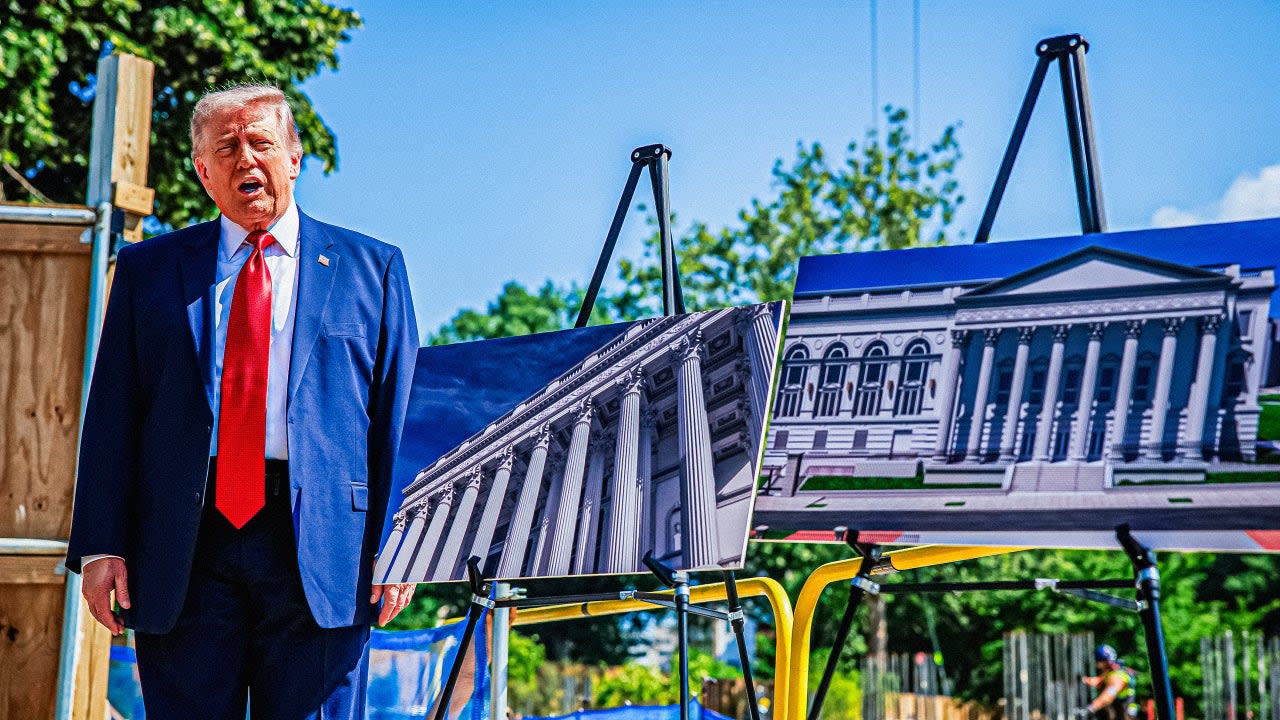

Since President Trump returned to office, some of the nation’s best-known historic sites, from the White House’s ill-fated East Wing to the imperiled Kennedy Center, have come under attack, prompting preservationists to sue. The National Trust for Historic Preservation, a Washington, D.C.-based nonprofit, has been a central player in these prominent cases.
Preservationists are gearing up for a prolonged legal fight to safeguard not only the landmarks themselves but the foundational protections of the National Historic Preservation Act (NHPA), passed in 1966. The law was a response to the wave of urban renewal in the 1950s and ’60s, including the controversial razing of New York City’s Penn Station, that wiped out historic buildings across the country. The National Trust’s president and CEO, Brent Leggs, calls today’s threats, which recall those of the past, “generational and existential.”
They come alongside proposed changes to NHPA’s Section 106, which requires federal agencies to consider how the projects they undertake or fund could affect historic places and, critically, to give the public a chance to weigh in before a final decision is made.
In late September, at the 2026 National Preservation Summit, Leggs announced the Historic Preservation Defense Fund, a campaign to raise $10 million over the next three years to support the National Trust’s legal defense, public advocacy, and community action “where and when historic places are threatened,” he tells Fast Company.
These objectives fall in line with the National Trust’s mission. Congress chartered the organization in 1949 to give the public a say in decisions about the nation’s most important historic places.
In the weeks since the announcement, the trust has made headway with an anonymous $1 million donation structured as a one-to-one matching gift, which Leggs is optimistic will attract gifts of $25,000 to $100,000. The scope of the campaign, he says, is “broad,” and the money will fund efforts nationwide, prioritized by urgency.
“It will allow the National Trust to work alongside new and existing partners to mitigate threats impacting national historic landmarks in our nation’s capital,” he says. “But also to respond to threats that are impacting local communities across the country.”
The Embattled Landmarks
The fund arrives as several high-profile lawsuits are underway in Washington. In December, two months after the Trump administration razed the East Wing to make way for a 90,000-square-foot ballroom, the National Trust sued President Trump and several federal agencies to halt construction. As the sole plaintiff, the Trust argued that the project lacked congressional authorization and circumvented required federal reviews. A federal judge agreed in March, barring above-ground work without Congress’s approval while allowing underground construction to continue.
Shortly after an appeals court upheld that order in August, the Supreme Court, in a 5-4 vote, let work on the colossal, gilded addition proceed, saying the trust likely lacked standing to sue. While the majority did not rule on whether the ballroom is legal, Chief Justice John Roberts in his dissent wrote that the project was “likely unlawful.” The case, which Leggs refers to as an “active lawsuit,” remains pending in the lower courts.
After Trump’s takeover of the Kennedy Center and his talk of taking the Edward Durell Stone-designed building “down to the steel,” the National Trust joined seven coplaintiffs, including the American Institute of Architects, the DC Preservation League and Docomomo US, in a lawsuit this past spring to prevent Trump and the Kennedy Center board from making major alterations to the structure without congressional approval or compliance with historic preservation laws.
The fund is also meant to bolster coalitions like the one behind the Kennedy Center suit. “Part of the inspiration behind the fund is for the National Trust to be resourced to advance a united preservation movement,” Leggs says.
Rewriting the Rules
A united front is more important than ever, as Trump pushes the limits of his power with projects like the triumphal arch, which is testing the rules and drawing backlash from lawmakers, preservationists, and aviation safety advocates. First proposed in October 2025, the 250-foot concrete arch is set to rise at Memorial Circle, on national park land at the end of the Arlington Memorial Bridge. Topped by a gilded winged figure, it would stand more than twice as tall as the 99-foot Lincoln Memorial.
The National Park Service found it would adversely affect more than three dozen historic sites, from Arlington National Cemetery Historic District to the National Cathedral, yet the administration is moving full speed ahead. Recently, Arlington County Board officials sued the Interior Department and the National Park Service to block plans for what they described in the complaint as “Trump’s latest vanity project,” arguing that the agency downplayed the arch’s potential harms and ignored the National Environmental Policy Act.
The Advisory Council on Historic Preservation, a federal agency responsible for advising on matters of historic preservation policy, has largely backed the arch. Today, 20 out of 24 of the council’s seats are filled by the president’s appointees.
The council abruptly ended the arch’s Section 106 consultation midway through. Travis Voyles, the council’s vice chairman, sent a letter dated September 24 to Tammy Stidham, the Park Service’s associate regional director. In it, he wrote that the Park Service had said any steps to reduce harm would undercut the administration’s vision for the arch: “Further, the NPS stated that implementation of alternatives to avoid or minimize the adverse effects would alter the fundamental nature of the proposed undertaking and fail to achieve its goals. . . . We are hereby terminating consultation pursuant to 36 CFR § 800.7(a)(4).
In response, the National Trust’s deputy general counsel, Elizabeth Merritt, argued in a letter to Voyles that he “cannot unilaterally terminate consultation,” adding that “the voices of the American people should not be prematurely silenced.”
These actions, preservation groups say, portend a greater shift in how the government treats its historic sites. In July, the council voted to advance sweeping changes to Section 106 of the National Historic Preservation Act that critics say would greatly weaken it. The rewrite would make public comment optional, scale back the requirement to consult Native American tribes, and exclude significant cultural landscape features, like the Grand Canyon, from the criteria for historic properties. The changes still need to go through White House review, in addition to a 30-day public comment period, before they can be finalized.
Preservationists are concerned that the preservation advisory council is already operating as if the changes have been greenlit, pointing to its decision to terminate the arch’s consultation as evidence that it is sidelining community input and bypassing the democratic process.
Without the protections of Section 106, Leggs says, “this would mean that that a place could be adversely harmed or demolished, or substantially altered, because the federal government advanced a priority that was different from the wishes of the local community.”
A Senate bill introduced in late September, the Bipartisan American Affordability and Jobs Act, would similarly weaken Section 106. According to 106 Strong, a coalition of 1,000 organizations and Tribal Nations, the bill would shut the public out of reviews, narrow what counts as harm to exclude effects like blighted views from a sacred landscape, and let officials proceed with a project they acknowledge will damage a historic place, with no effort to limit the harm.
This moment will likely mark a turning point for Americans as iconic and beloved local sites become vulnerable, Leggs says. “Every historic place is attached to a local community, and so as we speak about the harmful impacts to the cultural landscape in D.C., Washingtonians here are highly upset because D.C. isn’t just our nation’s capital, it’s their home, and it’s part of a local community.”
Sites across the country are being targeted, including two on the National Trust’s 2026 list of America’s 11 Most Endangered Historic Places. In Philadelphia, the Trump administration has moved to erase key historical narratives at the President’s House Site by removing public displays about the nine men and women George Washington enslaved there. Out west, the Greater Chaco Cultural Landscape, an ancestral Pueblo homeland spanning thousands of miles in the Four Corners region, is also at risk. In 2023, the Biden administration banned new oil and gas leasing on federal land within 10 miles of Chaco Culture National Historical Park. But last year, the Bureau of Land Management moved to revoke or modify the ban, a step that would open the surrounding land to drilling.
The fund’s timing positions the National Trust for the fights ahead. “I’m hopeful that out of crisis is an opportunity to shift public mindsets and to help our nation begin to understand what it means to steward and care for historic places in perpetuity,” Leggs says. “And this requires a deeper sense of commitment at all scales, and that is a deeper commitment from Congress, from the executive branch, from the judicial branch, and from the American public.”