
If you’ve been watching the NFL this season, you’ve probably noticed that a few dozen players have pretty big heads. Not in the diva sense, but literally.
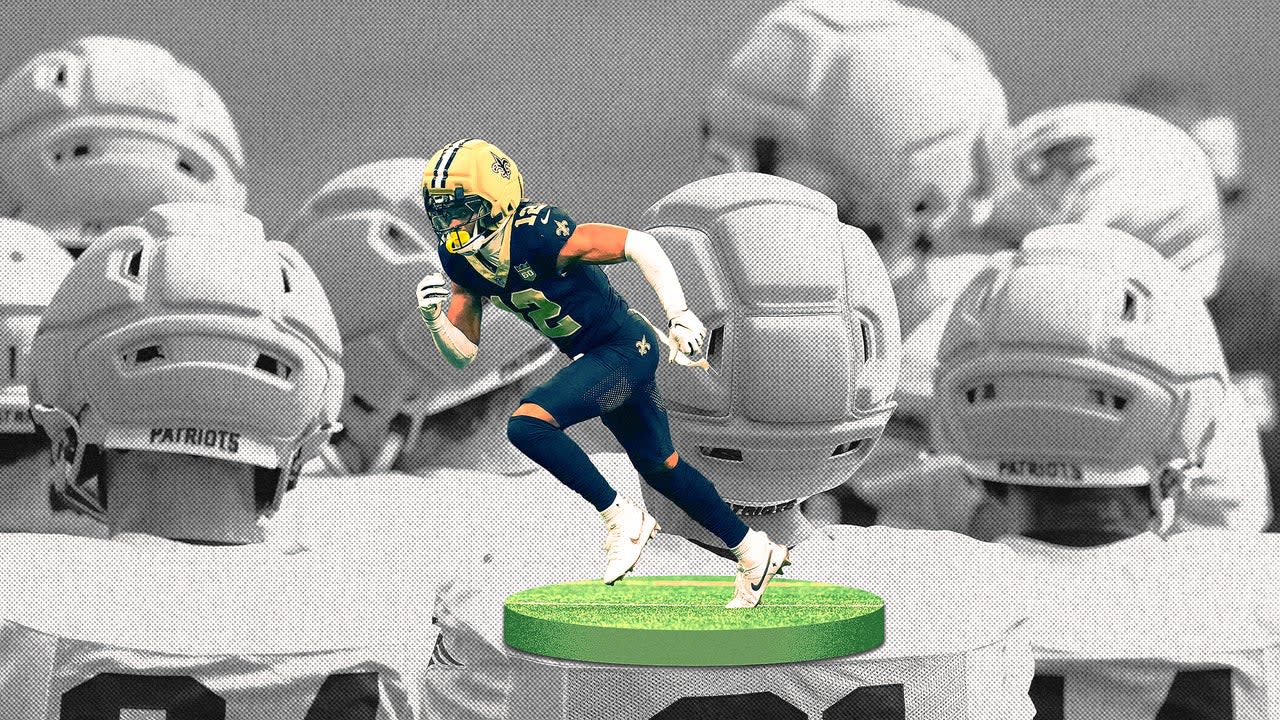
Take Chris Olave, the New Orleans Saints wide receiver. He wears a Guardian Cap, a padded cover on his helmet for added protection against head trauma. The trade-off is that it makes him look like he just nabbed a mushroom power-up in Super Mario. Olave, who suffered four concussions in his first three NFL seasons, has made peace with that. “Shoot, I got kids now,” he said after the Saints’ season opener. “I want to live a regular life after I’m done with football. I love my kids to death. So, I don’t really care how it looks no more.”
A detail of a guardian cap a protective cover for the helmet for Chris Olave #12 of the New Orleans Saints during the second half of a game against the Minnesota Vikings at Caesars Superdome on October 11, 2026, in New Orleans, Louisiana. [Photo: Derick Hingle/Icon Sportswire/Getty Images]
The NFL has spent the past decade trying to bring its concussion numbers down, with mixed results. In-game concussions fell 15% to 129 in the 2024 regular season, then jumped 30% to 168 last year. Much of that increase came on kickoffs, where a new format designed to bring back more returns sent concussions on the play from 8 in 2024 to 35 in 2025 .
Since 2022, when the league made it mandatory in practice, the Guardian Cap has been the NFL’s most noticeable safety measure. It has been optional in games since 2024 , and after a design refresh this offseason, it’s showing up on game days more than ever .
The tight ends and offensive players wear guardian caps over their helmets during a New England Patriots practice at Gillette Stadium on August 25, 2026. [Photo: Danielle Parhizkaran/The Boston Globe/Getty Images]
Foam, fabric, and a lot of jokes
The cap is made by Guardian Sports, a Georgia company run by Lee and Erin Hanson, a husband and wife whose materials business developed custom polyurethane for products like rocket boosters and golf ball covers . It’s a lightweight foam shell that straps over any standard helmet. It’s designed to compress and slide on impact, absorbing force before the blow reaches the helmet’s hard shell underneath.
The Guardian Cap comes in two main versions. NFL players and select college players wear the NXT, which weighs about 12 ounces. Youth, high school, and most college players wear the XT, a lighter version that weighs about half a pound and sells for up to $89.99 . More than 500,000 athletes across all levels wear one. The company also makes versions for hockey and lacrosse helmets.
The NFL allowed the cap in practice in 2020, then required it in practice for linemen, tight ends, and linebackers in 2022. By 2024, everyone but quarterbacks, kickers, and punters was required to wear a Guardian Cap in contact practices, and players could choose to wear it in games.
Players hated the look from the start. J.J. Watt, an All-Pro pass rusher, said it made him feel like a bobblehead. Jason Kelce mocked it by showing up to Philadelphia Eagles camp with bubble wrap around his cap. Jordyn Brooks, a Miami Dolphins linebacker, called them “UFO caps.” The 2024 game-day look wasn’t any better—a fabric sleeve printed with the team logo, stretched over the foam’s ridges like a shower cap on a carton of eggs.
This season, the cap finally got a makeover.
Running back Roschon Johnson #23 of the Chicago Bears wears a Guardian Cap in a preseason game between the Chicago Bears and the Cincinnati Bengals on August 22, 2026, at Paycor Stadium in Cincinnati, OH. [Photo: Jeff Moreland/Icon Sportswire/Getty Images]
A glow-up, not an upgrade
The Guardian Cap NXT 2.0 is what happens when the safety department finally gets a creative director. Approved by the NFL for 2026, it’s the same 12-ounce pad, with the same materials and, per Guardian Sports , the same performance. The difference is on the outside. The original’s lumpy, egg-carton ridges made it hard to print a logo on, so the 2.0 has a smooth surface that replaces the fabric sleeve and takes stick-on team decals directly.
In other words, the change is purely cosmetic.
The NXT (left) and NXT 2.0 (right) [Photos: Guardian Sports]
The cap is also racing against the helmets underneath it. Since the NFL and the players’ union began ranking helmets by lab performance, manufacturers have rolled out flexible shells , layered foams, and position-specific designs, with extra forehead padding for linemen and extra rear padding for quarterbacks.
The science is mostly physics. A concussion happens when the brain “accelerates, decelerates, and rotates” inside the skull, and no helmet can stop that, says Dr. John Leddy, president of the International Concussion Society. Padding can only stretch out the moment of impact, so the head speeds up and twists less violently. That’s what new helmet designs, and the cap, are graded on.
Helmet models also age fast. For the 2025 season, the NFL banned seven helmets that had been rated top-tier as recently as 2022, and 10 models tested well enough to be “Guardian Cap Optional,” meaning players who wear one can skip the cap in practice. By season’s end, more than 98% of players wore top-performing helmets.
The data beneath the padding
According to a 2026 study , at least one in four former NFL players who died between 2016 and 2021 had chronic traumatic encephalopathy, the degenerative brain condition known as CTE that is associated with repeated head impacts. Concussions alone don’t explain it. A 2023 study of 631 former football players’ brains found that the total force of every hit, not the number of concussions, best predicted the disease. “It’s the largest study of CTE pathology ever, and concussions were basically noise,” the lead author, Daniel Daneshvar of Harvard Medical School, told The New York Times . So the question isn’t whether the cap softens a blow. It’s whether softening every blow by a few percent adds up to anything.
In NFL-funded lab tests , the NXT cut impact severity by about 9%. The league says that climbs to about 20% when both players wear one. It also reported a 52% drop in concussions during 2022 training camps among the positions required to wear the cap (linemen, tight ends, and linebackers) compared with prior years. Commissioner Roger Goodell has repeatedly said the cap cut concussions in half.
A peer-reviewed study coauthored by the NFL’s chief medical officer, Dr. Allen Sills, and published in 2025, adds an asterisk. Practice concussions at cap-required positions fell by between 54% and 62%. But when researchers looked only at concussions caused by hits to the helmet shell, the part the cap actually covers, they found no statistically significant link between the cap and fewer concussions.
Independent researchers have found smaller, mixed effects. Virginia Tech’s helmet lab, whose star ratings have guided helmet buyers since 2011, found the NXT reduced linear acceleration 8% and rotational acceleration 14%, which it estimated would lower concussion risk by about a third in the lab. The youth XT cut them by just 3% and 5%. A University of Wisconsin study of 2,610 high school players found no meaningful difference in concussion rates between players who wore the youth cap in practice and those who didn’t.
Guardian Sports, for its part, sells the cap on reducing impact, not preventing concussions. Though its marketing still cites the NFL’s 54% to 62% figure, its disclaimer says no headgear can eliminate concussion risk, and that lab impact tests shouldn’t be used to draw conclusions about concussions at all.
A cap with an expiration date?
Olave, the wide receiver, is now a Guardian Sports brand partner . He isn’t waiting for the science, and wearing the cap hasn’t hurt his performance. Through five games, he’s second in the league in receiving yards and tied for second in receptions. He has more company on game days, too. About 20 players wore a Guardian Cap in games in 2024, roughly two dozen did in 2025, and more than 35 wore one in this year’s preseason alone.
But much of the league is already looking past the Guardian Cap. Last season, 56% of returning players chose cap-optional helmets. Jeff Miller, the NFL’s executive vice president for health and safety, told Yahoo Sports he sees the cap as “transitional.” Steve Rowson, a professor of biomedical engineering at Virginia Tech and director of the helmet lab, told the outlet he wonders whether add-ons will have a market in 5 to 10 years.
In Super Mario, the mushroom power-up helps you survive an extra hit. For now, Olave and a few dozen others are still hoping the Guardian Cap does the same.