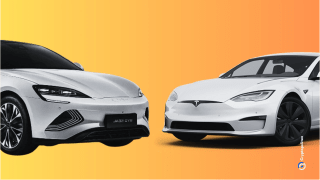

Chinese automakers have overtaken Japanese rivals in Europe for the first time ever over a full quarter, marking a significant milestone in the rapid expansion of brands such as BYD and Chery across the region.
Dataforce figures cited by Bloomberg show that Chinese-branded vehicles made up 12.7% of European registrations in the September quarter, roughly double their share a year earlier.
Japanese manufacturers, including Toyota and Nissan, held an 11.9% share.
Chinese automakers’ expansion accelerated further in September, when these brands captured 14.5% of monthly sales, according to the reprted figures.
Chinese automakers’ rapid expansion in Europe
Chinese brands accounted for only about 1% of European car sales five years ago.
Their rise has been driven by expanding model ranges and growing demand for vehicles that offer competitive pricing and technology.
BYD and Chery have emerged as prominent players in the region, with Chinese manufacturers expanding their presence across multiple European markets.
In the UK, Chery’s Jaecoo 7 SUV was the country’s best-selling model in March and September, according to Bloomberg’s report.
Chinese automakers had already moved ahead of South Korean brands in Europe before surpassing their Japanese counterparts.
The latest shift is notable given how long Japanese manufacturers have operated in the region. Toyota began selling vehicles in Europe in 1963, while Nissan has manufactured cars in the UK since 1986.
Why Chinese carmakers are gaining ground
European manufacturers are also facing pressure in China as competition intensifies.
The growing popularity of local brands among Chinese consumers has already put established European carmakers under pressure.
With Chinese cars rapidly gaining ground in Europe, the pressure is consistently rising on brands like Volkswagen and Renault.
Chinese companies have expanded their electric and hybrid vehicle offerings, using competitive prices and faster model launches to attract buyers.
Rising fuel costs could also help increase interest in more efficient vehicles, although demand will vary across markets and powertrain types.
EU steps up efforts to protect local automakers
The Chinese brands’ growing presence has prompted the European Union to use trade measures aimed at addressing concerns about subsidised imports.
The bloc imposes additional countervailing duties on Chinese-made battery electric vehicles, with rates varying by manufacturer and reaching 35.3% for some producers.
The EU has also reached an agreement with China to limit hybrid vehicle imports from China to 350,000 a year, with a 6% annual increase, likely starting in early December.
The four-year safeguard is intended to reduce the volume of Chinese-built vehicles entering the bloc.
Chinese manufacturers are meanwhile looking to expand local production.
Chery said it expects more than half of its exported vehicles to be manufactured overseas by the end of 2026, a strategy that could help it build closer ties with local markets and production networks.
The post Chinese cars overtake Japanese rivals in Europe as threat to local carmakers grows appeared first on Invezz