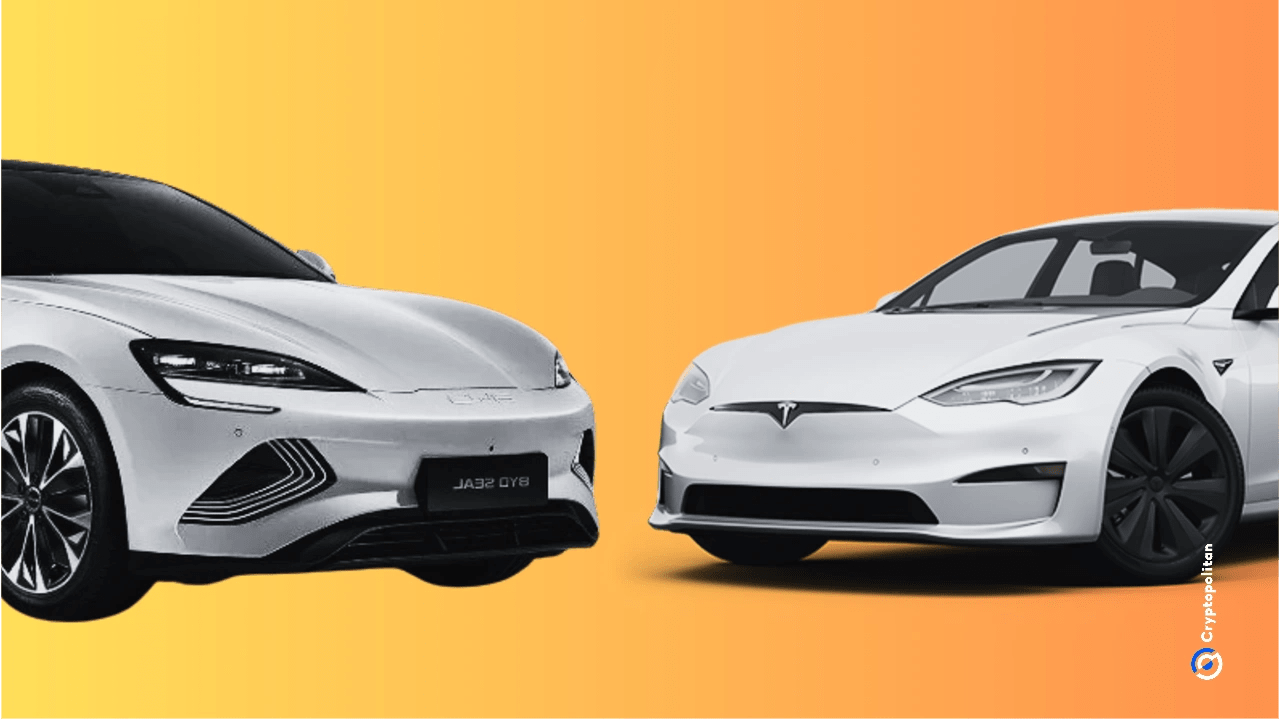

China’s carmakers have officially outsold their Japanese rivals in Europe over an entire quarter for the first time, and the numbers show just how quickly the market is changing.
BYD and Chery, among others, are winning customers in a place where companies such as Toyota and Nissan have been operating for many years to date.
Dataforce reported that Chinese brand sales have almost doubled in September from last year, accounting for 12.7% of all car sales in Europe, against 11.9% for Japanese brands. The sales increase was largely due to hybrid vehicles; however, Volkswagen, Renault, and other European brands dominate the market.
China’s automakers are winning European customers faster than expected
Five years ago, Chinese brands barely accounted for 1% of European vehicle sales. Today, they’re challenging manufacturers that have been around for generations.
Toyota started selling cars in Europe in 1963 and now operates factories across the continent. Nissan has manufactured vehicles at its Sunderland plant in Britain since 1986.
The UK has become a particularly important market for Chinese companies. Chery’s Jaecoo 7 SUV was Britain’s best-selling model in both March and September.
The figures measure new vehicle registrations rather than factory production, making them an indication of what European customers are actually buying.
Meanwhile, things aren’t going particularly well for foreign automakers back in China.
Drivers in China are shunning Volkswagen and BMW cars to favor their local counterparts. The reason is that local carmakers are designing and selling new cars at a faster rate and more cheaply than their competitors.
The falling demand among the locals has forced manufacturers to look for foreign markets.
In the recent car show held in Paris, Chinese car brands such as Chery, BYD and Geely Zeekr unveiled various cars designed specifically for Europeans.
BYD Dolphin G DM-i was one of those cars that the Chinese carmaker revealed at the Paris auto show.
It was designed specifically for European drivers as it was an inexpensive plug-in hybrid car made by BYD .
Europe moves to restrict Chinese imports as BYD faces higher costs
The European Union is trying to slow the expansion, partly because Chinese manufacturers benefit from government subsidies.
Brussels has already introduced additional tariffs on battery-electric vehicles manufactured in China.
This month, European officials also reached a preliminary agreement to restrict Chinese hybrid imports to 350,000 vehicles annually.
But shipments of hybrids have actually accelerated as manufacturers prepare for possible additional restrictions.
The EU is considering another approach that would make locally manufactured vehicles eligible for certain subsidies and incentives.
One proposal would connect company-car tax benefits to European production. That could matter considerably in Germany, where businesses and fleet operators account for substantial vehicle purchases.
China is also introducing changes that could hurt its own exporters.
On October 12, Beijing announced that the VAT rebate on new-energy vehicle exports will fall from 13% to 9% starting April 1, 2027.
JPMorgan warned in a note on Tuesday that the smaller rebate, combined with the reinstated battery consumption tax, could damage industry profitability faster than previously expected.
BYD executive Liu said the company’s existing factories in Southeast Asia should limit the effect of the rebate reduction on regional sales.
Liu also expects BYD to expand its international manufacturing operations as the global oil shock strengthens demand for electric vehicles.
However, he said BYD has not decided whether to raise overseas selling prices to recover the additional tax costs, especially as competition between manufacturers becomes more aggressive.
Morgan Stanley estimated in an October 13 research note that BYD’s planned manufacturing capacity outside mainland China had reached one million electric vehicles, with Europe accounting for just 30%.
The expansion comes while the company faces considerable financial pressure at home.
BYD’s first-half net profit dropped more than 20% from a year earlier to 12.3 billion yuan ($1.84 billion), weighed down by declining domestic demand.
Chinese manufacturers are already preparing to build more vehicles directly inside Europe, potentially reducing their dependence on imported cars.
Chery is preparing manufacturing operations in Barcelona, while BYD is approaching completion of its new factory in Hungary.
Meanwhile, Zhejiang Leapmotor has started producing its B10 SUV at Stellantis’ Zaragoza factory in Spain, under a joint venture between the two companies.
Don’t just read crypto news. Understand it. Subscribe to our newsletter. It’s free .