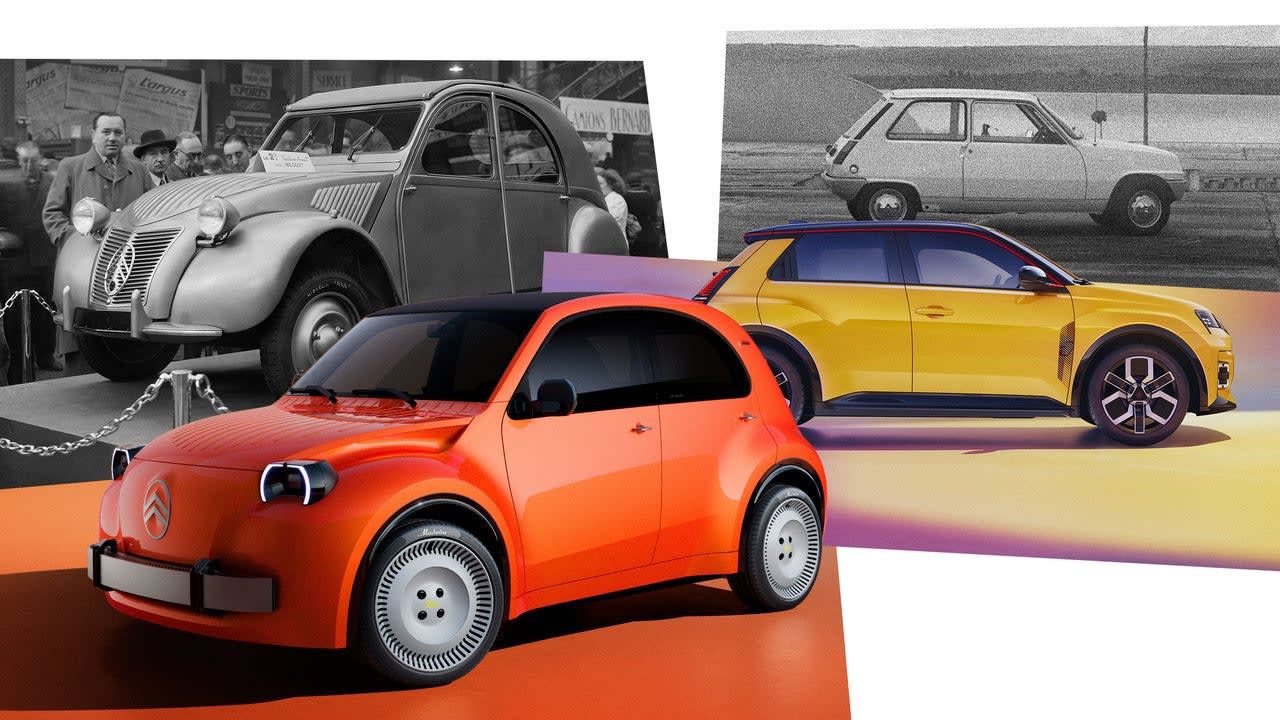

Walk around any city today and try to tell the cars apart. Go ahead, just try. They’re all smooth, rounded, anonymous blobs, shaped by the same wind tunnels and the same cost spreadsheets.
But something is happening in Europe. The legacy automakers Renault and Citroën are rolling out more designs modeled after their most iconic silhouettes. At this month’s Paris Motor Show, Citroën unveiled an electric 2 CV Concept and a little delivery van to go with it, while Renault showed a reborn R8 Gordini and an E-Space concept to join the retro R5, R4, and Twingo it already sells.
The Citroën 2 CV at the 1948 Paris Motor Show. [Photo: AFP/Getty Images]
People are lusting after these cars, both Gen Xers—who grew up when those cars were in their golden era—and some in the youngest generations, who are fed up with the blandness of modern car design and want new aesthetics. For many, these are cars with history. Cars with a magnetic design personality. They feel loaded with some kind of design love, if you’ll excuse my schmaltz.
2 CV Concept [Image: Citroën]
Adrian Clarke, a car designer turned critic who writes about design for The Autopian and Hagerty, the classic auto insurer, sees the revivals as a weapon that only old automakers (OEMs, in industry jargon) get to use. “Legacy OEMs now know that heritage and their brands are very powerful in creating emotional appeal for customers—and it’s something that newer brands like Tesla or Rivian and especially the Chinese OEMs don’t have,” he says. “Heritage and brand DNA become a key differentiator.”
Renault’s design chief agrees, with a warning attached. “This heritage is an asset, but it must be handled with care,” Alexandre Malval, vice president of Renault brand design, tells Fast Company . “The goal is not to reproduce cars from the past out of nostalgia, but to reinvent them so they are perfectly suited to our times.”
Renault 5 E-Tech (top) and a Renault 5 in Paris, ca. 1972 (bottom). [Images: © Renault Design, Roger Viollet Collection/Getty Images]
Raiding the attic
Nobody is digging through the back catalog with more enthusiasm than Renault. The Renault 5 E-Tech , a battery-powered remake of the 1972 hatchback, was Europe’s best-selling small electric car in the first half of 2026. It starts at 24,990 euros (about $28,000) in France, and Renault sold more than 100,000 of them across Europe in 2025, according to the French magazine Auto Plus .
Its sibling, the Renault 4 E-Tech, just got an update with up to 258 miles of range on Europe’s official test cycle, plus a cheaper trim coming before the end of the year. The new Twingo E-Tech, which channels the cheerful 1992 city car, starts at 19,490 euros (about $21,800).
Contemporary (left) and early ’90s Twingos. [Images: Renault, Gilles Bassignac/Gamma-Rapho/Getty Images]
Then there are the toys. The 5 Turbo 3E turns the wide-hipped rally hatchbacks of the early 1980s into an electric “mini supercar” limited to 1,980 units, at roughly 135,000 euros (about $180,000), according to Autocar . The 8 Gordini Concept transforms the classic four-door sedan from 1964 into a low, two-seat electric coupé with 270 horsepower.
5 Turbo 3E [Image: © Renault Design]
Renault says the Gordini is a one-time-only design exercise, although the Renault brand CEO, Fabrice Cambolive, told Autocar a limited run “could be one of the opportunities.”
A 1965 Renault 8 Gordini (top) and 2026 concept (bottom) [Images: © Renault Design]
And there’s more where those came from. Renault has spent half a decade turning its archive into one-offs. In 2024, it made the stellar electric R17 restomod (a classic car rebuilt with modern mechanicals) with the French designer Ora Ïto; then there’s the art car Renault 5 Diamant. It also released two off-road takes on the new R4, the Savane 4×4 and the JP4x4 , an open-sided beach car that nods to the R4 Plein Air of 1969. Renault says its revived icons will go on display at the Renault Collections museum it plans to open in Flins, west of Paris, next year.
2026 JP4x4 (left) and the 1968 Renault 4 Plein Air (right) [Images: © Renault Design/17mars, Keystone-France/Gamma-Rapho/Getty Images]
Citroën is the other iconic brand that is raiding its attic. Now part of Stellantis, it has gone after one of the biggest icons in European car history: the 2 CV ( Deux Chevaux in French). The car debuted at the 1948 Paris show and stayed in production until 1990. The new 2 CV Concept previews a production model coming by 2028 that Citroën says will be built in Europe, aim for a weight of about 2,200 pounds, and start at around 15,000 euros (about $16,800). It’s designed to fit a new European Union category for small, affordable electric cars. Next to it sat the 2 CV Fourgonnette Concept , a ribbed little van that Citroën calls a passion project from its designers.
The Citroën 2 CV “Van Type AU” at the 1950 Paris Motor Show (left) and the 2 CV Fourgonnette Concept. [Images: AFP/Getty Images, Citroën]
The internet lost its mind over the 2 CV, as it did with the R17, the R5, and the Gordini. In June, a viral post on X begged Renault to put the R17 into production; the company says it will remain a one-shot deal.
Nostalgia loop
Why is this happening now? Clarke, the car critic, traces the trend back three decades, to the Volkswagen New Beetle and Chrysler’s PT Cruiser. Back then, he says, the dread of Y2K sent baby boomers looking backward for comfort. “Until the internet came along,” he says. “Gen X started putting their memories online and the geeks inherited the earth, and now we’re stuck in a nostalgia loop thanks to the algorithm. What this means in terms of car design, or any design really, is that it reflects the society of the times.”
The unveiling of the PT Cruiser concept car shown at the 1999 North American International Auto Show. [Photo: Jeff Kowalsky/AFP/Getty Images]
Ferdinand Dudenhöffer, director of the Center Automotive Research institute in Bochum, Germany, and author of the forthcoming book The New Auto Superpower , thinks the PT Cruiser and the New Beetle were “flashes in the pan.” He tells me that, no matter what, “you can’t turn back the world with retro.”
The Volkswagen “New Beetle” on display for the media at the 1998 North American International Auto Show. [Photo: Matt Campbell/AFP/Getty Images]
That loop now reaches people who weren’t born when these cars were new. Gen Z and millennials have fallen for the gadgets and formats of their parents’ youth, from vinyl to point-and-shoot cameras. Canon told NPR that sales of its PowerShot compacts grew almost sevenfold between 2022 and 2025, and a YPulse survey of about 1,500 people aged 13 to 39 found that as many as two-thirds use some kind of analog tech . The same impulse drives Lego’s endless throwback sets and a booming market for retro gadgets . A car with round headlights and a 1948 silhouette speaks the same language.
Dudenhöffer isn’t convinced this faux nostalgia alone will work for cars. “In my opinion, it doesn’t land much with young customers,” he says. He believes they look to modern brands like China’s Xiaomi, and to autonomous driving, electric acceleration, and smart cockpits. The Porsche 356, he quips, is already for “old gentlemen’s Sunday drives.”
The Chinese threat to European, Japanese, and Korean carmakers is no longer theoretical. Chinese brands sold more cars in Europe in the first half of 2026 than in all of 2025, according to the market researcher Dataforce. From July to September, they outsold Japanese brands, Toyota included, over a full quarter for the first time , with 12.7% of the market. In September alone, their s a les doubled from a year earlier . BYD has even outsold Tesla in the European Union in the first nine months of the year, 206,002 cars to 188,035 , although Tesla’s sales there are up 69% after two years of decline .
Europe is pushing back. This month, the EU agreed with Beijing to cap imports of Chinese hybrids at 350,000 a year starting in December, a limit it says could cut those shipments by more than half . But cars assembled inside the EU don’t count against the quota, and Chinese carmakers are already moving in. Leapmotor has started building its B10 electric crossover at a Stellantis plant in Zaragoza, Spain. BYD expects to begin assembly at its new factory in Szeged, Hungary, by the end of the year, and plans to pick a second European site , most likely in Spain or France. Counterpoint Research expects them to take more than 20% of Europe’s car market by 2030 , and 29% of electric car sales.
Chinese automakers look unstoppable right now, and not only because of design and features. Their electric cars are still 21% cheaper on average than those from European brands, according to the clean transport group Transport & Environment.
Design heritage can’t protect a brand if people can’t afford the cars in the first place. Honda learned that the hard way. Its Honda e, a charming electric city car styled after the iconic first Civic, was supposed to sell 10,000 units a year in Europe. It sold 2,110 in 2022 , with a starting price that had climbed past 40,000 euros ($44,500), and Honda pulled it from Europe after three years.
Volkswagen ID. Buzz [Photo: Volkswagen]
The same story is playing out right now in the U.S., where retro EVs come with premium price tags. Volkswagen sold just 989 ID.4 crossovers in the third quarter of 2026. Sales of ID. Buzz vans, its electric homage to the hippie microbus, fell 82.5% from a year earlier. The European carmaker Fiat sold 52 electric 500e hatchbacks across the entire country in the same quarter, which comes to fewer than one a day.
Even Renault has a dud in the family. In July, the R5 led France’s electric car sales with 3,794 registrations, and the Twingo came in third. The R4, sold on the same nostalgia, came in 17th with 737 units. The French EV site Avem called it Renault’s “only disappointment” of the month. The R4 starts at 29,990 euros (about $33,600) in France, and Caradisiac reports the price will drop once a cheaper trim arrives.
Renault 4 [Image: © Renault Design]
Clarke points out that the modern Fiat 500 ( Cinquecento in Italian) sold by the boatload in Europe and stayed in production for an unusually long time “because it was a good, cheap little car but it also had a ton of boutique appeal.” The good, cheap car came first. And heritage gets dumped the moment it stops paying off. “Jaguar binned their heritage because it wasn’t helping them, and it was very patchy anyway,” Clarke says. “They were trading on former glory that didn’t resonate with people under 65 or those who don’t wear red trousers.”
A Fiat 500, ca. 1964 (top) and 500 E (bottom) [Photos: Touring Club Italiano/Marka/Universal Images Group/Getty Images, Stellantis]
Even some car designers who tap the past are wary of the nostalgia play. Volkswagen’s design chief, Andreas Mindt, told Auto Express that when it comes to retro appeal, “there’s a dead end to it.” Renault Group’s design boss, Laurens van den Acker, put it more poetically to Reuters : “Icons are not eternal; they have their moment in the sun.”
Dudenhöffer thinks the whole bet is misplaced. “The car of tomorrow is made of tech, not little stories from the day before yesterday,” he tells me. Older buyers, he argues, carry images of the past in their heads, “and that’s anti-tech and no-digital.”
2 CV [Photo: Citroën]
That’s why Renault and Citroën keep insisting they’re not making replicas. Citroën’s CEO, Xavier Chardon, said in the 2 CV announcement that reinventing the car “isn’t about replicating a car from the past.” The company tried bringing back the original’s skirted rear wheels, the body panels that hide the tops of the back tires, and then dropped them. That look gave the car “too retro a character, when our ambition is to offer a resolutely modern interpretation of this icon,” Citroën tells me via email.
R8 Gordini Concept[ Image: © Renault Design]
Meanwhile, Renault calls the R8 Gordini “not a reproduction of the original model but a contemporary reinterpretation.” The successful revivals follow that rule. The R5 and the Twingo borrow a famous face, but they also come at the right size and the right price. The egg holders in the 2 CV’s doors are a lovely touch (the original 2 CV was designed to carry two farmers and a basket of eggs across a rough field without breaking any), but the 15,000 euro (about $16,700) sticker is what will sell it.
Citröen 2 CV interior [Image: Citroën]
Citroën’s real test is getting the concept’s 2 CV design cues—the silhouette, the flared fenders, the round headlights, the door handles, the bench seat—into the production car. That car has to fit what Citroën calls its “group’s industrial strategy,” meaning the platforms and parts shared with other Stellantis brands. The company says it wants to keep “the vast majority” of the design cues intact and that, at this stage, it’s fairly confident it will pull it off.
Which leaves the hardest job still undone. Malval of Renault admits that inventing a new icon is far tougher than updating an old one. New icons that don’t grow out of an existing model line are “still waiting to be imagined,” he says. “And there’s no way for us to say for sure that they’ll become icons; it’s up to the customers to decide!” Without a set framework, he adds, “it’s a bit like starting with a blank slate.”
For now, the old icons buy Europe’s carmakers time and attention against Chinese automakers, and they’re doing it with cars that people actually want to look at. Nostalgia—real or faux—can get some buyers through the showroom door, but it doesn’t necessarily close the sale. To fight back, Dudenhöffer argues, Europe’s carmakers have to “learn from China and bring innovations forward,” in a package “that shows the future” at reasonable prices. Good, distinct designs at affordable prices will be the ones that succeed, as we have seen with the R5. And they would work even if nobody remembered the originals.