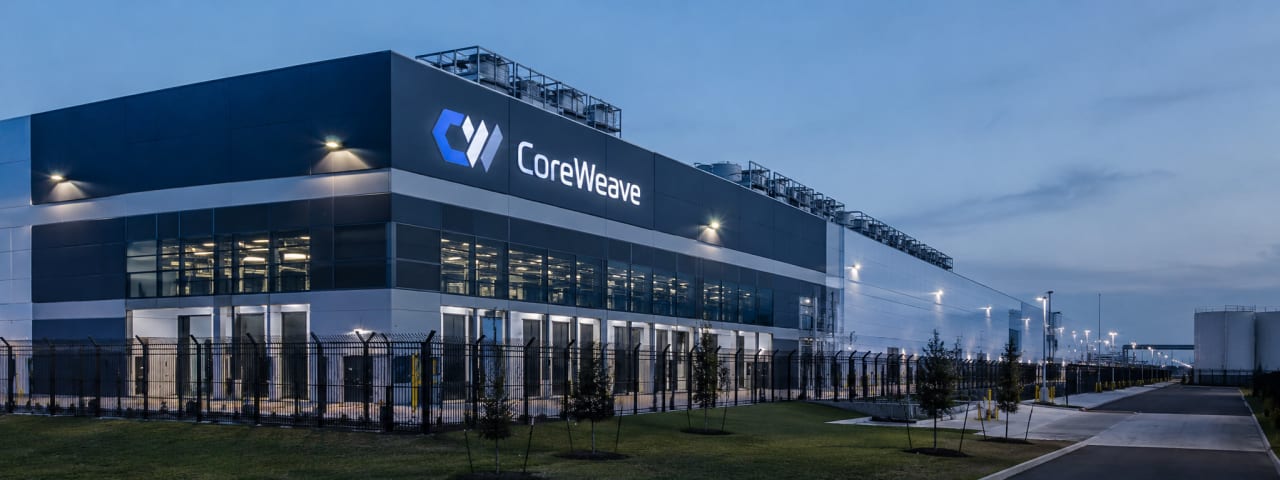

CoreWeave shares fell more than 5% in premarket trading on Tuesday as oil prices climbed above $110 a barrel, reviving concerns about risk assets after US stocks recovered on Monday following last week’s losses.
S&P 500 futures were down 0.09%, while Nasdaq 100 futures fell 0.5%.
HSBC Global Investment Research also reiterated its bearish outlook on CoreWeave, warning that its business model could struggle to generate returns comparable to those of larger cloud computing companies.
The AI computing provider’s shares plunged about 20% last week as rising bond yields intensified concerns over its debt-funded expansion.
Worries about whether revenue from artificial intelligence would justify the industry’s enormous infrastructure investments added to the selling pressure, following a Gartner forecast that questioned the sustainability of returns across the sector.
HSBC sees weaker long-term profitability
In a research note on Monday, HSBC maintained its Reduce rating on CoreWeave and retained its price target of $39, implying a potential downside of 36% from Monday’s closing price.
The bank also kept its earnings estimates unchanged, leaving them significantly below Wall Street consensus forecasts.
Debt market woes and moderating LLM revenues exacerbate structural concerns, it said.
HSBC said hyperscalers could generate substantially more revenue per megawatt of computing capacity because they offer capacity under more lucrative short-term contracts and operate differentiated general-purpose cloud businesses.
These services contrast with the more commoditised, graphics processing unit-focused infrastructure offered by neocloud providers.
Hyperscalers also serve numerous smaller customers that purchase a broader technology stack, whereas neocloud companies derive most of their revenue from large customers seeking bare-metal computing instances.
HSBC acknowledged that neocloud providers had secured several lucrative short-term contracts between May and September 2026.
CoreWeave secured three-to-six-month contracts in September at an annualised revenue rate of approximately $40 million per megawatt. HSBC also cited agreements involving SpaceX, Anthropic and Google that could generate between $22 million and $50 million per megawatt annually.
However, HSBC warned that the economics underpinning such deals could come under pressure.
“In this context, we note a slight moderation in the pace of growth for LLM providers, which could moderate demand for spot compute capacity. We also note rising yields and debt market concerns could stop neoclouds from building speculative capacity, which could have been offered under lucrative short-term contracts,” HSBC said.
The bank’s 2028-2030 non-GAAP earnings-per-share estimates are 50%-70% below consensus.
It expects CoreWeave to achieve a long-term non-GAAP operating margin of 15%-16%, compared with management’s guidance of about 25%.
JPMorgan argues debt concerns are overblown
HSBC’s assessment contrasts with JPMorgan’s more optimistic view of CoreWeave, with the bank arguing that investor concerns about mounting debt and rapid cash burn may be overstated.
In a Friday note, equity analysts including Samik Chatterjee said the company’s financing requirements reflected the pace of its expansion rather than weak project economics.
The analysts pointed to strong demand for computing power and long-term take-or-pay contracts that secure customers before new capacity becomes operational.
JPMorgan estimates that a typical five-year contract generates an unlevered internal rate of return in the mid-teens, exceeding CoreWeave’s estimated blended cost of capital of 9%-11%.
“Beyond the sound economics on a project for a typical 5-year contract agreement, there is an additional monetization lever in recontracting GPUs beyond the 5-year duration,” the analysts added.
The bank also argued that contract economics provide a buffer against debt-related risks.
In a conservative scenario, capital spending accounts for about 51% of a five-year contract’s value, with approximately 80% financed through asset-level debt.
After repaying that borrowing, CoreWeave could retain cash equivalent to about 16% of the contract’s value, potentially covering roughly five years of data centre obligations even without renewing the agreement.
Heavy investment keeps cash flow under pressure
Despite its positive assessment of project economics, JPMorgan acknowledged that CoreWeave’s aggressive expansion would continue to weigh on near-term cash flow.
The bank estimates that each gigawatt of fully operational capacity could generate $10 billion to $15 billion in annual revenue.
However, bringing an additional gigawatt online requires more than $35 billion in upfront capital expenditure.
“The cash burn is not a function of unfavorable economics per project but more of the capacity being ramped each year relative to the installed active capacity at this time,” the analysts wrote.
Cantor Fitzgerald has also maintained its Overweight rating on CoreWeave, with a $176 price target.
The firm argued that the company does not face a demand problem, noting that customers continue to seek computing power while available capacity remains scarce.
The post CoreWeave stock falls 5% in premarket: why HSBC sees 36% downside appeared first on Invezz