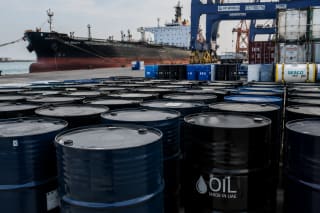
For oil, the shift in targeting matters more than the airport damage: claimed strikes on two Aramco facilities and a confirmed hit on Dammam bring the conflict into the Eastern Province, the centre of Saudi crude output. With Aramco silent, traders are left to price the risk without knowing whether any production or export capacity was affected, which tends to support a geopolitical premium until damage is clarified. The timing adds pressure, as JPMorgan noted last week that the global tanker fleet is already close to full use, so any disruption to Gulf loadings or routing would land on a market with little shipping slack. The Saudi-Iranian contact is the main counterweight, and any sign of de-escalation could quickly erode that premium.
—
The Houthis are no longer just hitting Riyadh’s runways; they say they are now aiming at the kingdom’s oil, and Riyadh has picked up the phone to Tehran.
Summary:
Yemen’s Iran-aligned Houthis claimed a Saturday strike on Riyadh’s international airport that killed 13 people and wounded more than 300, the third attack on the airport in a week
A projectile hit Terminal 4 on Sunday, causing a fire and injuries, while Saudi defences intercepted a cruise missile near the airport and a drone in the Eastern Province
The Houthis said they also struck Dammam’s King Fahd International Airport and two Saudi Aramco facilities; Saudi authorities confirmed the Dammam strike, while Aramco did not comment
Trump said the US was considering joining Saudi strikes on the Houthis, and the group warned of a stronger response to further Saudi action
Riyadh airport remains closed and schools have moved online until Thursday, though an international energy conference went ahead
Saudi Arabia’s foreign minister discussed de-escalation with his Iranian counterpart, their first publicly reported contact since the Houthi strikes intensified
Saudi Arabia’s foreign minister has spoken with his Iranian counterpart about the regional escalation and efforts to ease tensions, Saudi state media reported on Sunday, in their first publicly reported contact since Yemen’s Iran-aligned Houthis stepped up attacks on the kingdom. The call came after a weekend in which the Houthis claimed a deadly strike on Riyadh’s main airport and said they had widened their targets to include Saudi oil facilities.
The Houthis claimed responsibility for Saturday’s attack on Riyadh’s international airport, which killed 13 people and wounded more than 300, according to Saudi authorities and India’s embassy, which said one of its injured citizens had died. It was the third attack on the airport in a week, after two earlier strikes killed four people. On Sunday, an unidentified projectile hit Terminal 4 and caused a fire, injuring an unspecified number of people, while Saudi air defences intercepted a cruise missile near the airport and a drone in the Eastern Province.
Houthi military spokesperson Yahya Saree said the group had also struck the airport in Dammam and two Saudi Aramco facilities. Saudi aviation authorities confirmed a strike on Dammam’s King Fahd International Airport, which a witness told Reuters hit the tarmac beside parked aircraft at around 1730 GMT (1:30 p.m. ET). Aramco and the Saudi government’s media office did not respond to requests for comment, so the claimed strikes on oil facilities remain unverified.
That claim is the most significant development for energy markets. Dammam serves the capital of the Eastern Province, the heart of Saudi oil production, and the region has been hit before: the 2019 drone and missile attack on the Abqaiq processing plant briefly knocked out roughly half of Saudi output, showing how concentrated the kingdom’s infrastructure is.
The escalation follows a stepped-up Saudi campaign in Yemen after the Houthis seized strategic territory along the Red Sea coast last month. The group said Saudi Arabia carried out 124 air strikes in a single day and warned that worse would follow unless the strikes stopped. US President Donald Trump said Washington was considering joining the Saudi campaign, a spillover from the wider war with Iran that the US and Israel began in February.
Daily life in Riyadh is adjusting. The airport remains closed, schools have shifted to remote learning until Thursday, and Germany’s economy minister was seeking another route home. An international energy conference nevertheless opened as planned about 10 km from the airport. Whether the Saudi-Iranian contact produces restraint, or whether Washington joins the strikes, will likely shape the next phase for both the conflict and the oil risk premium.
This article was written by Eamonn Sheridan at investinglive.com.