
IPO
SpaceX stock earnings blew investors away.
The rocket and AI company beat on earnings and revenue and became profitable for the first time.
Still, questions are swirling around capex, aggressive targets, and a potential merger with Tesla .
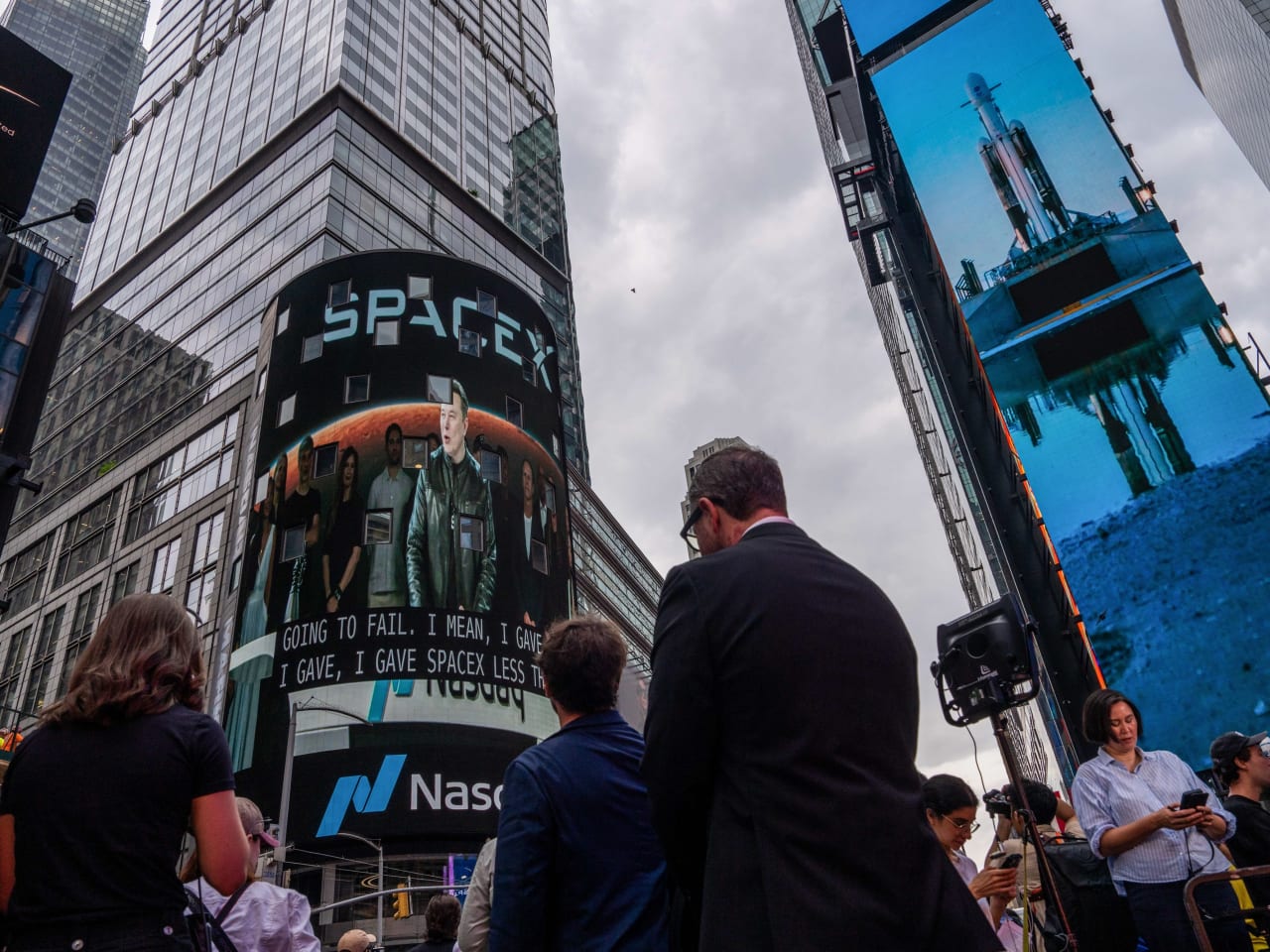
SpaceX is lifting off after its latest earnings report.
Elon Musk’s rocket company wowed investors on Tuesday night with its results for the third quarter, beating on earnings and revenue.
Here were the key numbers:
Earnings per share : $0.45, above $0.13 expected
Revenue : $14.5 billion (+161% year-over-year), above $12.7 billion expected
The company also became profitable for the first time, crossing a major milestone. SpaceX recorded net income of $4.4 billion, up from the $1 billion loss it had from the same period last year.
SpaceX shares popped after the print, with the stock surging as much as 12% to $166.12 before paring slightly.
(function(){function e(){window.addEventListener(`message`,function(e){if(e.data[`datawrapper-height`]!==void 0){var t=document.querySelectorAll(`iframe`);for(var n in e.data[`datawrapper-height`])for(var r=0,i;i=t[r];r++)if(i.contentWindow===e.source){var a=e.data[`datawrapper-height`][n]+`px`;i.style.height=a}}})}e()})();
Analysts are weighing the firm’s future growth potential and are circling around guidance on investment spending as well as a potential merger deal with Tesla. Here’s what Wall Street is talking about post-print:
Capex, capex, capex
Concerns are building over SpaceX’s $19 billion capex
Paul Hennessy/SOPA Images/LightRocket via Getty Images
Questions are swirling around the firm’s aggressive investment spending. Capital expenditures were $19.5 billion for the quarter, slightly under estimates for $19.6 billion.
The spending is drawing concerns over how much SpaceX is investing, particularly when some of its long-term projects, like establishing a colony on Mars or putting data centers in orbit, have struck investors as more science fiction than reality.
Capex has also been top of mind for the market. Investors have grown antsy about the billions of dollars tech giants are pouring into AI infrastructure while the ultimate profit potential remains uncertain.
In the earnings call , the firm said it was expecting to scale capex to $35 billion to $40 billion over the next quarter, around double what it spent over the last three-month period.
At the current rate, SpaceX is spending around $1.34 for every $1 in revenue, according to Mark Malek, the chief investment officer at Siebert Financial.
“SpaceX’s results were spectacular, but its next-quarter building budget could exceed twice its latest revenue. Is that visionary or reckless?” Malek wrote in a note to clients on Wednesday.
Is SpaceX growing too quickly?
SpaceX CEO Elon Musk floated the firm reaching $1 trillion in full-year revenue as soon as 2028.
Justin Sullivan/Getty Images
Elon Musk set a lofty revenue target for SpaceX , a factor that is swaying more investors to join the bullish camp. The CEO floated an annual recurring revenue run-rate of $500 billion to $1 trillion by the end of next year, with full-year revenue potentially coming in at $1 trillion in 2028.
The figures are at least five times what consensus estimates on Wall Street are, Piper Sandler wrote in a client note.
“Clearly, we (and our sell-side peers) have been grossly mis-modeling SPCX, and our model requires substantial revision. We are keeping our estimates unchanged for now, while we complete this process,” Alexander Potter and Ben Johnson, two analysts at the firm, said.
Potter and Johnson also raised concerns that SpaceX’s growth target may be too aggressive.
“We wonder: if SpaceX keeps growing this quickly, could something ‘break’?” they wrote. “What happens if there’s a society-wide AI pushback? Or if debt markets seize up? Extrapolation in the midst of an exponential ramp can sometimes lead companies astray,” they said, adding that they still held a “positive bias” on the stock through the end of the year.
Siebert’s Malek said the company’s third-quarter results warrant “scrutiny” from investors, pointing to how one-time benefits and stock-based compensation positively impacted some of the business’s financials. Musk’s $1 trillion revenue target, also seems to be more of an “aspiration” for the company rather than “actionable financial guidance.”
“It may communicate the scale of his ambition, but it does not belong in an investor’s valuation model,” he said. “The company’s “Investors need to see whether profitablility survives when those favorable factors disappear.”
Tesla-SpaceX merger coming?
Chatter is building about a possible merger between Tesla and SpaceX.
Jade GAO / AFP via Getty Images
The big question for investors: is SpaceX about to merge with Tesla?
It would like the be the biggest merger ever. It would also give Musk unprecedented control over the companies, and create a mega-cap tech giant with sprawling business interests across multiple industries.
On the call with investors, Musk confirmed that committees have been created to explore a merger.
SpaceX and Tesla are likely to announce a merger within the next six months, though the deal could take between 12 to 18 months, or possibly longer, thanks to regulatory hurdles and investor concerns that Tesla may shift away from its EV business, the market intelligence firm Counterpoint Research wrote in a note.
The merger will likely be done through a SpaceX-led all-stock deal, JPMorgan strategists wrote in a note.
The deal would also likely result in a “meaningful premium” on Tesla stock, analysts at RBC Capital Markets said.
“We believe TSLA holders would be receptive at $480/share, reflecting our SOTP intrinsic value plus a ~15% premium,” analysts said, adding that it expected further commentary Wednesday on Tesla’s third-quarter earnings call after the bell.
Read the original article on Business Insider