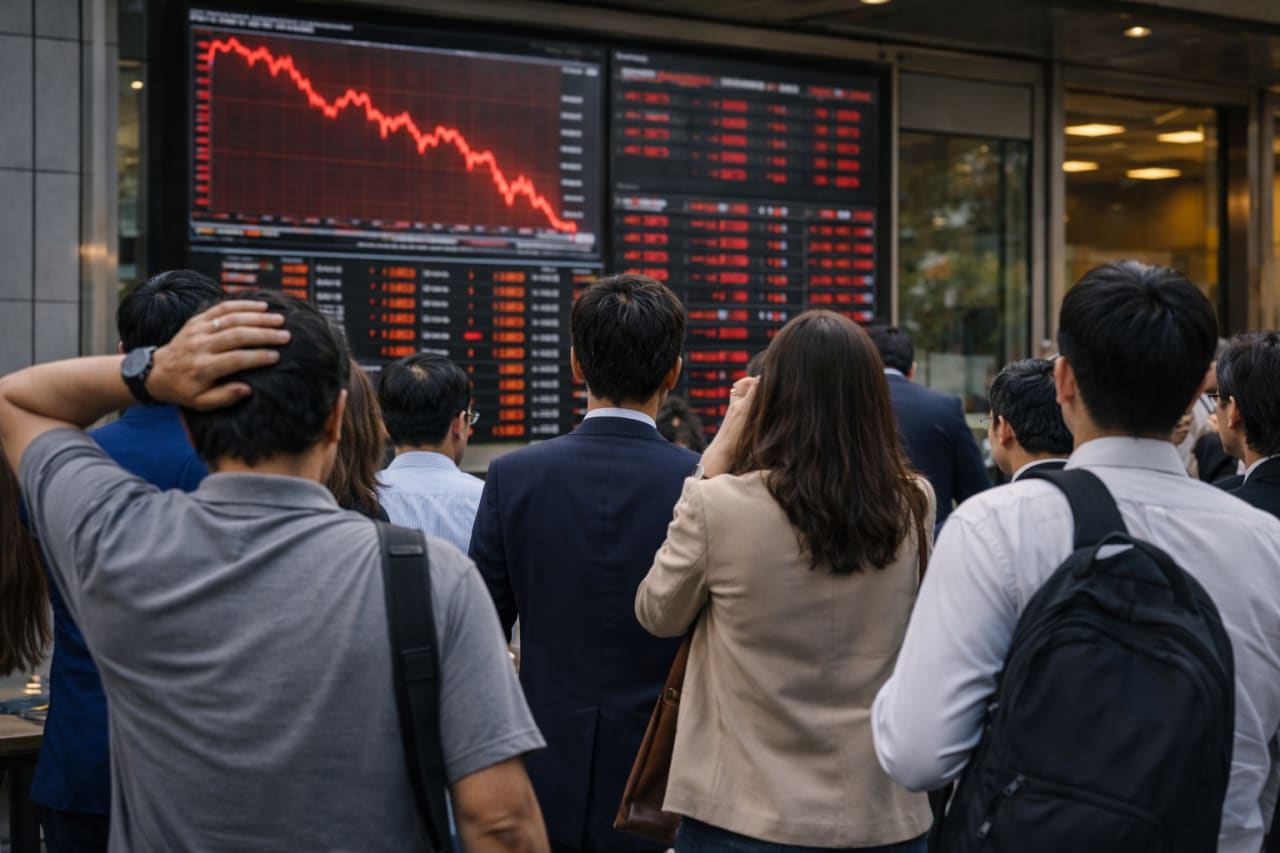

Samsung Electronics and SK Hynix fell sharply in Seoul on Monday, even as memory-chip prices kept climbing and AI demand kept supply tight.
By 9:58 AM, Samsung was down 2.48% and SK Hynix 3.81%, helping push the KOSPI down 2.33%.
Foreign investors were net sellers as renewed Middle East tensions, elevated US Treasury yields and weakness in global semiconductor shares hit risk appetite.
The plunge came even as memory fundamentals remain exceptionally strong, but investors are looking beyond today’s shortage and asking whether record margins can survive the capacity expansion expected from major producers.
Memory prices are still rising, so demand is not the problem
Samsung last week projected third-quarter operating profit of 107.4 trillion won , almost nine times the year-earlier level and the highest quarterly operating profit ever reported by a technology company.
The surge reflects AI infrastructure spending, tight DRAM supply and strong high-bandwidth memory demand.
Pricing remains supportive, as TrendForce expects conventional DRAM contract prices to rise another 10% to 15% quarter-on-quarter in the fourth quarter. The researcher said AI server demand keeps the market undersupplied.
CLSA Securities Korea’s Sanjeev Rana remains bullish. “Demand continues to exceed supply and HBM pricing is poised for a big step up in 2027,” he told Bloomberg.
That makes Monday’s selling difficult to explain as a deterioration in immediate demand, and the industry still has strong pricing and earnings visibility.
Instead, investors across the sector are beginning to ask a different question: how much of that strength is already reflected in valuations?
Investors are looking beyond record profits to peak scarcity
Samsung shares are more than 25% below their June peak despite record earnings, as investors question the durability of profit growth.
“The market’s focus has shifted to whether the sharp earnings growth that started a year ago would be sustainable,” Mirae Asset Securities analyst Kim Seok-hwan told Reuters.
The concern is not that DRAM prices collapse. It is that the rate of improvement is already slowing.
TrendForce’s forecast for a 10%-15% fourth-quarter increase in conventional DRAM prices compares with a roughly 60% jump in the second quarter.
Analysts expect Samsung’s fourth-quarter operating profit to rise about 8.2% sequentially, well below the pace of growth seen in the third quarter.
For a cyclical industry, that moderation matters, as exceptionally high memory margins rarely persist indefinitely.
Bigger risk begins when new memory capacity arrives
Samsung, SK Hynix and Micron are all increasing investment to meet extraordinary demand for AI memory.
Commercially, that makes sense while customers are competing for limited supply. However, for equity investors, the expansion introduces the next risk.
Kiwoom Securities analyst Han Ji-young said the market’s concern “lies not in immediate changes in memory demand”, according to MoneyToday.
Investors are instead asking whether tight supply and elevated margins can persist as capacity expansion by the three biggest memory manufacturers accelerates from next year through 2028.
The post Why are Samsung and SK Hynix crashing even as memory prices keep climbing? appeared first on Invezz


