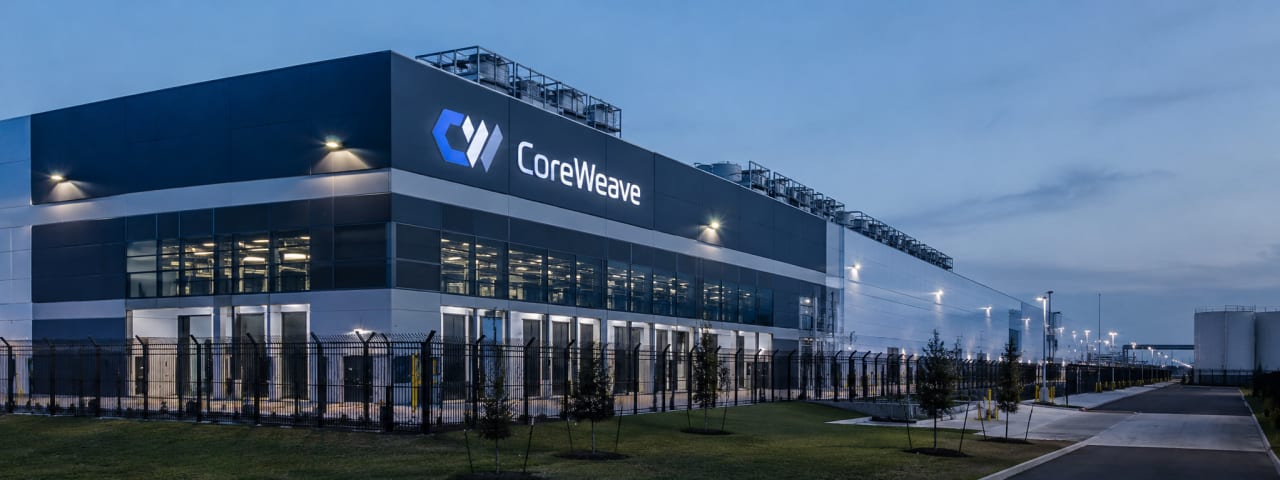

CoreWeave shares CRWV and bonds came under heavy pressure on Wednesday as investors grew increasingly concerned about the scale of borrowing by technology companies to finance the artificial intelligence infrastructure build-out.
Shares of the AI-focused cloud computing provider plunged 16%, while yields on its outstanding debt surged, reflecting a growing demand for compensation for the risks associated with financing the sector.
The yield to maturity on CoreWeave’s 9.625% bond due in 2032 reached 14.8%, while the yield on its 9.75% bond due in 2031 stood at around 14.9%.
Bond yields move inversely to prices, meaning the increase reflects a sharp decline in the market value of the securities.
The sell-off highlights a shift in investor sentiment towards companies that have borrowed heavily to build data centres and expand computing capacity to meet demand from AI developers.
While investors were previously eager to gain exposure to the AI boom, concerns about borrowing costs, future revenues and the ability to generate adequate returns are increasingly influencing investment decisions.
“The era of easy money, which we experienced in the first nine months of the year, is starting to disappear and dissipate,” said Luis Alvarado, co-head of global fixed income strategy at Wells Fargo Investment Institute.
“Now the extra dollar or the marginal dollar is going to be more looked at with a microscope into the concessions that the issuer is giving you back.”
CoreWeave debt draws attention from prominent investors
The sharp increase in CoreWeave’s borrowing costs also attracted attention from prominent technology investors.
Chamath Palihapitiya, founder and chief executive of Social Capital and chief executive of AI company 8090, highlighted the rising yield on CoreWeave’s 2032 bond in a post on X late Tuesday.
👀 https://t.co/z5HgwQU8UQ pic.twitter.com/VdpxrpKNx7
— Chamath Palihapitiya (@chamath) October 13, 2026
He shared a chart showing that the yield had “touched 15%” before it “closed at a new high”.
Palihapitiya also referred to his analysis of whether the AI infrastructure boom was creating a private credit bubble, highlighting “how little extra lenders appear to charge for AI risk.”
Tesla and SpaceX chief executive Elon Musk responded to the post with a brief assessment: “yikes.”
Heavy borrowing and data centre expansion weigh on outlook
CoreWeave’s balance sheet is “relatively bad” compared with those of its neocloud peers, according to Paul Meeks, head of technology research at Freedom Capital Markets, CNBC reported .
Meeks attributed the difference to CoreWeave’s heavier borrowing and its ongoing construction of additional data centres.
“The yields have blown out because there’s just more and more concern — that I don’t share — about the wherewithal of these guys [being] able to over time pay back their interest expense,” he said.
“It’s definitely not a deteriorating situation,” he added.
“Maybe it’s not improving, and I didn’t really expect it to improve until these data centers get up and running.”
Meeks expects CoreWeave to report flat margins between June and September, followed by a potentially significant improvement between September and December.
The company’s next quarterly results are expected in November.
CoreWeave has raised more than $35 billion this year through chip-backed loans, high-yield bonds, convertible bonds and share sales.
Its debt and lease obligations totalled approximately $52 billion at the end of June, underscoring the scale of its financing commitments.
Chief executive Michael Intrator defended the company’s financial position in an internal memo to employees, viewed by Bloomberg , arguing that the stock’s decline reflected irrational market behaviour.
“When you are building a new type of technology company, there will be periods of time when the market misunderstands and acts irrationally,” he said, according to the report.
“We are confident in our business model, our customers, the extraordinary quality of our execution, and the relentless discipline around the financial engine we have built.”
Gartner warns of pressure on neocloud business models
The pressure on CoreWeave comes also as research and advisory firm Gartner warns that the AI industry’s spending ambitions could prove difficult to justify through revenue generation.
AI providers are on track to invest nearly $1 trillion in hardware and facilities in 2026, followed by another $6 trillion through 2030, Gartner estimates.
However, the firm projects that total AI-attributable revenue during this period will reach only around $3.6 trillion.
“Enterprise and consumer AI revenue will be insufficient to support profitable returns on all planned AI capital expenditures during this period,” said Will Sommer, senior director analyst at Gartner.
The widening gap between projected investment and potential revenue could put considerable pressure on companies providing specialised cloud computing infrastructure.
“By 2030, Gartner predicts that cost pressure and a lack of a differentiating business model will force over 80% of neocloud providers to cease independent operations.”
The post Why is CoreWeave stock crashing 16% on Wednesday? appeared first on Invezz